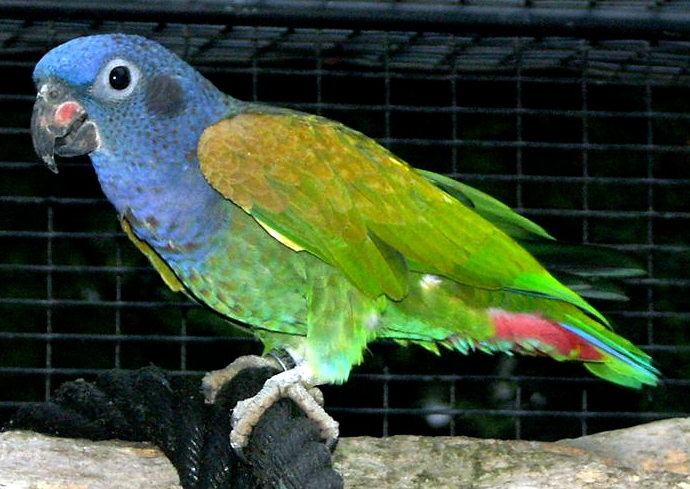
Bronze-winged Parrot
Pionus chalcopterus
Order: Psittaciformes / Family: Psittacidae

Wikimedia Commons
About the Bronze-winged Parrot
The Bronze-winged Parrot (Pionus chalcopterus) is a captivating species native to the vibrant forests of northwestern South America. This medium-sized parrot, measuring about 28 centimeters in length, belongs to the Psittacidae family, known for its diverse and colorful members. The Bronze-winged Parrot's unique blend of colors and its vivacious social behavior make it a significant entity within its ecosystem. Found primarily in Colombia, Ecuador, Peru, and Venezuela, this parrot thrives in the humid lowland forests, montane forests, and secondary growth areas up to an elevation of 2,000 meters. The Bronze-winged Parrot plays a vital role in seed dispersal, contributing to forest regeneration and biodiversity. Its presence in these rich ecosystems highlights the interconnectedness of avian species and their habitats. During the breeding season, which typically spans from January to June, the Bronze-winged Parrot engages in elaborate courtship displays, showcasing its vibrant plumage and social acumen. As the seasons shift, these parrots may adjust their altitudinal range in search of food, demonstrating their adaptability. In recent years, the Bronze-winged Parrot's populations have experienced fluctuations due to habitat loss and the illegal pet trade. Despite these challenges, this parrot remains a resilient and integral part of its environment, underscoring the need for ongoing conservation efforts to ensure its survival and the health of its habitats.
The Bronze-winged Parrot belongs to the family Psittacidae, within the order Psittaciformes. These birds typically live average 25 years, up to 30 years recorded..
How to Identify a Bronze-winged Parrot
The Bronze-winged Parrot is easily identifiable by its striking plumage and distinctive silhouette. Adult parrots display a predominantly dark green body with a beautiful bronze sheen on the wings, which is most visible in good lighting. The underparts are a slightly paler green, providing a subtle contrast. A notable feature is the red undertail coverts, a characteristic shared with other members of the Pionus genus. The head and neck feature a bluish hue, which can appear more pronounced in males. Juvenile Bronze-winged Parrots resemble adults but have duller plumage and lack the full intensity of the bronze and blue hues. Both sexes are similar in appearance, though males may have slightly more vivid coloration. When perched, these parrots exhibit a robust, compact posture with a short tail and a thick, curved bill. In flight, their broad wings and steady, direct flight pattern help distinguish them from other parrots. While the Bronze-winged Parrot shares its range with several similar species, such as the Blue-headed Parrot, its unique bronze wing coloration is a reliable distinguishing feature.
Having trouble telling birds apart? Upload a photo to our bird identification tool for an instant species match.
Bronze-winged Parrot Habitat and Range
Preferred Habitat
The Bronze-winged Parrot inhabits humid lowland and montane forests, thriving in areas with dense foliage and abundant food sources. These parrots prefer forest edges, clearings, and secondary growth, where they can find fruiting trees and nesting sites. They are commonly found at elevations ranging from sea level to 2,000 meters. During the breeding season, they may seek out higher altitudes for optimal nesting conditions. In urban areas, these parrots can sometimes be observed in parks and gardens, though they are more commonly associated with rural and forested environments. Seasonal shifts in food availability may prompt local movements, but the Bronze-winged Parrot is generally considered non-migratory.
Geographic Range
The Bronze-winged Parrot's range encompasses parts of northwestern South America, including Colombia, Ecuador, Peru, and Venezuela. It occupies a variety of habitats within this range, from lowland rainforests to montane cloud forests. The parrot's distribution is patchy, with population densities varying based on habitat quality and food availability. In Colombia, the species is prevalent in the western Andes and the Pacific lowlands. In Ecuador, it is found along the western slopes of the Andes. The Bronze-winged Parrot does not undertake long-distance migrations but may engage in altitudinal movements in response to seasonal food resources.
Want to know which birds visit your area? Browse our backyard birds by location guides for region-specific species lists.
What Does the Bronze-winged Parrot Eat?
The Bronze-winged Parrot primarily feeds on a diverse diet of fruits, seeds, and nuts. Ficus fruits, palm fruits, berries, and seeds from various forest trees form the bulk of their diet. Their strong beaks are adept at cracking open hard shells to access the nutritious contents within. During the wet season, when fruits are abundant, these parrots can be observed foraging in the forest canopy, often in small, noisy flocks. As the dry season approaches and fruit becomes scarcer, the parrots may expand their diet to include flowers and nectar, exploiting a wider range of food sources. They are diurnal foragers, typically feeding during the early morning and late afternoon when temperatures are cooler.
Bronze-winged Parrot Behavior and Social Structure
The Bronze-winged Parrot is a social and gregarious species, often seen in pairs or small flocks. These parrots exhibit strong social bonds, engaging in mutual preening and vocal communication to reinforce their relationships. Territorial behavior is minimal, though they may defend feeding and nesting sites against intruders. During courtship, males perform elaborate displays, including head-bobbing and wing-flapping, to attract females. These displays highlight their vibrant plumage and social acumen. Flocking patterns are loose but cohesive, with groups maintaining contact through a series of calls. When confronted by predators, the Bronze-winged Parrot relies on its agility and swift flight to evade capture. These parrots are active during the day, with peak activity periods in the early morning and late afternoon.
Bronze-winged Parrot Nesting and Reproduction
Bronze-winged Parrots nest in tree cavities, often choosing natural hollows or abandoned woodpecker holes. They may also adapt to artificial nest boxes if available. Nesting sites are typically located at a height of 10 to 30 meters above the ground, providing security from ground predators. The female lays a clutch of 3 to 4 eggs, which she incubates for about 24 days. During this period, the male plays a crucial role by feeding the female and defending the nest site. Once hatched, the chicks are altricial and depend entirely on their parents for food and warmth. The fledging period lasts approximately 8 to 10 weeks, after which the young parrots begin to explore their surroundings with their parents. The Bronze-winged Parrot typically raises one brood per year, although in favorable conditions, a second brood may be attempted.
Bronze-winged Parrot Sounds and Vocalizations
The Bronze-winged Parrot is not known for melodious singing but rather for its distinctive vocalizations. Its primary calls are a series of harsh, croaky squawks that can be heard over long distances. These calls serve as contact calls between flock members and are often described as rough and guttural. Alarm calls are sharper and more urgent, alerting the flock to potential threats. During the dawn chorus, Bronze-winged Parrots become particularly vocal, engaging in a cacophony of calls as they start their daily activities. These vocalizations, while not musical, are an integral part of the parrot's social communication.
Interesting Facts About the Bronze-winged Parrot
- 1The Bronze-winged Parrot's wings appear iridescent due to microscopic feather structures that reflect light.
- 2In flight, the Bronze-winged Parrot's wings produce a distinctive whirring sound, helping flock members stay together.
- 3The Bronze-winged Parrot can live up to 25 years in the wild, with some individuals reaching even longer lifespans in captivity.
- 4These parrots are known to use tools, such as sticks, to manipulate food items and access hard-to-reach seeds.
- 5Bronze-winged Parrots have complex social structures, involving intricate hierarchies and cooperative behaviors within flocks.
Bronze-winged Parrot Conservation Status
The IUCN currently lists the Bronze-winged Parrot as Least Concern, but its population trend is decreasing. Habitat destruction and fragmentation due to agriculture and logging pose significant threats to its survival. Additionally, the illegal pet trade exerts pressure on wild populations. Conservation efforts focus on habitat protection and the establishment of sustainable land-use practices. Community-based initiatives aim to raise awareness about the ecological importance of preserving parrot habitats and reducing illegal trade. Historically, the Bronze-winged Parrot has faced challenges, but conservation actions provide hope for its continued survival.
Other Psittacidae Species


Birds Similar to the Bronze-winged Parrot
These species are often confused with the Bronze-winged Parrot due to similar appearance or overlapping range.