
Blue-headed Parrot
Pionus menstruus
Order: Psittaciformes / Family: Psittacidae
Wikimedia Commons
About the Blue-headed Parrot
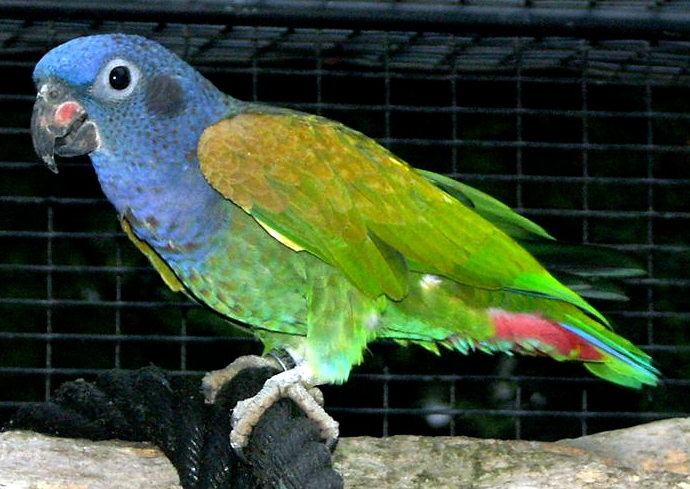
The Blue-headed Parrot, or Pionus menstruus, stands out with its distinctive blue head contrasted by a green body. This parrot plays a critical role in its ecosystem, acting as both seed disperser and consumer, ensuring the vitality of tropical forests. Found predominantly in the lowland rainforests of South America, it thrives in countries like Brazil, Colombia, and Venezuela. The species demonstrates remarkable adaptability to various forest types, including secondary and disturbed forests, making it a resilient resident of its habitat.
Beyond its ecological role, the Blue-headed Parrot holds cultural significance among indigenous peoples, often seen as a symbol of the vibrant biodiversity of the Amazon basin. Its presence is a key indicator of forest health, given its reliance on abundant fruiting trees. Seasonal behaviors include slight elevational movements during the dry season in search of food, though it primarily remains within its home range year-round.
The Blue-headed Parrot's ecological role extends to its interactions with other species. By feeding on various fruits, seeds, and blossoms, it aids in plant reproduction through seed dispersal. This behavior supports forest regeneration and the maintenance of plant diversity. Its preference for foraging in the canopy means it often escapes predators, ensuring its continued presence in the ecosystem. As a social species, the Blue-headed Parrot engages in communal roosting and feeding, showcasing its complex social structures and communication skills.
The Blue-headed Parrot belongs to the family Psittacidae, within the order Psittaciformes. These birds typically live average 25 years, with some living up to 35 years in captivity..
How to Identify a Blue-headed Parrot
The Blue-headed Parrot is easily identifiable by its vibrant blue head, contrasting sharply with the green plumage covering the rest of its body. Adult birds exhibit a distinct ring of white feathers around the eyes, adding to their expressive appearance. The beak is a pale pinkish color, often with a hint of yellow near the base. Juvenile Blue-headed Parrots have a more subdued coloration, with less pronounced blue on the head and a generally duller appearance. As they mature, the vivid blue becomes more prominent.
In terms of size, the Blue-headed Parrot is medium-sized, measuring approximately 27 centimeters in length. Both males and females share similar plumage, making sex differentiation based on appearance challenging. However, some subtle size differences may occur, with males occasionally larger than females.
While in flight, the Blue-headed Parrot displays a broad-winged silhouette, with steady, direct flight patterns. When perched, its posture is upright, often displaying its alert demeanor. The species might be confused with the Red-billed Parrot, but the latter lacks the distinctive blue head, making identification straightforward for keen observers.
Having trouble telling birds apart? Upload a photo to our bird identification tool for an instant species match.
Blue-headed Parrot Habitat and Range
Preferred Habitat
Blue-headed Parrots primarily inhabit tropical lowland rainforests, thriving in areas with dense canopy cover and abundant fruiting trees. They favor elevations up to 1,000 meters but occasionally venture into montane forests. These parrots are commonly found in Brazil's Amazon Basin, Colombia's Chocó region, and Venezuela's Orinoco River valley.
During certain seasons, they may explore secondary forests and forest edges, showcasing their adaptability. Unlike many forest-dwelling birds, Blue-headed Parrots can occasionally be seen in semi-urbanized areas where forest remnants exist. They rarely venture into open fields or grasslands, preferring the protection and resources offered by wooded environments.
The Blue-headed Parrot's habitat usage remains relatively constant throughout the year, with minimal shifts in location. This stability in habitat preference underscores the importance of preserving continuous forest tracts to support their populations. They exhibit a preference for areas with a high density of fruiting trees, which provide essential food resources throughout the year.
Geographic Range
The Blue-headed Parrot's range extends across a broad swath of northern South America. It is commonly observed in the Amazon Basin, covering much of Brazil, Peru, northern Bolivia, and eastern Ecuador. Northern populations are found in Colombia, Venezuela, and the Guianas, while southern populations reach as far south as northern Argentina.
Unlike some migratory parrot species, the Blue-headed Parrot remains largely sedentary within its range, relying on the vast tracts of continuous forest available. There are no significant migratory movements, although local dispersal may occur in response to food availability.
Population density is highest in areas with extensive, undisturbed forest cover. Regions like the Brazilian Amazon and the Colombian lowlands are population hotspots, where the species finds abundant food sources and nesting opportunities. Conservation of these vital habitats is crucial to maintaining healthy populations of the Blue-headed Parrot across its range.
Want to know which birds visit your area? Browse our backyard birds by location guides for region-specific species lists.
What Does the Blue-headed Parrot Eat?
The Blue-headed Parrot's diet primarily consists of fruits, seeds, and flowers, making it a key player in the forest ecosystem as both a consumer and seed disperser. The parrot showcases a diverse palate, often feeding on the fruits of fig trees, palms, and other native species. During the dry season, when fruits are less abundant, it may supplement its diet with seeds and blossoms, displaying its dietary adaptability.
Foraging predominantly occurs in the canopy, where the parrot uses its strong beak to crack open hard seeds and access the nutritious contents within. The Blue-headed Parrot often forages in small flocks, allowing it to efficiently locate and exploit food resources.
The species exhibits a flexible feeding schedule, with activity peaking during the early morning and late afternoon when temperatures are cooler. Its ability to exploit a range of food sources ensures its survival across diverse habitats and varying seasonal conditions, contributing to its resilience in the face of environmental changes.
Blue-headed Parrot Behavior and Social Structure
The Blue-headed Parrot displays complex social behaviors, often forming small flocks of up to 20 individuals. These groups engage in cooperative foraging and roosting, highlighting the parrot's social nature. The parrot's daily activity pattern includes periods of active foraging interspersed with rest and social interaction.
During the breeding season, pairs exhibit strong territorial behavior, defending nesting sites from intruders with vocalizations and displays. Courtship involves mutual preening and food sharing, strengthening pair bonds. Once nesting commences, the pair becomes more secretive, focusing on incubating eggs and raising chicks.
The Blue-headed Parrot's response to predators involves a combination of loud alarm calls and evasive flight, often retreating to dense foliage for cover. Despite these potential threats, the parrot's presence in large flocks provides additional security, as multiple eyes can detect danger more effectively.
Social interactions extend beyond breeding pairs, with non-breeding individuals forming loose associations. These flocks exhibit a fluid structure, with individuals joining and leaving based on resource availability and predator presence. The parrot's sociability and adaptability enable it to thrive in its dynamic forest environment.
Blue-headed Parrot Nesting and Reproduction
Blue-headed Parrots prefer to nest in hollow tree cavities, typically selecting sites high in the canopy to avoid ground predators. They do not excavate their own nests, instead relying on natural cavities or those created by woodpeckers. The choice of nest location plays a crucial role in chick survival, providing protection from both predators and harsh weather.
Clutch size for the Blue-headed Parrot averages between 2 and 4 eggs, with both parents participating in incubation, which lasts approximately 26 days. The male often takes on the role of feeding the female during this period, ensuring she remains nourished while tending to the eggs.
Once the chicks hatch, both parents share in feeding duties, regurgitating food to meet the growing chicks' nutritional needs. Fledging occurs about 8 weeks post-hatching, though young parrots often remain with their parents for several additional weeks, learning essential survival skills.
The species typically raises one brood per year, though favorable conditions and abundant resources may occasionally allow for a second. Parental investment is substantial, with a focus on ensuring the successful rearing of each brood. The reliance on tree cavities highlights the importance of preserving mature forests with suitable nesting sites.
Blue-headed Parrot Sounds and Vocalizations
The Blue-headed Parrot's vocalizations include a series of harsh, high-pitched calls often described as squawks or screeches. These calls serve multiple purposes, including communication within flocks and signaling alarm in the presence of predators. The parrot's primary song, though less melodic than some bird species, consists of a repetitive, rhythmic series of notes that can be heard over considerable distances.
Alarm calls are more urgent and rapid, designed to alert fellow flock members to potential threats. During the early morning, the Blue-headed Parrot may participate in a dawn chorus, contributing to the cacophony of sounds that characterize tropical forests at daybreak.
The parrot's vocal repertoire, while not as extensive as that of some songbirds, plays a vital role in its social interactions and survival strategies. The ability to communicate effectively allows the Blue-headed Parrot to maintain cohesion within flocks and coordinate activities such as foraging and roosting.
Interesting Facts About the Blue-headed Parrot
- 1The Blue-headed Parrot can live up to 35 years in captivity, showcasing impressive longevity for a bird of its size.
- 2During breeding season, pairs of Blue-headed Parrots perform unique courtship dances, involving synchronized movements and mutual vocalizations.
- 3The species often visits clay licks, where it consumes mineral-rich soil that helps neutralize toxins found in some of its food sources.
- 4Blue-headed Parrots have a powerful bite force, capable of cracking open hard nuts and seeds with ease.
- 5Their social structure allows for cooperative care, where non-breeding individuals may help feed and protect the young.
- 6Despite being forest dwellers, Blue-headed Parrots occasionally venture into agricultural areas, sometimes feeding on cultivated crops.
- 7Their strong, direct flight allows them to travel long distances in search of food, although they typically remain within forested areas.
Blue-headed Parrot Conservation Status
The International Union for Conservation of Nature (IUCN) currently lists the Blue-headed Parrot as a species of Least Concern. Despite this favorable status, the population faces ongoing threats from habitat loss due to deforestation, particularly in the Amazon Basin. Logging, agricultural expansion, and urban development contribute to the fragmentation and degradation of its natural habitat. Conservation efforts focus on preserving large tracts of continuous forest and establishing protected areas that safeguard critical habitats. Community-based conservation initiatives aim to engage local populations in sustainable practices that benefit both human and avian communities. While the overall population trend remains stable, continued vigilance is necessary to ensure that habitat loss does not escalate to levels that could threaten the species. Monitoring programs and research initiatives provide essential data to guide conservation strategies and inform policy decisions. Historically, the Blue-headed Parrot has demonstrated resilience, adapting to various habitat types and ecological conditions. This adaptability, combined with ongoing conservation efforts, offers hope for the species' continued survival amidst environmental challenges.
Other Psittacidae Species


Birds Similar to the Blue-headed Parrot
These species are often confused with the Blue-headed Parrot due to similar appearance or overlapping range.

