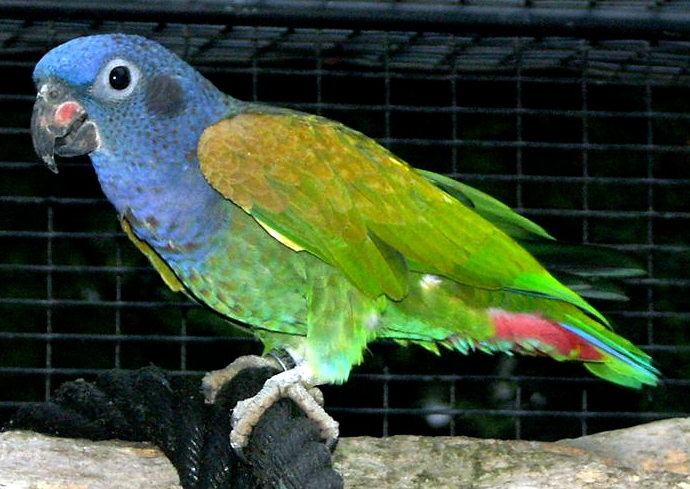
Scaly-headed Parrot
Pionus maximiliani
Order: Psittaciformes / Family: Psittacidae

Wikimedia Commons
About the Scaly-headed Parrot
The Scaly-headed Parrot (Pionus maximiliani) is a medium-sized parrot native to the subtropical and tropical forests of South America. This species is particularly prominent in Brazil, Paraguay, and northern Argentina. The Scaly-headed Parrot plays a crucial role in its ecosystem, primarily by aiding in seed dispersal. Its diet, which consists largely of fruits, seeds, and flowers, allows it to transport and release seeds across its habitat, contributing to forest regeneration. In addition to seed dispersal, this parrot's feeding habits help control insect populations, as it occasionally consumes insects and their larvae. The vibrant green plumage, with a distinctive scaly pattern on the head, is more than just a visual trait; it serves as an effective camouflage against the lush backdrop of its forest habitat. During the breeding season, which generally spans from September to February, the Scaly-headed Parrot seeks out tree cavities for nesting. These cavities, often in tall trees, provide the necessary protection from predators. The parrot's distinct call plays a significant role during this time, with calls becoming more frequent and varied to attract mates and establish territories. As a non-migratory bird, the Scaly-headed Parrot remains in its tropical habitat year-round. However, seasonal variations in food availability can cause slight shifts in local movements. During times of food scarcity, these parrots may venture closer to human settlements, where they are sometimes seen in orchards and gardens, further underscoring their adaptability. Their presence in both primary and secondary forests, as well as their occasional visits to urban areas, highlights their ecological versatility. Moreover, the Scaly-headed Parrot contributes to the cultural tapestry of the regions it inhabits. In many local communities, it is a familiar sight and sound, often encountered in gardens and parks. Despite this familiarity, the species faces challenges from habitat destruction, primarily due to deforestation for agriculture and urban development.
The Scaly-headed Parrot belongs to the family Psittacidae, within the order Psittaciformes. These birds typically live average 20-30 years, with some living up to 35 years in captivity..
How to Identify a Scaly-headed Parrot
The Scaly-headed Parrot is easily recognizable by its medium size, measuring approximately 27 centimeters in length. Its plumage is predominantly green, with a distinct bluish tinge on the wings and tail tips. The head, true to its name, exhibits a unique scaly pattern formed by dark feather edges that contrast with the lighter feather bases. This pattern is more pronounced in adults, whereas juveniles display a duller, less defined pattern. There is little sexual dimorphism in this species, with males and females appearing similar, although males may have slightly more vibrant coloration. In flight, the Scaly-headed Parrot showcases a broad-winged silhouette with a short, squared tail. It flies with rapid, shallow wingbeats, interspersed with short glides. When perched, this parrot often adopts a relaxed posture, with its tail hanging down and wings slightly drooped. It can be confused with other Pionus species, such as the Blue-headed Parrot, but the Scaly-headed Parrot's distinctive head pattern and lack of a blue crown help differentiate it. Its call, a series of raspy, high-pitched notes, also aids in identification, especially when visual confirmation is challenging.
Having trouble telling birds apart? Upload a photo to our bird identification tool for an instant species match.
Scaly-headed Parrot Habitat and Range
Preferred Habitat
The Scaly-headed Parrot predominantly inhabits subtropical and tropical moist lowland forests, as well as subtropical and tropical moist montane forests. It thrives in areas with dense canopy cover, where it can find ample food and nesting opportunities. This parrot is often found at elevations ranging from sea level to about 1,500 meters. While primary forests are its preferred habitat, it is also frequently observed in secondary forests and wooded areas near agricultural lands. During the non-breeding season, the Scaly-headed Parrot may venture into more open areas, such as savannas and scrublands, in search of food. Occasionally, these parrots are spotted in urban settings, particularly in cities with expansive parks and green spaces, reflecting their adaptability to different environments.
Geographic Range
The Scaly-headed Parrot has a broad range across central and eastern South America. Its primary range includes Brazil, where it is found in the Atlantic Forest and parts of the Amazon Basin. It extends into eastern Paraguay and reaches as far south as the province of Misiones in Argentina. Unlike many other parrot species, the Scaly-headed Parrot is non-migratory, residing within its range year-round. However, localized movements are common, especially in response to seasonal variations in food availability. These movements often lead to temporary increases in population density in certain areas, particularly where food sources are abundant. Despite its wide range, the Scaly-headed Parrot's population density can vary significantly, with some areas hosting large, stable populations and others experiencing declines due to habitat loss.
Want to know which birds visit your area? Browse our backyard birds by location guides for region-specific species lists.
What Does the Scaly-headed Parrot Eat?
The Scaly-headed Parrot primarily feeds on a diverse diet of fruits, seeds, and flowers. Commonly consumed fruits include those of the Cecropia and Ficus trees, which are abundant in its forest habitat. This parrot also shows a preference for seeds of leguminous plants and occasionally supplements its diet with buds and nectar. During the breeding season, its diet expands to include more protein-rich foods, such as insects and their larvae, which are vital for chick development. The Scaly-headed Parrot typically forages in the early morning and late afternoon, taking advantage of cooler temperatures. It employs a methodical approach to foraging, often hanging upside down to reach fruits and flowers. This behavior not only allows it to access a wider range of food but also aids in seed dispersal as it moves through the forest canopy.
Want to attract Scaly-headed Parrots to your yard? See our recommended feeders and seed types for the best results.
Scaly-headed Parrot Behavior and Social Structure
The Scaly-headed Parrot is a social species, often seen in pairs or small groups. These groups can sometimes merge into larger flocks, especially around abundant food sources. Within these flocks, the Scaly-headed Parrot exhibits a complex social structure characterized by cooperative behaviors such as mutual preening. Territorial behavior is most evident during the breeding season, with pairs becoming more vocal and aggressive to protect nesting sites. Courtship displays involve synchronized movements and vocalizations, helping strengthen pair bonds. This parrot generally remains active during the day, with peak activity occurring in the early morning and late afternoon when it forages and socializes. At night, it roosts in tree canopies, often in the company of other parrots, which provides safety in numbers. When faced with predators, the Scaly-headed Parrot relies on its agility and rapid flight to escape, often seeking the cover of dense foliage.
Scaly-headed Parrot Nesting and Reproduction
The Scaly-headed Parrot typically nests in natural tree cavities, preferring tall trees that offer protection from predators. It may also use abandoned woodpecker holes or even artificial nest boxes if available. The nesting season generally spans from September to February, corresponding with the rainy season in much of its range. A typical clutch consists of 2 to 4 eggs, which the female incubates for about 24 to 26 days. During this period, the male plays a crucial role in feeding the female and defending the nest site. After hatching, both parents participate in feeding the chicks, which fledge approximately 8 weeks post-hatching. The Scaly-headed Parrot usually raises one brood per year, but in areas with abundant resources, a second brood is possible.
Scaly-headed Parrot Sounds and Vocalizations
The Scaly-headed Parrot's vocal repertoire includes a variety of calls and songs. Its primary song consists of a series of raspy, high-pitched notes delivered in rapid succession. These notes can sound harsh and metallic, often likened to the sound of a rusty hinge. In addition to songs, the parrot emits several call notes, including a sharp alarm call used to alert others to potential threats. During the dawn chorus, the Scaly-headed Parrot becomes particularly vocal, with calls echoing through the forest canopy. These vocalizations serve not only in mate attraction and territory defense but also in maintaining flock cohesion during flight.
Interesting Facts About the Scaly-headed Parrot
- 1The Scaly-headed Parrot can live up to 30 years in the wild, demonstrating remarkable longevity for a bird of its size.
- 2This parrot's unique scaly head pattern is not just for show; it provides effective camouflage in dense foliage.
- 3Unlike many parrots, the Scaly-headed Parrot is relatively quiet, making it a less conspicuous inhabitant of its forest home.
- 4The Scaly-headed Parrot participates in mutual preening, a behavior that helps strengthen social bonds within flocks.
- 5Its diet includes a surprising variety of fruits and seeds, contributing significantly to seed dispersal in its habitat.
- 6The Scaly-headed Parrot is known to use its strong beak to crack open hard seeds, showcasing its adaptability in foraging.
- 7Despite its wide range, the Scaly-headed Parrot is rarely seen far from forested areas, highlighting its preference for dense habitats.
Scaly-headed Parrot Conservation Status
The Scaly-headed Parrot is currently listed as Least Concern by the IUCN, but its population trend is decreasing. Primary threats include habitat loss due to deforestation for agriculture and urban development. In some areas, illegal trapping for the pet trade further exacerbates population declines. Conservation efforts focus on habitat preservation, with several protected areas established within its range. Historical population data indicate a decline in certain regions, but stable populations persist in protected areas. Ongoing research and monitoring are essential to ensure the long-term survival of this species.
Attracting Scaly-headed Parrots to Your Feeder
The Scaly-headed Parrot is a regular visitor to backyard bird feeders across its range. At the Eye On The Fly feeding station, we observe Scaly-headed Parrots regularly and capture footage with our feeder cameras.
Other Psittacidae Species


Birds Similar to the Scaly-headed Parrot
These species are often confused with the Scaly-headed Parrot due to similar appearance or overlapping range.