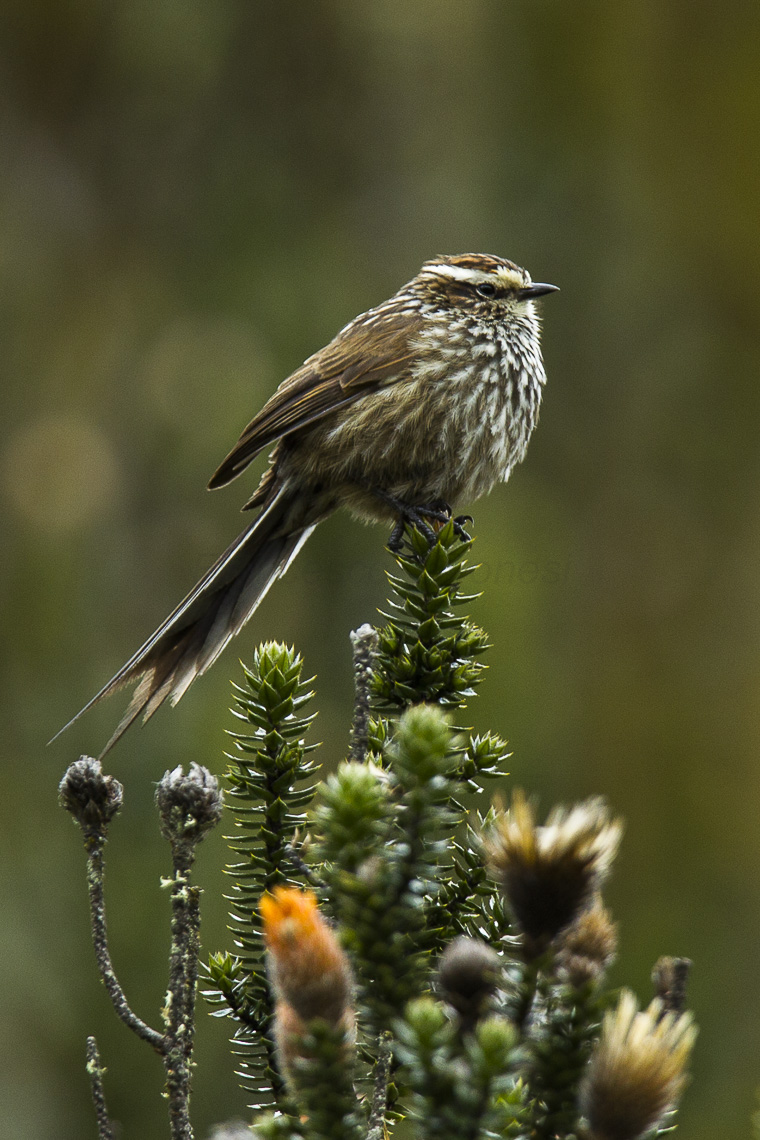
Brown-capped Tit-Spinetail
Leptasthenura fuliginiceps
Order: Passeriformes / Family: Furnariidae

Wikimedia Commons
About the Brown-capped Tit-Spinetail
The Brown-capped Tit-Spinetail, scientifically known as Leptasthenura fuliginiceps, is a small passerine bird endemic to the Andes mountain range. This species is a member of the Furnariidae family, which includes a variety of insectivorous birds known for their specialized foraging techniques. The Brown-capped Tit-Spinetail thrives in montane forest habitats, often at altitudes ranging from 2,500 to 4,000 meters. Its presence is most prominent in countries like Bolivia, Peru, and Argentina, where it occupies both humid and semi-humid forest ecosystems, often dotted with Polylepis trees.
Ecologically, the Brown-capped Tit-Spinetail plays a significant role in controlling insect populations, as its diet primarily consists of small arthropods. By foraging through the dense foliage and tree bark, it helps maintain the health of its forest environment. Seasonal behaviors of the Brown-capped Tit-Spinetail include altitudinal movements in search of food during colder months. These shifts are not migratory in the traditional sense but are still crucial for its survival in fluctuating mountain climates.
The tit-spinetail's adaptability to various montane habitats underscores its ecological value as a species that bridges diverse Andean ecosystems. Its presence indicates a richly biodiverse environment, and the bird contributes to seed dispersal indirectly by affecting insect populations that interact with plant life. The Brown-capped Tit-Spinetail, while not currently endangered, serves as an indicator species for environmental changes due to its sensitivity to habitat disruption and climate variation.
The Brown-capped Tit-Spinetail belongs to the family Furnariidae, within the order Passeriformes. These birds typically live average 4-6 years, with a maximum recorded of 8 years..
How to Identify a Brown-capped Tit-Spinetail
The Brown-capped Tit-Spinetail is easily recognized by its distinct brown cap, contrasting with its otherwise grayish-brown body. Adults exhibit a subtle rufous tint on their wings and tail feathers. The tail itself is long and graduated, a characteristic feature that aids in identification. Juveniles resemble adults but may display slightly duller plumage, lacking the full intensity of the adult's coloration.
In terms of sexual dimorphism, males and females of the Brown-capped Tit-Spinetail appear similar, making field identification based on sex challenging. However, observing behavior during breeding seasons can offer clues to their gender roles. The bird's flight silhouette is characterized by a quick, fluttering motion, often interspersed with brief glides. While perched, the tit-spinetail typically holds its tail cocked above the horizontal, displaying an alert posture.
It can be confused with other Furnariidae species, such as the Rusty-crowned Tit-Spinetail, but the Brown-capped Tit-Spinetail's unique crown coloration and tail structure help differentiate it. Birders should note its agile movements and the habitat it occupies when making identifications.
Having trouble telling birds apart? Upload a photo to our bird identification tool for an instant species match.
Brown-capped Tit-Spinetail Habitat and Range
Preferred Habitat
The Brown-capped Tit-Spinetail inhabits montane forests, with a preference for areas abundant in Polylepis trees. These forests provide both food and nesting sites, supporting the bird's year-round presence. The species thrives at elevations between 2,500 and 4,000 meters, making it a true resident of high-altitude environments.
In terms of habitat preferences, the Brown-capped Tit-Spinetail favors humid and semi-humid forests, often found on slopes and ridges where tree cover is dense. During different seasons, it may move slightly in altitude, seeking areas with sufficient insect prey and suitable nesting sites. Unlike many other species, it is rarely found in urban settings, preferring remote, undisturbed natural environments.
The presence of the Brown-capped Tit-Spinetail in a given forest is often indicative of healthy, mature montane ecosystems, where vegetation is dense enough to support its foraging and nesting needs.
Geographic Range
The Brown-capped Tit-Spinetail is primarily found in the Andes of South America, with its range extending through Bolivia, Peru, and northern Argentina. It occupies a relatively narrow altitudinal band, thriving between 2,500 and 4,000 meters. This bird does not undertake long-distance migrations, although it may exhibit altitudinal movements in response to seasonal food availability.
The breeding range of the Brown-capped Tit-Spinetail is largely confined to the high Andes, where it is a resident species. Its range overlaps with several other montane bird species, creating a rich tapestry of avian biodiversity in this region. The Brown-capped Tit-Spinetail is not considered highly migratory, but local population densities can fluctuate based on environmental conditions and food resources.
In terms of population hotspots, the tit-spinetail is most commonly encountered in protected areas and national parks where its preferred habitat is preserved. Conservation of these areas is crucial for maintaining stable populations of this and other montane species.
Want to know which birds visit your area? Browse our backyard birds by location guides for region-specific species lists.
What Does the Brown-capped Tit-Spinetail Eat?
The Brown-capped Tit-Spinetail primarily feeds on insects and other small arthropods, which it gleans from foliage and tree bark. It exhibits a methodical foraging technique, moving agilely through branches with its long tail providing balance. The bird's diet changes slightly with the seasons, as it takes advantage of the most abundant insect species available at any given time.
During the warmer months, the tit-spinetail may also consume small amounts of plant material, such as seeds or berries, although this is less common. It forages throughout the day, with peak activity during the early morning and late afternoon when insects are most active. The Brown-capped Tit-Spinetail's ability to exploit various microhabitats within the forest allows it to maintain a consistent food intake despite environmental fluctuations.
The species often forages alone or in pairs, although it may occasionally join mixed-species flocks, taking advantage of the increased foraging efficiency these groups provide. Its selective feeding habits help control pest populations, contributing to the ecological balance of its montane habitat.
Brown-capped Tit-Spinetail Behavior and Social Structure
The Brown-capped Tit-Spinetail displays a range of behaviors that reflect its adaptation to montane environments. It is primarily a solitary or pair-bonded species outside the breeding season, but it may form loose flocks during non-breeding periods, particularly in areas with abundant food resources.
Territorial behavior becomes pronounced during the breeding season when pairs establish and defend nesting territories. Courtship involves a series of vocalizations and displays, with males often showcasing their agility and plumage to attract females. These displays serve to reinforce pair bonds and signal readiness for breeding.
In response to predators, the Brown-capped Tit-Spinetail relies on its quick, darting flight to evade capture. It also uses alarm calls to alert nearby birds of potential threats. Daily activity patterns typically involve periods of intense foraging interspersed with rest and preening. The tit-spinetail's ability to adapt its behavior to changing environmental conditions is key to its survival in the challenging montane regions it inhabits.
Brown-capped Tit-Spinetail Nesting and Reproduction
The Brown-capped Tit-Spinetail constructs its nest in natural cavities, often utilizing holes in trees or rock crevices. The nest is composed of a variety of materials, including moss, feathers, and plant fibers, which provide insulation and camouflage.
Clutch size typically ranges from two to four eggs, with both parents sharing incubation duties. The incubation period lasts approximately two weeks, followed by a fledging period of about three weeks. During this time, both parents are actively involved in feeding and caring for the young, ensuring their survival in the demanding montane environment.
The species usually produces one brood per year, although favorable conditions may allow for a second. Nesting sites are often reused in subsequent years, provided they remain secure and undisturbed. The choice of nesting location is critical, as it must offer protection from predators and harsh weather conditions.
Brown-capped Tit-Spinetail Sounds and Vocalizations
The Brown-capped Tit-Spinetail is known for its distinctive song, which consists of a series of high-pitched, rapid trills and chirps. These vocalizations serve both to establish territory and to communicate with mates. The song has a musical quality, reminiscent of a swift, flowing melody that carries well through dense forest environments.
In addition to its primary song, the tit-spinetail emits a variety of call notes used in different contexts, such as contact calls between mates or alarm calls to warn of predators. These calls are generally sharp and piercing, contrasting with the more melodic song. During the dawn chorus, the Brown-capped Tit-Spinetail's song is particularly prominent, signifying the start of daily activities.
The bird's vocalizations are an essential tool for maintaining social bonds and navigating its complex habitat, where visual contact can be limited by dense foliage.
Interesting Facts About the Brown-capped Tit-Spinetail
- 1The Brown-capped Tit-Spinetail is one of the few bird species that thrives exclusively at high altitudes, often above 3,000 meters.
- 2Despite its small size, the Brown-capped Tit-Spinetail plays a crucial role in maintaining the health of Andean montane forests.
- 3The species can be found in Polylepis forests, a unique ecosystem that supports a range of specialized wildlife.
- 4Brown-capped Tit-Spinetail nests are often intricately constructed, showcasing the bird's ability to utilize diverse materials.
- 5While not migratory, the Brown-capped Tit-Spinetail may move altitudinally to access seasonal food resources.
- 6The species' vocalizations are particularly complex, with a range of calls and songs used for communication.
- 7The Brown-capped Tit-Spinetail's long tail is not just for show; it aids in balance and maneuverability among branches.
Brown-capped Tit-Spinetail Conservation Status
The Brown-capped Tit-Spinetail is currently listed as Least Concern by the IUCN, with stable population trends across its range. While not immediately threatened, the species faces potential risks from habitat loss due to deforestation and climate change. Its reliance on montane forest habitats makes it vulnerable to environmental changes that could alter these ecosystems. Conservation efforts focus on preserving natural habitats, particularly the Polylepis forests that are crucial to the tit-spinetail's survival. Protected areas and national parks play a significant role in safeguarding these environments, providing refuges for the species and other montane wildlife. Historically, the Brown-capped Tit-Spinetail has maintained stable populations, although continued vigilance is necessary to ensure that its habitats remain intact in the face of human encroachment and environmental shifts.
Other Furnariidae Species


Birds Similar to the Brown-capped Tit-Spinetail
These species are often confused with the Brown-capped Tit-Spinetail due to similar appearance or overlapping range.