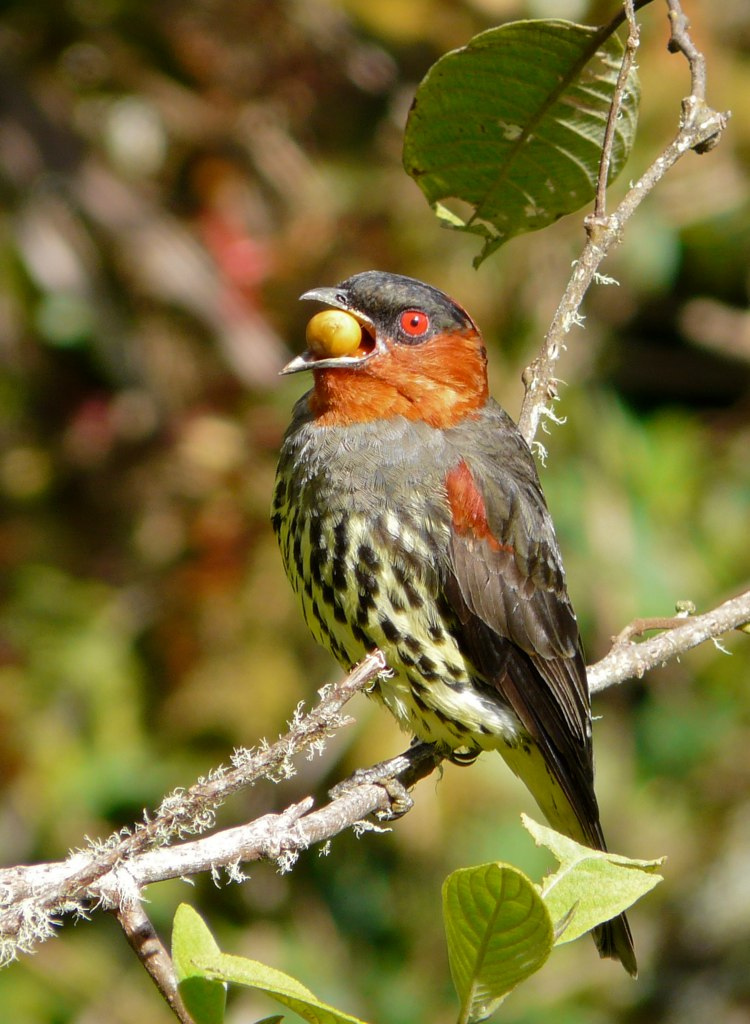
Brown-winged Schiffornis
Schiffornis turdina
Order: Passeriformes / Family: Cotingidae

Wikimedia Commons
About the Brown-winged Schiffornis
The Brown-winged Schiffornis (Schiffornis turdina) belongs to the Cotingidae family and is an enigmatic bird of the Passeriformes order. This species inhabits the dense tropical forests of Central and South America, from the lowlands of Honduras to the lush Amazon Basin. Its presence is most prevalent in moist forest environments, where it plays a crucial ecological role as both a seed disperser and insect predator. The Brown-winged Schiffornis thrives in the understory layer of these forests, often found near water sources and in areas with thick foliage. This bird's ability to adapt to various forested habitats, including secondary growth forests, makes it a key player in its ecosystem. The Brown-winged Schiffornis is known for its sedentary lifestyle, with little evidence of long-distance migration. However, seasonal movements within its range are not uncommon, as individuals may shift habitats in response to food availability. During the breeding season, which varies depending on location but generally occurs during the rainy season, the Brown-winged Schiffornis becomes more vocal and conspicuous. It is during this time that their distinctive calls resonate through the forest, a key behavior for attracting mates and establishing territory. The ecological significance of the Brown-winged Schiffornis extends beyond its role as a consumer. It contributes to forest regeneration through seed dispersal, primarily by consuming fruits and later depositing seeds through its droppings. This activity supports the growth of a diverse range of plant species, thereby maintaining the health and complexity of its habitat.
The Brown-winged Schiffornis belongs to the family Cotingidae, within the order Passeriformes. These birds typically live typically 4-6 years, with a maximum recorded lifespan of 8 years..
How to Identify a Brown-winged Schiffornis
The Brown-winged Schiffornis is a medium-sized bird, measuring approximately 20-22 cm in length. Its most distinctive feature is the rich brown coloration of its wings, which contrasts with the more subdued olive-green tones of its body. The bird's plumage is uniform and lacks the vibrant colors seen in many other cotingids, making its identification more reliant on subtle field marks. Adults of both sexes appear similar, with no significant sexual dimorphism in plumage. Juveniles resemble adults, although they may exhibit slightly duller colors and less defined feather edges. In flight, the Brown-winged Schiffornis displays a rounded wing silhouette, with a steady and direct flight pattern. When perched, it tends to adopt an upright posture, often remaining still for extended periods as it scans its surroundings for prey. This posture, combined with its muted colors, allows it to blend seamlessly into the forest understory. The Brown-winged Schiffornis is sometimes confused with related species, such as the Greenish Schiffornis, but can be distinguished by its more pronounced brown wing coloration and its distinct vocalizations.
Having trouble telling birds apart? Upload a photo to our bird identification tool for an instant species match.
Brown-winged Schiffornis Habitat and Range
Preferred Habitat
The Brown-winged Schiffornis is predominantly found in humid, lowland tropical forests. It favors areas with dense understory vegetation where it can forage and nest. These habitats often include primary forests as well as well-developed secondary growth. Typically, the bird inhabits elevations ranging from sea level to approximately 1200 meters, though it is most common in the lowlands. Seasonal habitat shifts may occur, with the Brown-winged Schiffornis moving to areas with higher fruit and insect availability. While generally associated with rural and remote forest locations, it can occasionally be found in more disturbed areas, provided that sufficient tree cover and natural vegetation are maintained. Unlike some other bird species, the Brown-winged Schiffornis is not commonly found in urban environments, as it relies heavily on natural forest ecosystems for survival.
Geographic Range
The Brown-winged Schiffornis has a range that extends from southern Mexico through Central America and into parts of northern South America. Its distribution includes countries such as Honduras, Nicaragua, Costa Rica, Panama, Colombia, Venezuela, and the northwestern regions of Brazil. Within this range, the bird occupies a variety of tropical forest habitats but is most prevalent in lowland areas. The population density of the Brown-winged Schiffornis tends to be higher in regions with extensive forest cover and minimal human disturbance. While it is a resident species throughout much of its range, some populations may exhibit altitudinal movements in response to seasonal changes in food availability. These movements are typically local and do not involve long-distance migration. In regions where forest fragmentation has occurred, the Brown-winged Schiffornis may become less common, highlighting the importance of intact forest ecosystems for its continued existence.
Want to know which birds visit your area? Browse our backyard birds by location guides for region-specific species lists.
What Does the Brown-winged Schiffornis Eat?
The diet of the Brown-winged Schiffornis consists primarily of fruits and insects, reflecting its role as both a frugivore and insectivore. Its fruit consumption includes a wide variety of small berries and drupes, which it plucks while perched or during short flights. This fruit diet may vary seasonally, with the bird targeting different fruiting plants depending on availability. In addition to fruits, the Brown-winged Schiffornis actively hunts insects and other small arthropods, which it captures through gleaning and hawking techniques. It often forages in the understory, using its keen eyesight to locate prey among the foliage. The bird's diet adapts to seasonal changes, with a potential increase in insect consumption during periods when fruits are less abundant. These dietary habits not only fulfill its nutritional needs but also contribute to the ecological dynamics of the forest by controlling insect populations and aiding in seed dispersal.
Brown-winged Schiffornis Behavior and Social Structure
The Brown-winged Schiffornis exhibits a primarily solitary lifestyle, although it may occasionally be observed in pairs, particularly during the breeding season. Its territorial behavior becomes more pronounced during this period, with males actively defending their chosen area through vocal displays. Courtship displays involve a combination of vocalizations and subtle physical displays, with the male often taking the lead in attracting a mate. Unlike some other bird species, the Brown-winged Schiffornis does not typically form large flocks. Instead, it maintains a low-profile presence within the dense forest vegetation. Its daily activity patterns are diurnal, with peak foraging occurring during the early morning and late afternoon. In response to potential threats, the Brown-winged Schiffornis relies on its cryptic plumage and the dense forest cover to avoid detection. When alarmed, it may emit short, sharp calls to signal danger to conspecifics and nearby species.
Brown-winged Schiffornis Nesting and Reproduction
The nesting habits of the Brown-winged Schiffornis align with its preference for secluded forest environments. This bird constructs its nest in the understory, often opting for locations that provide ample cover and protection. The nest itself is typically a cup-shaped structure, crafted from leaves, twigs, and other plant materials. It is usually situated in a low tree fork or among dense foliage, providing camouflage from potential predators. The Brown-winged Schiffornis lays a clutch of two to three eggs, which are incubated primarily by the female over a period of approximately 17-19 days. During this time, the male may assist by providing food and guarding the nest. Once the eggs hatch, both parents share the responsibility of feeding and caring for the nestlings. Fledging occurs after about 20-22 days, with the young remaining under parental care for a short period thereafter. The species typically raises one brood per year, although favorable conditions may allow for a second.
Brown-winged Schiffornis Sounds and Vocalizations
The vocalizations of the Brown-winged Schiffornis are a defining characteristic of the species. Its primary song consists of a series of clear, melodious whistles that rise and fall in pitch, creating a haunting yet beautiful sequence that resonates through the forest understory. This song is often repeated in intervals, serving as both a territorial declaration and a mate attraction signal. In addition to its song, the Brown-winged Schiffornis produces various call notes, including short, sharp chips used as contact calls between individuals. Alarm calls are higher-pitched and more urgent, often eliciting a response from nearby birds. During the dawn chorus, the Brown-winged Schiffornis is an active participant, its song contributing to the rich tapestry of sounds that define these early morning hours in the forest.
Interesting Facts About the Brown-winged Schiffornis
- 1The Brown-winged Schiffornis can consume fruits that are toxic to other birds, aiding in seed dispersal of specific plant species.
- 2Despite its unassuming appearance, the Brown-winged Schiffornis is known for its remarkably haunting and melodic song.
- 3The species is particularly adept at remaining motionless for extended periods, an effective strategy for avoiding predators.
- 4Brown-winged Schiffornis nests are often placed in such dense undergrowth that they are seldom found by even experienced birders.
- 5This bird's name 'Schiffornis' comes from the combination of the Latin words 'schiff' (meaning boat) and 'ornis' (meaning bird), although the exact origin of the name is unclear.
- 6The Brown-winged Schiffornis has a unique courtship display involving a series of coordinated movements and calls to attract a mate.
- 7It has adapted to exploit a variety of fruiting trees, making it an important species for forest regeneration.
Brown-winged Schiffornis Conservation Status
The Brown-winged Schiffornis currently holds a conservation status of Least Concern according to the IUCN Red List. However, its population faces pressures from habitat loss due to deforestation and land conversion for agriculture. While the species remains relatively widespread, localized declines have been observed in areas where forest cover has been significantly reduced. Conservation efforts focus on habitat preservation and restoration, emphasizing the importance of maintaining large tracts of continuous forest to support viable populations. Historical data suggest that the Brown-winged Schiffornis population has remained stable in regions with intact ecosystems, underscoring the critical role these habitats play in its survival.