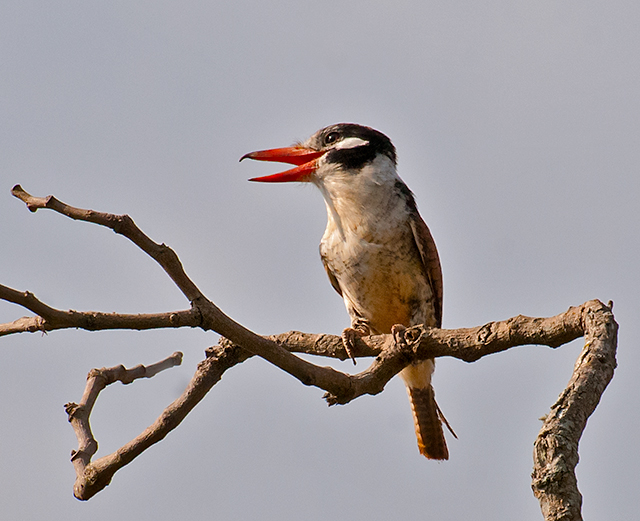
Buff-bellied Puffbird
Notharchus swainsoni
Order: Piciformes / Family: Bucconidae

Wikimedia Commons
About the Buff-bellied Puffbird
The Buff-bellied Puffbird, Notharchus swainsoni, is a striking bird native to the tropical forests of South America, particularly in Brazil, Paraguay, and northeastern Argentina. This bird is part of the Bucconidae family, known for their unique 'puffing' appearance due to their fluffy plumage and stout bodies. Buff-bellied Puffbirds inhabit lowland and foothill forests, typically found at elevations ranging from sea level to 1,200 meters. Their presence is a marker of healthy ecosystems, as they play a crucial role in controlling insect populations. These birds thrive in dense canopy layers, where they blend seamlessly with the foliage. Seasonal behaviors of the Buff-bellied Puffbird include subtle shifts in habitat preference, often moving to edge forests during the breeding season to exploit the abundant insect life. They demonstrate high site fidelity, frequently returning to the same territories year after year. Ecologically, Buff-bellied Puffbirds contribute to the biodiversity of their habitats by participating in seed dispersal and serving as prey for larger predatory birds. Their presence is a testament to the intactness of tropical forest ecosystems, and they are often indicators of environmental health. These puffbirds are generally solitary or found in pairs, which is typical for many members of the Bucconidae family. The Buff-bellied Puffbird's role in the ecosystem extends beyond insect control, as they influence the population dynamics of their prey species, maintaining a balance within the forest undergrowth. Despite their relatively stable population, habitat loss poses a significant threat to their numbers, emphasizing the need for conservation efforts focused on preserving tropical forest ecosystems.
The Buff-bellied Puffbird belongs to the family Bucconidae, within the order Piciformes. These birds typically live typically around 5-8 years, with some reaching 10 years..
How to Identify a Buff-bellied Puffbird
Adult Buff-bellied Puffbirds have a distinctive appearance, characterized by their buff-colored belly, which contrasts with their black-and-white plumage on the upperparts. The head, back, and wings exhibit a striking black coloration with white markings, while the face and throat are predominantly white, giving them a masked appearance. Juveniles resemble adults but might have slightly duller coloring and less distinct markings. Males and females look similar, making it difficult to distinguish between the sexes in the field. When compared to similar species, the Buff-bellied Puffbird can be distinguished by its unique belly coloration and its relatively larger size compared to other puffbirds. In flight, their silhouette is robust with short wings and a stout body, which makes their flight pattern appear somewhat labored. While perching, they maintain an upright posture, often remaining motionless for extended periods, a typical behavior of puffbirds. Their large head and stout bill are also key identification features that aid birders in distinguishing them in their natural habitat.
Having trouble telling birds apart? Upload a photo to our bird identification tool for an instant species match.
Buff-bellied Puffbird Habitat and Range
Preferred Habitat
Buff-bellied Puffbirds primarily inhabit tropical and subtropical forests, favoring areas with dense tree cover and high humidity. They are commonly found in lowland rainforests and foothill forests up to elevations of 1,200 meters. These birds prefer undisturbed forests but can occasionally be found in secondary growth or forest edges. Seasonal shifts might lead them to explore open areas or forest peripheries, especially during breeding seasons. Unlike some other bird species, Buff-bellied Puffbirds are rarely found in urban environments, preferring the tranquility and complexity of forest ecosystems. They rely heavily on the canopy for foraging and roosting, which offers them protection and a rich supply of food.
Geographic Range
The Buff-bellied Puffbird's range is primarily confined to South America, with the core populations found in Brazil, northeastern Argentina, and Paraguay. These regions provide the ideal tropical and subtropical forest environments that the species requires for survival. The bird does not engage in long-distance migrations, but it may exhibit local movement patterns in response to food availability and habitat conditions. Within their range, Buff-bellied Puffbirds are more densely populated in areas that have maintained robust forest cover, such as the Atlantic Forest in Brazil. They occupy a year-round residence in their preferred habitats, lacking the migratory behavior common in many other bird species. This sedentary lifestyle underscores the importance of stable, protected habitats for their continued survival.
Want to know which birds visit your area? Browse our backyard birds by location guides for region-specific species lists.
What Does the Buff-bellied Puffbird Eat?
The diet of the Buff-bellied Puffbird is primarily insectivorous, with a focus on various arthropods including beetles, grasshoppers, and spiders. During the wet season, when insect activity peaks, their diet may expand to include small vertebrates such as lizards and frogs. Buff-bellied Puffbirds employ a 'sit-and-wait' hunting strategy, perching motionless on branches before swooping down to capture prey. They prefer to hunt in the forest canopy, though they may descend to lower levels to exploit abundant food sources. The size of their prey typically ranges from small insects to larger arthropods, which they skilfully catch with their stout bills. Feeding usually occurs during dawn and dusk, taking advantage of the cooler temperatures when prey is most active. This opportunistic feeding schedule helps them maintain energy levels and support their reproductive activities during the breeding season.
Buff-bellied Puffbird Behavior and Social Structure
Buff-bellied Puffbirds exhibit solitary or paired social structures, rarely forming large flocks. They maintain defined territories, which they defend with vocalizations and occasional displays. Their territorial calls serve both to deter intruders and to attract mates. Courtship displays involve mutual feeding and synchronized movements, strengthening pair bonds. These puffbirds are known for their sedentary nature, spending significant time perched motionless in the canopy, scanning for prey. Their response to predators is typically passive, relying on camouflage and stillness to avoid detection. Daily activity patterns are crepuscular, with peaks during dawn and dusk when they forage actively. Despite their solitary tendencies, Buff-bellied Puffbirds may join mixed-species flocks occasionally, especially when food resources are abundant, allowing them to benefit from the increased vigilance and foraging success associated with group living.
Buff-bellied Puffbird Nesting and Reproduction
Buff-bellied Puffbirds nest in tree cavities, often utilizing abandoned woodpecker holes or natural openings. They prefer nesting sites in large, mature trees, which provide the necessary protection and stability. The typical clutch size ranges from two to three eggs, which both parents incubate for about 17 to 20 days. Once hatched, the chicks remain in the nest for approximately 24 to 26 days before fledging. Both parents share responsibilities in feeding and caring for the young, ensuring a high rate of survival for the offspring. Buff-bellied Puffbirds usually produce one brood per year, timed to coincide with the peak abundance of food resources. Their nesting behavior underscores the importance of preserving old-growth forests, which provide essential nesting sites for cavity-nesting birds like the Buff-bellied Puffbird.
Buff-bellied Puffbird Sounds and Vocalizations
The primary vocalization of the Buff-bellied Puffbird consists of a series of low-pitched, rhythmic hoots, which can be described as a 'hoot-hoot-hoot' pattern. These calls serve both territorial and mate-attraction purposes. In addition to their primary song, Buff-bellied Puffbirds emit sharp, alarm calls when threatened, which are shorter and more staccato in nature. During the dawn chorus, their hoots can often be heard resonating through the forest, contributing to the ambient soundscape. Their calls are reminiscent of distant owl hoots, offering an intriguing auditory experience for those exploring their habitats.
Interesting Facts About the Buff-bellied Puffbird
- 1The Buff-bellied Puffbird's scientific name, Notharchus swainsoni, honors the English ornithologist William Swainson.
- 2Despite their sedentary reputation, Buff-bellied Puffbirds can cover large territories, up to several hectares, when foraging.
- 3Their 'sit-and-wait' hunting strategy is highly energy efficient, allowing them to conserve energy in dense forest environments.
- 4Buff-bellied Puffbirds are part of the Piciformes order, which also includes woodpeckers and toucans, known for unique adaptations.
- 5In some regions, Buff-bellied Puffbirds are indicators of forest health, as their presence suggests intact canopies and diverse prey.
- 6These puffbirds have a lifespan up to 10 years in the wild, demonstrating remarkable resilience and adaptability in their habitats.
- 7The Buff-bellied Puffbird's unique vocalizations can travel over considerable distances, facilitating communication across large territories.
Buff-bellied Puffbird Conservation Status
The Buff-bellied Puffbird is currently listed as Least Concern by the IUCN, with population trends considered stable. However, habitat destruction due to deforestation poses a significant threat to their long-term survival. Conservation efforts focus on protecting and restoring primary forest habitats, ensuring the preservation of essential nesting and foraging areas. Historical population changes have shown resilience, but ongoing habitat fragmentation requires continued monitoring and conservation actions. Protecting large tracts of undisturbed forest remains crucial for maintaining healthy populations of the Buff-bellied Puffbird.
Other Bucconidae Species


Birds Similar to the Buff-bellied Puffbird
These species are often confused with the Buff-bellied Puffbird due to similar appearance or overlapping range.