
White-eared Puffbird
Nystalus chacuru
Order: Piciformes / Family: Bucconidae
Wikimedia Commons
About the White-eared Puffbird
The White-eared Puffbird (Nystalus chacuru) is an intriguing member of the Bucconidae family, commonly found across a wide range of forested and semi-open habitats in South America. This bird is particularly noted for its distinctive white ear patches that contrast sharply with its predominantly brown plumage. The White-eared Puffbird favors habitats that provide ample perching opportunities such as forest edges, savannas, and scrublands. Its distribution spans countries including Brazil, Bolivia, Paraguay, and Argentina. This puffbird plays a significant ecological role as both a predator and prey within these ecosystems. By controlling insect populations, it contributes to the ecological balance. Additionally, the White-eared Puffbird serves as an indicator species for habitat health due to its preference for specific environmental conditions. Seasonally, the White-eared Puffbird remains relatively sedentary, though it may undertake minor local movements in response to changes in food availability. During the breeding season, it becomes more territorial, establishing and defending nesting sites with vigor. Its presence is often marked by its distinctive vocalizations, which can be heard echoing through its preferred habitats. The White-eared Puffbird's ability to thrive in both undisturbed and altered landscapes speaks to its adaptability, though ongoing habitat destruction poses a threat to its long-term survival. Understanding its habits and requirements is crucial for conservation efforts aimed at preserving South America's rich avian diversity.
The White-eared Puffbird belongs to the family Bucconidae, within the order Piciformes. These birds typically live average 5-7 years, with some individuals living up to 9 years..
How to Identify a White-eared Puffbird
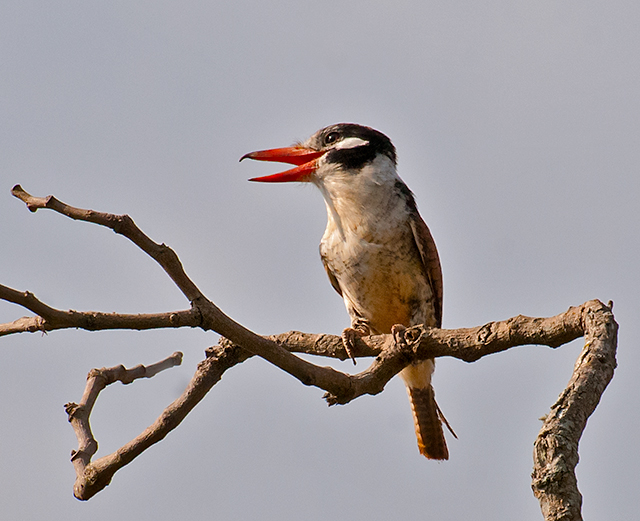
Adult White-eared Puffbirds are easily identified by their striking plumage. They possess a bold white cheek patch that contrasts with their deep brown crown and back. Their underparts are a paler buff color, often with faint streaking. Their stout bill is black, and their eyes are dark, giving them a piercing expression. Juveniles display similar patterns but with slightly more muted coloring. Males and females do not exhibit significant differences in plumage, making sex differentiation in the field challenging. When perched, the White-eared Puffbird maintains an upright, alert posture, often sitting conspicuously on open branches. Its silhouette is distinctive, with a stocky build and a large head relative to its body size. In flight, the puffbird exhibits a direct, undulating pattern, characterized by short bursts of wing beats followed by glides. While there are several puffbird species in South America, the combination of its white cheek patches and typical habitat choices minimizes confusion with other species.
Having trouble telling birds apart? Upload a photo to our bird identification tool for an instant species match.
White-eared Puffbird Habitat and Range
Preferred Habitat
The White-eared Puffbird thrives in a variety of habitats including forest edges, savannas, and scrublands. It is commonly found at elevations ranging from sea level up to 1,500 meters. In Brazil, it often inhabits the Cerrado biome, characterized by vast tropical savannas. The bird also adapts well to disturbed areas, including agricultural landscapes and regions undergoing reforestation. However, it generally avoids dense, unbroken forest interiors, preferring open spaces where it can easily hunt from exposed perches. During the dry season, it may move to areas with more abundant food resources, though it does not typically migrate long distances.
Geographic Range
The White-eared Puffbird's range is extensive across South America, primarily in Brazil, Bolivia, Paraguay, and northern Argentina. It occupies a broad swath of central Brazil, particularly within the Cerrado and Pantanal regions. The bird does not engage in long-distance migrations, instead remaining relatively sedentary throughout the year. Its population density is highest in areas with a mosaic of open habitats interspersed with forested patches. These areas provide the optimal combination of perching sites and feeding grounds. While the species is widespread, localized populations may vary depending on habitat quality and availability.
Want to know which birds visit your area? Browse our backyard birds by location guides for region-specific species lists.
What Does the White-eared Puffbird Eat?
The diet of the White-eared Puffbird mainly consists of insects and small vertebrates. It primarily hunts from a perch, scanning the surroundings before swooping down to capture prey on the ground. Common food items include grasshoppers, beetles, and small lizards. During the wet season, it may also consume fruits and seeds, taking advantage of seasonal abundance. The puffbird's foraging schedule is typically most active during the early morning and late afternoon when temperatures are cooler. Its hunting technique involves brief flights from perches, making it an efficient predator despite its seemingly leisurely demeanor.
White-eared Puffbird Behavior and Social Structure
The White-eared Puffbird is largely solitary, though pairs may be observed during the breeding season. It defends its territory aggressively, using its loud calls to warn off intruders. Courtship involves mutual preening and vocal exchanges, strengthening pair bonds. The puffbird's vocalizations are a key aspect of its territorial behavior, serving as both a deterrent to rivals and an attraction to potential mates. It is generally a diurnal species, active during daylight hours, with peak activity occurring at dawn and dusk. In response to predators, the puffbird relies on its cryptic plumage to blend into its surroundings, often freezing motionless to avoid detection.
White-eared Puffbird Nesting and Reproduction
White-eared Puffbirds nest in cavities, often using abandoned woodpecker holes or natural tree cavities. They do not construct traditional nests but may line the cavity with leaves. Preferred nesting sites are typically located in trees or occasionally in earthen banks. The female lays two to three eggs, which both parents incubate over a period of approximately 18-21 days. After hatching, the chicks remain in the nest for about 24-28 days before fledging. Both parents share the responsibility of feeding and protecting the young, ensuring their development in a relatively short breeding season.
White-eared Puffbird Sounds and Vocalizations
The White-eared Puffbird's primary song is a series of melodious whistles, each note descending in pitch and delivered at regular intervals. These whistles are often heard at dawn and dusk, amplifying the bird's presence in its habitat. In addition to its song, the puffbird produces a variety of call notes, including sharp, repeated 'chur' sounds used for communication between mates. When alarmed, it emits a more abrupt, harsh call to alert others of potential danger. The puffbird's vocal repertoire is both a critical component of its social interactions and a useful tool for birders in locating these birds within dense habitats.
Interesting Facts About the White-eared Puffbird
- 1The White-eared Puffbird can remain motionless for long periods, which aids in both hunting and avoiding predators.
- 2Despite its name, the White-eared Puffbird's 'ears' are actually patches of white feathers, not true ears.
- 3This species is known for its striking vocalizations, which can be heard over considerable distances.
- 4White-eared Puffbirds often share their habitat with similar puffbird species, necessitating keen observation to differentiate them.
- 5The White-eared Puffbird's preference for open, edge habitats makes it more visible to birders than more forest-dwelling relatives.
- 6They are part of the Bucconidae family, which is composed of puffbirds known for their 'puffy' appearance due to loose plumage.
- 7White-eared Puffbirds have no genuine seasonal migration pattern, a rarity among birds with such a wide range.
White-eared Puffbird Conservation Status
The IUCN currently lists the White-eared Puffbird as a species of Least Concern, with populations considered stable. However, habitat destruction and fragmentation pose ongoing threats, particularly in rapidly developing regions like the Brazilian Cerrado. Conservation efforts focus on preserving critical habitats and promoting sustainable land use practices. Historically, the puffbird's adaptability has allowed it to persist despite environmental changes, but continuous monitoring is necessary to ensure future stability. Protecting large tracts of contiguous habitat remains essential for the conservation of this and other similar species in South America.
Other Bucconidae Species


Birds Similar to the White-eared Puffbird
These species are often confused with the White-eared Puffbird due to similar appearance or overlapping range.

