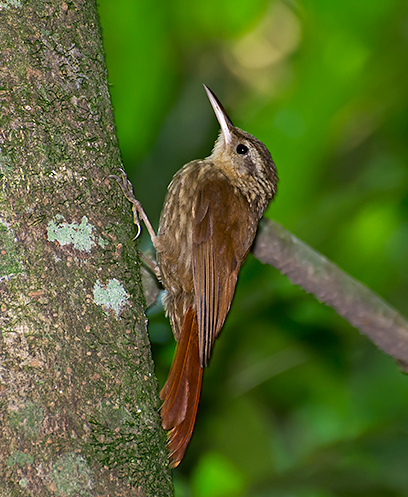
Buff-throated Woodcreeper
Xiphorhynchus guttatus
Order: Passeriformes / Family: Furnariidae

Wikimedia Commons
About the Buff-throated Woodcreeper
The Buff-throated Woodcreeper, Xiphorhynchus guttatus, is a medium-sized bird belonging to the family Furnariidae, commonly found in the tropical rainforests of Central and South America. It plays a crucial ecological role as both a predator of insects and a participant in the complex symbiotic relationships within its habitat. This species is especially prevalent in regions such as the Amazon Basin, extending its range through the Guianas, Venezuela, and parts of the Brazilian Atlantic Forest. These woodcreepers are primarily associated with lowland and submontane forests but can also inhabit secondary growth and even plantations, reflecting their adaptability. The Buff-throated Woodcreeper is an integral part of the ecosystem, contributing to the control of insect populations and assisting in the maintenance of forest health. During the breeding season, this bird exhibits a remarkable increase in its already extensive vocal repertoire, which plays a significant role in territorial defense and mate attraction. Seasonal changes in behavior are primarily dictated by the wet and dry seasons typical of tropical climates, which influence food availability and nesting opportunities. As a species that often follows mixed-species flocks, the Buff-throated Woodcreeper enhances its foraging efficiency, while also benefiting from the collective vigilance against predators. Its presence in diverse forest types underscores its ecological flexibility, although deforestation poses a significant threat to its habitat. The Buff-throated Woodcreeper's resilience and adaptability are key to its survival in rapidly changing environments.
The Buff-throated Woodcreeper belongs to the family Furnariidae, within the order Passeriformes. These birds typically live typically 5-7 years, with some individuals living up to 12 years..
How to Identify a Buff-throated Woodcreeper
Identifying the Buff-throated Woodcreeper involves noting several key field marks. Adults display a rich brown plumage with a buff-colored throat and streaked breast, which can sometimes appear rufous in certain lighting conditions. The bird possesses a long, slightly decurved bill, which is an adaptation for extracting insects from bark crevices. Juveniles resemble adults but may show less defined streaking on the breast and a slightly duller overall appearance. There is little sexual dimorphism, with males and females appearing similar; however, subtle differences in bill length may be observed upon close inspection. Confusion may arise with similar species like the Cocoa Woodcreeper or the Plain-brown Woodcreeper, but the Buff-throated Woodcreeper can be distinguished by its characteristic throat coloring and more pronounced streaking. In flight, this species exhibits a rapid wingbeat pattern and a distinctive, slightly undulating flight. When perched, the Buff-throated Woodcreeper often adopts an upright posture, using its stiff tail feathers for support as it ascends tree trunks in search of prey.
Having trouble telling birds apart? Upload a photo to our bird identification tool for an instant species match.
Buff-throated Woodcreeper Habitat and Range
Preferred Habitat
The Buff-throated Woodcreeper primarily inhabits tropical lowland and submontane forests, thriving in both primary and secondary growth areas. It is commonly found in the Amazon Basin, extending into the Atlantic Forest of Brazil and the lowland forests of the Guianas. This bird shows a preference for dense, humid forest environments where it can forage effectively. While primarily a forest dweller, the Buff-throated Woodcreeper is occasionally observed in degraded habitats and plantations, indicating some degree of adaptability. It typically resides at elevations ranging from sea level up to 1,500 meters. Unlike some other woodcreepers, it does not exhibit significant seasonal habitat shifts, remaining within forested areas throughout the year. Urban presence is minimal, as it tends to avoid heavily human-altered landscapes, preferring instead the complexity and cover of natural or semi-natural forested environments.
Geographic Range
The range of the Buff-throated Woodcreeper covers extensive parts of Central and South America. Its breeding range includes the Amazon Basin, spanning countries such as Brazil, Peru, Ecuador, Colombia, Venezuela, and the Guianas. It is also found along the eastern slopes of the Andes, though less commonly. Unlike many migratory birds, the Buff-throated Woodcreeper does not undertake long-distance migrations, instead remaining within its tropical range year-round. Occasional movements within its range may occur in response to local food availability or habitat changes. Population density is highest in the lush, undisturbed rainforests of the Amazon, where the species capitalizes on the abundant resources. Although widespread, it faces population pressures in areas where deforestation and habitat fragmentation are prevalent, particularly outside of protected areas.
Want to know which birds visit your area? Browse our backyard birds by location guides for region-specific species lists.
What Does the Buff-throated Woodcreeper Eat?
The Buff-throated Woodcreeper's diet primarily consists of insects and arthropods, which it gleans from tree bark and foliage. Beetles, ants, and spiders form the bulk of its prey, though it will also consume small lizards and other invertebrates when available. Seasonal diet changes are minimal due to the consistent availability of its primary food sources in tropical forests. The bird employs a methodical foraging technique, using its long bill to probe crevices and snag prey hidden beneath bark or leaves. Prey size typically ranges from small insects to moderate-sized arthropods, allowing for a diverse diet. The Buff-throated Woodcreeper is primarily an active forager during the day, with peak feeding activity occurring in the early morning and late afternoon. Its participation in mixed-species flocks not only enhances foraging opportunities but also reduces the risk of predation while feeding.
Buff-throated Woodcreeper Behavior and Social Structure
The Buff-throated Woodcreeper is a highly social bird, often seen foraging in mixed-species flocks, which offers protection and increased foraging efficiency. Territorial behavior is most pronounced during the breeding season, when males vocalize frequently to assert dominance and attract mates. Courtship displays are subtle, involving mutual preening and feeding between pairs. Once bonded, pairs are monogamous and exhibit strong site fidelity, returning to the same nesting area each year. The Buff-throated Woodcreeper exhibits a diurnal activity pattern, with peaks of activity during the early morning and late afternoon, coinciding with cooler temperatures and increased prey availability. In the presence of predators, such as raptors or snakes, the woodcreeper relies on its cryptic coloration to remain undetected, often freezing in place against tree trunks. Its interaction with mixed-species flocks is a crucial aspect of its behavior, as it benefits from the collective vigilance of the group while enhancing its own foraging success.
Buff-throated Woodcreeper Nesting and Reproduction
Buff-throated Woodcreepers typically nest in natural cavities within trees, often high above the ground to avoid predators. They may also use abandoned woodpecker holes or similar structures. The nest is constructed from a variety of plant materials, including leaves, bark, and twigs, providing a secure environment for the eggs. A typical clutch consists of 2 to 3 eggs, which are incubated by both parents over a period of approximately 16 to 18 days. Once hatched, the chicks remain in the nest for an extended period, fledging after about 22 to 25 days. Both parents share in feeding and caring for the young, ensuring a high level of parental investment. The Buff-throated Woodcreeper usually raises one brood per year, although in areas with abundant resources, a second brood may be attempted. The nesting period coincides with the peak of the rainy season, when food availability is highest.
Buff-throated Woodcreeper Sounds and Vocalizations
The Buff-throated Woodcreeper is known for its complex vocalizations, which include a series of high-pitched, melodious whistles. Its primary song consists of a rapid succession of notes, often described as a musical trill that rises and falls in pitch. These vocalizations serve multiple purposes, including territory establishment and mate attraction. In addition to its song, the woodcreeper produces sharp call notes that function as alarms or contact calls within mixed-species flocks. During the dawn chorus, the Buff-throated Woodcreeper's song can be heard throughout the forest, contributing to the rich soundscape of the tropical rainforest. Its alarm calls are short and abrupt, often likened to the squeak of a rusty hinge, providing an effective alert to potential threats.
Interesting Facts About the Buff-throated Woodcreeper
- 1The Buff-throated Woodcreeper can ascend tree trunks using its stiff tail feathers for support, much like a woodpecker.
- 2Despite its name, the Buff-throated Woodcreeper is not closely related to true woodpeckers, though they share similar foraging behaviors.
- 3This species often follows army ant swarms, taking advantage of the insects displaced by the ants' movement.
- 4The Buff-throated Woodcreeper's song can travel long distances in the dense rainforest, serving as an effective communication tool.
- 5Its long, decurved bill is specially adapted to probe into crevices and extract hidden insects from beneath bark.
- 6The Buff-throated Woodcreeper plays an important role in mixed-species flocks, helping to spot predators and alert other birds.
- 7Some individuals of this species have been known to live for over a decade, indicating a relatively long lifespan for a bird of its size.
Buff-throated Woodcreeper Conservation Status
The Buff-throated Woodcreeper is currently classified as Least Concern by the IUCN, with a stable population trend across its range. However, ongoing deforestation and habitat fragmentation in the Amazon and other tropical forest regions pose significant threats to its long-term survival. Conservation efforts focus on protecting large swathes of primary forest and establishing corridors to connect fragmented habitats. Historically, this species has maintained stable populations due to its adaptability and broad range, but continued habitat loss could lead to declines in certain areas. Conservationists emphasize the importance of sustainable forestry practices and the establishment of protected areas to safeguard the future of the Buff-throated Woodcreeper and other forest-dependent species.
Other Furnariidae Species


Birds Similar to the Buff-throated Woodcreeper
These species are often confused with the Buff-throated Woodcreeper due to similar appearance or overlapping range.