
Lesser Woodcreeper
Xiphorhynchus fuscus
Order: Passeriformes / Family: Furnariidae
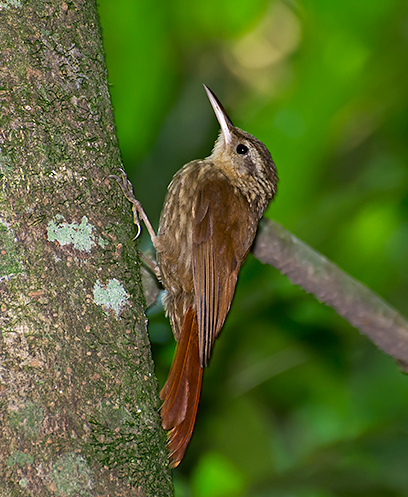
Wikimedia Commons
About the Lesser Woodcreeper
The Lesser Woodcreeper (Xiphorhynchus fuscus) is a fascinating bird that resides primarily in the subtropical and tropical forests of South America. Noted for its slender curved bill and adept climbing skills, it plays a crucial role in the ecosystem as an insectivore, controlling insect populations. Found predominantly in the Atlantic Forest, which spans parts of Brazil, Paraguay, and Argentina, this bird contributes to the region's biodiversity.
The Lesser Woodcreeper measures about 20 centimeters in length, making it a medium-sized member of the Furnariidae family. Its presence is a hallmark of healthy forest ecosystems, as it relies on abundant tree cover and diverse insect life. The bird's ecological significance extends beyond pest control; it also acts as an indicator species for forest health, given its sensitivity to habitat changes.
Seasonality affects the Lesser Woodcreeper's behavior, particularly during breeding, when it becomes more territorial and vocal. Outside the breeding season, the bird's activity is more subdued, though it remains a persistent forager throughout the year. The Lesser Woodcreeper's resilience to habitat fragmentation, to a degree, underscores its adaptability, but continued deforestation poses a significant threat to its long-term survival.
The Lesser Woodcreeper belongs to the family Furnariidae, within the order Passeriformes. These birds typically live typically 4-6 years, with some individuals reaching up to 10 years..
How to Identify a Lesser Woodcreeper
The Lesser Woodcreeper displays a distinctive plumage that aids in its identification. Adults possess an overall brown coloration with rufous tinges on the wings and tail, which blend seamlessly with the forest environment. The bird's underparts are paler, sometimes with faint streaking, providing subtle contrast.
Juveniles resemble adults but often have a duller coloration and less pronounced rufous on the wings. There is no significant sexual dimorphism in this species, meaning males and females look alike, making field identification based on sex challenging.
In flight, the Lesser Woodcreeper exhibits a distinctive silhouette, with its long tail and narrow, pointed wings. When perched, it typically clings to tree trunks or large branches, using its tail as a brace, a behavior common among woodcreepers. This posture, combined with its thin, curved bill, differentiates it from similar species such as the Olivaceous Woodcreeper, which has a more uniform olive-brown coloration and lacks the distinct rufous highlights.
Having trouble telling birds apart? Upload a photo to our bird identification tool for an instant species match.
Lesser Woodcreeper Habitat and Range
Preferred Habitat
The Lesser Woodcreeper inhabits a range of forested environments, primarily favoring subtropical and tropical moist lowland and montane forests. It thrives in the dense canopy of the Atlantic Forest but can also be found in secondary growth and forest edges.
This species occupies elevations from sea level up to about 1,800 meters, adapting to various forest types across this range. While it is more commonly associated with rural and undisturbed areas, the Lesser Woodcreeper can occasionally be found in less densely vegetated urban parks that boast mature trees, although this is less typical.
Seasonal habitat shifts are minimal, as the Lesser Woodcreeper generally remains within its preferred forested areas year-round, showing little migration or dispersal from its established territories.
Geographic Range
The geographical range of the Lesser Woodcreeper spans a significant portion of the Atlantic Forest biome, covering southeastern Brazil, eastern Paraguay, and northeastern Argentina. In Brazil, it is commonly found in the states of Rio de Janeiro, São Paulo, and Santa Catarina.
This bird is non-migratory, establishing a stable presence within its range throughout the year. Within these regions, population densities can vary, with higher concentrations in pristine forest areas where tree density and insect availability meet its ecological needs.
There are no significant migration patterns for this species, as it is largely resident in its range. The Lesser Woodcreeper is a marker of the Atlantic Forest's unique assemblage of flora and fauna, emphasizing the importance of this biome for its continued survival.
Want to know which birds visit your area? Browse our backyard birds by location guides for region-specific species lists.
What Does the Lesser Woodcreeper Eat?
The Lesser Woodcreeper's diet consists primarily of insects, which it gleans from tree bark and foliage. Its feeding technique involves meticulously creeping along trunks and branches, using its slender bill to probe crevices and dislodge hidden prey.
This bird favors beetles, ants, and caterpillars, though it will consume a variety of small arthropods to meet its nutritional needs. The Lesser Woodcreeper's diet does not change drastically with seasons, although it may adjust to the availability of specific prey types that fluctuate throughout the year.
Feeding occurs throughout daylight hours, with the bird's activity peaking during the cooler hours of morning and late afternoon. The Lesser Woodcreeper's foraging behavior is solitary, reflecting its territorial nature, though it occasionally joins mixed-species flocks for increased foraging efficiency.
Lesser Woodcreeper Behavior and Social Structure
The social structure of the Lesser Woodcreeper is predominantly solitary, except during the breeding season when pairs form and defend territories vigorously. Territorial disputes involve vocalizations and displays meant to deter intruders.
Courtship displays are subtle, involving mutual preening and soft calls between pairs. Flocking behavior is not characteristic of this species, though it may participate in mixed-species flocks, benefiting from the collective vigilance against predators.
In response to predators, the Lesser Woodcreeper relies on its cryptic plumage to remain undetected. It often freezes against the tree bark, blending seamlessly with its surroundings. Daily activity patterns involve active foraging interspersed with rest periods, particularly during the hottest part of the day.
Lesser Woodcreeper Nesting and Reproduction
The nesting habits of the Lesser Woodcreeper involve the selection of tree cavities or crevices in dead wood, which provide secure sites away from predators. Nests are constructed using bark strips, leaves, and other plant materials, creating a soft lining for the eggs.
A typical clutch consists of 2 to 3 eggs, which both parents incubate for approximately 15 to 18 days. The fledging period lasts around 18 to 21 days, during which time both parents feed and care for the young, ensuring their rapid growth and development.
The Lesser Woodcreeper is known to produce one brood per year, a reproductive strategy that aligns with its stable territorial nature and the resource availability of its forest habitat.
Lesser Woodcreeper Sounds and Vocalizations
The Lesser Woodcreeper's primary song consists of a series of sharp, ascending notes that carry well through the forest canopy. This song serves primarily as a territorial call, warning other woodcreepers to stay away.
Its call notes are short and harsh, often used in communication between pairs or as alarm signals when predators are nearby. During the dawn chorus, the Lesser Woodcreeper's vocalizations become more frequent, adding to the cacophony of the waking forest.
Compared to other woodcreepers, its vocalizations are less melodious, focusing more on utility and communication within dense habitats.
Interesting Facts About the Lesser Woodcreeper
- 1The Lesser Woodcreeper can cling to vertical surfaces, using its stiff tail feathers for support, much like a woodpecker.
- 2Despite its name, the Lesser Woodcreeper's range is not limited to dense forests; it can also survive in secondary growth areas.
- 3Its slender, curved bill is specially adapted for extracting insects from crevices, showcasing an evolutionary niche specialization.
- 4The Lesser Woodcreeper is a non-migratory bird, maintaining year-round territories in its South American habitat.
- 5Their cryptic brown coloration allows Lesser Woodcreepers to blend seamlessly into the forest, making them difficult for predators to spot.
- 6During the breeding season, Lesser Woodcreepers become more vocal and territorial, a shift from their usually solitary behavior.
- 7Lesser Woodcreepers contribute to the control of insect populations, playing a crucial ecological role in their habitat.
Lesser Woodcreeper Conservation Status
The Lesser Woodcreeper holds a conservation status of Least Concern according to the IUCN, though its populations are experiencing pressures from habitat loss. Deforestation, primarily for agriculture and urban development, poses the greatest threat to its habitat. While the population trend appears stable in protected areas, ongoing habitat destruction could lead to declines. Conservation efforts focus on preserving and restoring the Atlantic Forest, a critical step for maintaining Lesser Woodcreeper populations. Historically, the bird's adaptability to secondary growth has provided some resilience, though unmitigated habitat loss remains a significant concern for future stability.
Other Furnariidae Species


Birds Similar to the Lesser Woodcreeper
These species are often confused with the Lesser Woodcreeper due to similar appearance or overlapping range.

