Callaeas kokakophilus
Callaeas kokakophilus
Order: Passeriformes / Family: Callaeatidae
About the Callaeas kokakophilus
The Callaeas kokakophilus, commonly known as the South Island kokako, is an enigmatic songbird native to New Zealand, belonging to the family Callaeatidae in the order Passeriformes. Renowned for its rich, flute-like calls, the South Island kokako inhabits dense, native forests in the South Island of New Zealand. It is closely related to the North Island kokako, although the two are distinct species. The South Island kokako is particularly significant as it serves as an indicator species for the health of New Zealand's native forests. The bird's presence suggests a robust forest ecosystem, as it requires large areas of contiguous old-growth forest to thrive. Historically, the South Island kokako played a vital role in Maori culture, with its melodic calls often described in traditional stories and songs. Ecologically, the South Island kokako contributes to seed dispersal and forest regeneration. The bird's feeding habits assist in the spread of native plant species, fostering biodiversity within its habitat. Seasonal behaviors of the South Island kokako include vocal duets performed by mating pairs, especially pronounced during the spring breeding season. This bird's elusiveness and rarity add to its intrigue, as confirmed sightings have become increasingly rare in recent decades. The South Island kokako's role in New Zealand's ecosystem is intertwined with the survival of its native flora and fauna, making its conservation a priority for preserving the island's ecological integrity. Efforts to protect and restore its habitat are essential for maintaining the biodiversity and natural heritage of New Zealand's forests.
The Callaeas kokakophilus belongs to the family Callaeatidae, within the order Passeriformes. These birds typically live estimated up to 15 years in the wild..
How to Identify a Callaeas kokakophilus
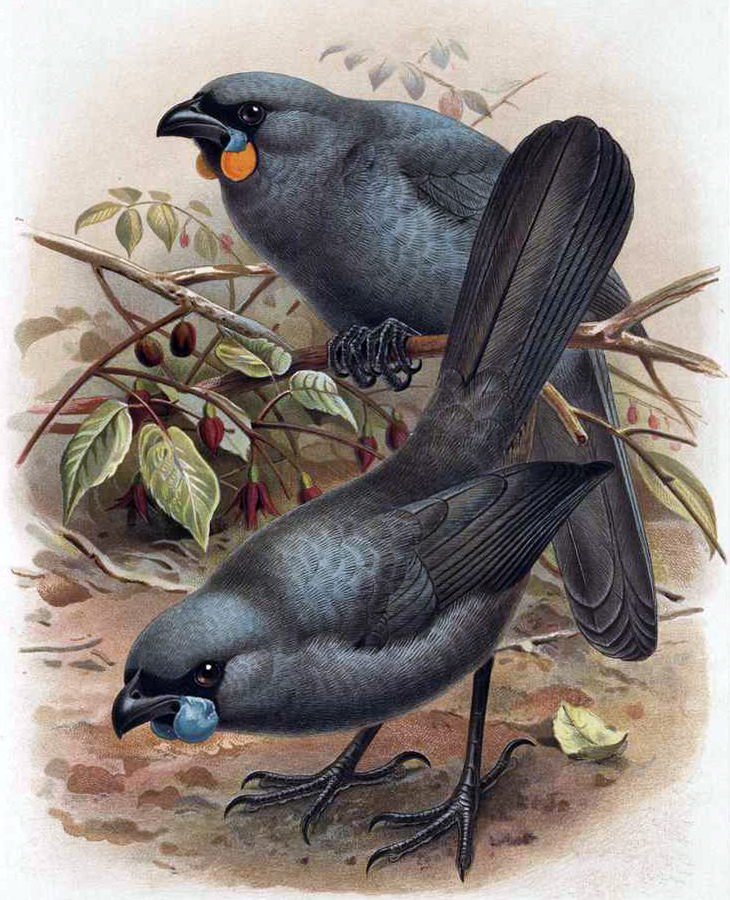
The South Island kokako is a medium-sized bird, approximately 38-45 centimeters in length, with a distinctive blue-grey plumage. The adults display a striking black facial mask and wattles, which are a vibrant blue, hanging below the corners of their beak. These wattles are a key identifying feature, aiding in differentiating them from the North Island kokako, which has orange wattles. Juvenile South Island kokakos may have slightly duller plumage and less pronounced wattles. Males and females appear similar, making it challenging to distinguish between the sexes in the field. However, males are typically slightly larger with a deeper call. In flight, the South Island kokako exhibits a silhouetted shape characterized by rounded wings and a long tail. Its perching posture is often upright, with a tendency to hop along branches rather than fly over long distances. This behavior, along with its coloration, makes it blend seamlessly into the forest canopy, contributing to its reputation as a difficult bird to spot. The South Island kokako is occasionally confused with the kokako of the North Island, but the difference in wattle color serves as a reliable distinguishing feature.
Having trouble telling birds apart? Upload a photo to our bird identification tool for an instant species match.
Callaeas kokakophilus Habitat and Range
Preferred Habitat
The South Island kokako inhabits temperate, old-growth forests of the South Island, typically at altitudes ranging from sea level to 1200 meters. These habitats include dense podocarp-broadleaf forests, which provide an abundance of food sources and nesting sites. The bird favors areas with a high density of tree ferns and epiphytes, which are indicative of a healthy forest environment. Seasonal habitat shifts for the Callaeas kokakophilus are minimal, as the bird is largely sedentary, relying on the same territory throughout the year. It is predominantly found in remote, undisturbed areas, although historical records suggest it once occupied a broader range, including more accessible lowland forests. The decline in suitable habitat due to deforestation and land conversion has led to a contraction of its range, making it a rare sight in urbanized or heavily modified landscapes. Conservation efforts focus on preserving and restoring its native forest habitat to prevent further decline.
Geographic Range
The South Island kokako's range is restricted to the South Island of New Zealand, with historical records indicating a distribution across much of the island, from the Marlborough Sounds in the north to Fiordland in the south. Presently, confirmed sightings are exceedingly rare, with most occurring in remote forested regions of Fiordland and the West Coast. There is no evidence of migratory behavior, as the South Island kokako is largely sedentary, relying on its established territory year-round. Population density hotspots are challenging to determine due to the scarcity of current sightings, but historical accounts suggest higher population densities in areas with extensive tracts of unbroken forest. The South Island kokako's presence in these regions underscores the importance of preserving large, contiguous forest areas to support its survival.
Want to know which birds visit your area? Browse our backyard birds by location guides for region-specific species lists.
What Does the Callaeas kokakophilus Eat?
The diet of the South Island kokako primarily consists of fruits, leaves, and insects. Seasonal variations in food availability influence its diet, with a preference for fruits and berries during the summer and autumn months. Common food sources include the berries of native plants such as miro, kahikatea, and coprosma. During the winter and spring, when fruits are less abundant, the South Island kokako shifts its diet to include more foliage and small invertebrates. Foraging techniques involve gleaning insects from the leaves and bark of trees, as well as plucking fruits from the canopy. The bird's robust bill is well-suited for handling a variety of food items, from soft berries to tougher leaves. Its feeding schedule is typically diurnal, with peak activity occurring in the early morning and late afternoon. The South Island kokako plays a crucial role in seed dispersal, assisting in the propagation of native plant species throughout its forest habitat.
Callaeas kokakophilus Behavior and Social Structure
The South Island kokako exhibits unique social and territorial behaviors. It is typically observed in monogamous pairs, maintaining lifelong bonds with its mate. Territoriality is a prominent aspect of its behavior, with pairs defending their territory vocally, often engaging in melodious duets. These vocal displays serve both to strengthen pair bonds and to assert territorial boundaries. During the breeding season, which occurs from September to February, courtship involves elaborate vocalizations and mutual preening. Unlike many other bird species, the South Island kokako does not form large flocks. It is generally solitary or found in pairs, although young birds may form small groups before establishing their own territories. In response to predators, the South Island kokako relies on its cryptic plumage and stealthy movements through the forest canopy to avoid detection. Its daily activity pattern involves alternating periods of foraging and resting, with vocalizations most pronounced during the dawn chorus when pairs engage in their iconic duets.
Callaeas kokakophilus Nesting and Reproduction
The nesting behavior of the South Island kokako involves constructing a large, cup-shaped nest made of twigs, leaves, and moss. Nests are typically situated high in the forest canopy, often in the forks of large trees such as rimu or kahikatea, providing safety from ground predators. The female primarily undertakes nest building, though the male may assist by gathering materials. The typical clutch size ranges from two to three eggs, which are pale blue with brown speckles. The incubation period lasts approximately 18-21 days, with the female responsible for incubating the eggs while the male provides food. After hatching, both parents contribute to feeding the chicks, which fledge at about 30 days old. The South Island kokako typically raises one brood per year, though in favorable conditions, a second brood may be attempted. Parental care is extended, with fledglings remaining with their parents for several months, learning essential survival skills before establishing their own territories.
Callaeas kokakophilus Sounds and Vocalizations
The South Island kokako is renowned for its ethereal, flute-like song. The primary song consists of a series of slow, melodious notes with a characteristic rising and falling pitch, often described as haunting and beautiful. These songs are delivered in a duet by pairs, with each bird contributing alternate notes to create a harmonious melody. Call notes are softer and more conversational, used for communication between mates. Alarm calls are sharp and abrupt, serving to alert conspecifics of potential threats. During the dawn chorus, the South Island kokako's song is particularly prominent, resonating through the forest and establishing territorial presence. Compared to other birds, the kokako's song is unique, with a quality reminiscent of a human whistle or a distant flute.
Interesting Facts About the Callaeas kokakophilus
- 1The South Island kokako was declared extinct in 2007, but occasional unverified reports keep hope alive for its rediscovery.
- 2The kokako's wattles are not just ornamental; they aid in thermoregulation by dissipating excess heat.
- 3Despite being poor fliers, kokakos are known for their agility in navigating dense forest canopies.
- 4Maori legend refers to the kokako as a 'guardian of the forest,' revered for its enchanting song.
- 5The kokako's song can be heard up to a kilometer away, thanks to its unique resonance.
- 6The South Island kokako's DNA is closely studied to understand its evolutionary divergence from the North Island species.
- 7Efforts to preserve the kokako's habitat also benefit a wide range of other endemic species in New Zealand.
Callaeas kokakophilus Conservation Status
The South Island kokako is currently listed as Critically Endangered on the IUCN Red List. Its population trend is declining, primarily due to habitat loss, predation by introduced mammals such as rats and stoats, and competition for food resources. Conservation efforts focus on habitat restoration, predator control, and raising public awareness about the species' plight. Historical records suggest that the South Island kokako once thrived throughout much of the South Island, but extensive deforestation and the introduction of invasive species have significantly reduced its numbers. Ongoing conservation initiatives aim to reestablish viable populations by protecting remaining suitable habitats and potentially undertaking reintroduction programs if captive breeding becomes feasible.