
Huia
Heteralocha acutirostris
Order: Passeriformes / Family: Callaeatidae
Wikimedia Commons
About the Huia
The Huia, scientifically known as Heteralocha acutirostris, was a unique bird native to New Zealand. It belonged to the family Callaeatidae within the order Passeriformes. The Huia was especially significant not only due to its striking sexual dimorphism but also its cultural importance to the Māori people. This bird was primarily found in the dense, temperate forests of the North Island, particularly in areas like the Tararua and Ruahine Ranges. The species played a vital ecological role as both a predator and a seed disperser, contributing to the forest ecosystem's overall health. The Huia's diet consisted largely of invertebrates, which it extracted from the bark and wood of trees, aiding in pest control. Its unique feeding method facilitated the spread of seeds and nutrient cycling within its habitat. Seasonally, the Huia exhibited some movement within these forested regions, possibly in response to food availability and breeding requirements. These movements ensured that it utilized the resources of its environment efficiently throughout the year. The bird's cultural significance to the Māori was profound, with its feathers being regarded as symbols of rank and prestige. The loss of the Huia around the early 20th century was not only an ecological tragedy but also a cultural one. Efforts to understand and possibly restore aspects of its lost habitat continue, but the Huia stands as a poignant reminder of the fragile balance between nature and human activity.
The Huia belongs to the family Callaeatidae, within the order Passeriformes. These birds typically live not well documented; estimated around 10 years..
How to Identify a Huia
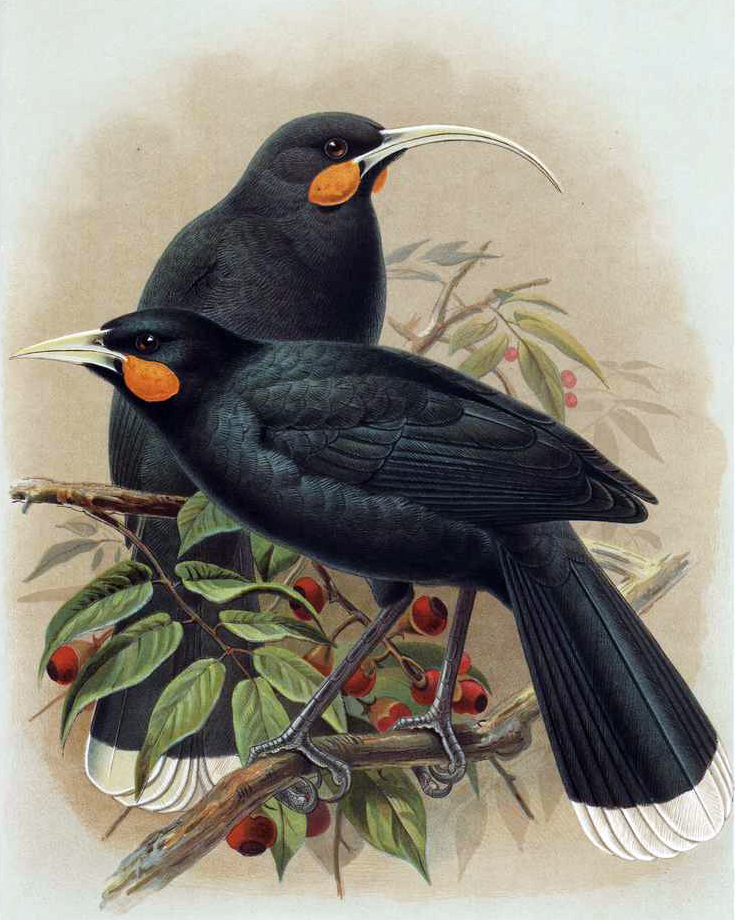
The Huia's most distinctive feature was its beak, which varied significantly between males and females, a rare trait among birds. Males had shorter, more robust beaks suitable for chiseling wood, while females possessed long, curved beaks ideal for probing deeply into crevices. This dimorphism enabled the Huia pair to exploit different feeding niches, reducing competition between them. In terms of plumage, both sexes displayed predominantly black feathers with a greenish sheen, accented by a striking white-tipped tail. Juveniles resembled adults but had less pronounced sheens and slightly duller plumage. No other bird within its habitat shared this combination of features, making the Huia unmistakable when observed in its native environment. In flight, the Huia possessed a strong, undulating pattern, characteristic of many passerines, and perched with a confident, upright posture.
Having trouble telling birds apart? Upload a photo to our bird identification tool for an instant species match.
Huia Habitat and Range
Preferred Habitat
The Huia inhabited the dense, temperate rainforests of New Zealand's North Island, thriving in areas rich with large, mature trees such as podocarps and beech. These forests provided the necessary resources and microhabitats for the Huia's specialized feeding habits and nesting requirements. The bird favored elevations ranging from lowland forests up to 1,200 meters, with a preference for remote, undisturbed areas. Seasonal shifts saw the Huia moving slightly in response to food availability, but it predominantly remained within forested regions. Unlike some other birds, the Huia showed negligible adaptation to urban environments, relying instead on the integrity of its natural woodland home.
Geographic Range
Historically, the Huia was confined to the North Island of New Zealand, with its distribution closely linked to the availability of mature, unspoiled forest habitats. While not migratory, the species did exhibit some local movement patterns, likely driven by food sources and breeding activities. Within the North Island, the Huia was once a common sight in the Tararua and Ruahine Ranges, as well as in the forests surrounding the Manawatu Gorge. However, by the late 19th and early 20th centuries, its range had dramatically reduced due to habitat destruction and hunting pressures. These pressures led to localized extinctions, leaving only fragmented populations in isolated forest patches before the species ultimately disappeared.
Want to know which birds visit your area? Browse our backyard birds by location guides for region-specific species lists.
What Does the Huia Eat?
The Huia's diet primarily consisted of invertebrates, particularly beetle larvae, which it extracted from tree bark and wood using its specialized beak. Males and females would often work in tandem, with males chiseling into wood to expose larvae, while females used their long beaks to probe into deeper crevices. This cooperative feeding strategy reduced competition and allowed the Huia pair to efficiently exploit various food sources. Seasonally, the diet might have expanded to include other invertebrates such as caterpillars and spiders, while occasionally consuming fruits and seeds when insect prey was scarce. The Huia foraged throughout the day, with peak activity during the early morning and late afternoon.
Huia Behavior and Social Structure
The Huia exhibited a fascinating social structure, often observed in pairs or small family groups rather than large flocks. Its territorial behavior was pronounced, with pairs defending their feeding and nesting areas vigorously against intruders. Courtship displays involved mutual preening and the exchange of food items, strengthening pair bonds. The Huia's vocalizations played a role in territorial defense and mate attraction, though little is known about the specifics of these calls. The bird's response to predators involved alarm calls and coordinated evasive actions, often retreating to dense foliage for cover. Daily activity patterns included periods of intense foraging interspersed with rest and social interactions, primarily during the daylight hours.
Huia Nesting and Reproduction
Huia pairs nested in tree cavities, often choosing large, mature trees that provided both protection and proximity to food sources. The nest itself was constructed from twigs, leaves, and moss, forming a well-insulated structure. Clutch sizes typically ranged from two to four eggs, with both parents sharing incubation duties. The incubation period lasted approximately 14 to 16 days, after which the altricial chicks hatched. Both parents participated in feeding and caring for the young, which fledged after about 20 to 25 days. The number of broods per year likely depended on food availability, with most pairs raising one successful brood annually.
Huia Sounds and Vocalizations
The Huia's vocalizations were noted for their melodious and varied nature, featuring a range of whistles and flute-like notes. These calls played a crucial role in communication between mates and in maintaining territorial boundaries. Alarm calls consisted of sharp, repetitive notes that alerted other Huias to potential danger. During the dawn chorus, the Huia's song added a rich layer to the forest soundscape, blending with the songs of other native birds. Although precise recordings of the Huia's calls do not exist, historical accounts describe them as both hauntingly beautiful and complex.
Interesting Facts About the Huia
- 1The Huia's beak dimorphism is one of the most pronounced among birds, with females having beaks up to 50% longer than males.
- 2A single Huia tail feather was so valued it could be exchanged for a canoe or a large amount of land among the Māori.
- 3The last confirmed sighting of the Huia occurred in 1907, and it was officially declared extinct shortly thereafter.
- 4The Huia's name is thought to mimic the sound of its call, reflecting the bird's prominence in Māori culture and language.
- 5The Huia's extinction is often cited as one of the pivotal events leading to the establishment of modern conservation in New Zealand.
- 6In Māori mythology, the Huia was considered a sacred bird, and its feathers were worn by chiefs as a mark of status.
- 7Despite being extinct, the Huia remains a symbol of New Zealand's unique biodiversity and the importance of conservation.
Huia Conservation Status
The Huia is now classified as extinct by the IUCN, with the last confirmed sighting reported in 1907. The primary threats leading to its extinction included habitat destruction due to logging and land conversion, as well as hunting pressures. Huias were highly prized for their feathers and as scientific specimens, which accelerated their decline. Conservation efforts at the time were insufficient to halt this loss, but the Huia's extinction has since served as a catalyst for more robust conservation measures for other threatened species in New Zealand. Current efforts focus on habitat restoration and protection for remaining native bird species.
Other Callaeatidae Species

Birds Similar to the Huia
These species are often confused with the Huia due to similar appearance or overlapping range.