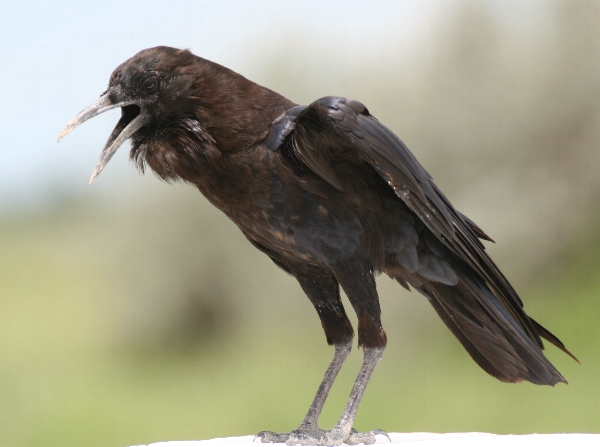
Carrion Crow
Corvus corone
Order: Passeriformes / Family: Corvidae

Wikimedia Commons
About the Carrion Crow
The Carrion Crow, Corvus corone, stands as a testament to avian intelligence and adaptability. This medium-sized passerine is a prevalent member of the Corvidae family, found throughout much of Europe and eastern Asia. With a reputation for cunning and resourcefulness, the Carrion Crow plays a prominent role in the ecosystems it inhabits by controlling pest populations and aiding in the decomposition process. The bird's unassuming black plumage belies its complex social behaviors and problem-solving capabilities, which have been the focus of numerous scientific studies.
Carrion Crows thrive in diverse environments, ranging from rural countryside to bustling urban centers. They are highly adaptable, capable of exploiting a wide array of food sources and nesting sites. Their presence is especially notable in the United Kingdom, Germany, and across the Russian plains, where they are a familiar sight perched on lamp posts or foraging in fields. The species shows some regional variation, with the eastern populations sometimes interbreeding with the Hooded Crow (Corvus cornix), forming zones of hybridization.
Ecologically, Carrion Crows serve as both predators and scavengers. Their diet includes insects, small mammals, seeds, and carrion, which helps maintain the balance in their ecosystems. In urban areas, they are known to raid garbage bins and scavenge roadkill, showcasing their adaptability and opportunistic nature. Seasonally, these birds may alter their diet depending on availability, shifting to more plant-based sources in winter when animal prey is scarce.
The Carrion Crow's role in folklore and human culture is significant. Often associated with death due to their black plumage and scavenging habits, they have been both revered and feared in various cultures. Despite such associations, conservationists now recognize them as vital components of their environments, contributing to nutrient cycling and habitat health. Their intelligence and ability to learn from human activities ensure their continued presence across their range, making them a fascinating subject for both ornithologists and casual birdwatchers.
The Carrion Crow belongs to the family Corvidae, within the order Passeriformes. These birds typically live typically 10-15 years, with a maximum recorded of 20 years..
How to Identify a Carrion Crow
Identifying the Carrion Crow is straightforward due to its distinctive all-black plumage. Adult Carrion Crows exhibit glossy black feathers with a slight green or purple sheen when viewed in direct sunlight. Unlike some other corvids, they lack any contrasting plumage colors, which helps distinguish them from the Hooded Crow in areas where their ranges overlap. Juveniles resemble adults but have slightly duller plumage and brownish tinges in their feathers, which they lose as they mature.
Males and females of the species are similar in appearance, making sex differentiation challenging in the field. Both sexes share the same size, typically measuring around 44 to 51 cm in length, with a wingspan ranging from 84 to 100 cm. Their stout, black bills and solid black legs further aid in identification.
In flight, the Carrion Crow displays a broad, rounded wing shape and a fan-shaped tail. Their flight is characterized by steady, strong wingbeats and gliding interspersed with flaps, which helps distinguish them from the similar-sized Rook (Corvus frugilegus), which has more pointed wings and an angular flight pattern. When perched, the Carrion Crow's upright posture and watchful demeanor make it a prominent and often solitary figure on tree branches or urban structures.
Having trouble telling birds apart? Upload a photo to our bird identification tool for an instant species match.
Carrion Crow Habitat and Range
Preferred Habitat
Carrion Crows inhabit a broad range of habitats, showcasing their adaptability. They are found in woodlands, farmlands, grasslands, and urban areas. In rural regions, they frequent fields and hedgerows, often observed foraging on the ground. They thrive at various elevations, from sea level in coastal areas to mountainous regions up to 2000 meters. In urban environments, they have adapted to exploit resources such as garbage and roadkill, making them common in cities like London, Berlin, and Tokyo.
Seasonal habitat shifts are minimal for the Carrion Crow, as they are largely sedentary. However, they may move short distances to access more abundant food supplies during harsh winters. Their ability to inhabit both highly developed urban areas and isolated rural landscapes speaks to their versatile nature. Unlike some species that retreat from human presence, Carrion Crows are often found in proximity to human populations, taking advantage of the opportunities provided by urban ecosystems.
Geographic Range
The Carrion Crow's range spans much of Europe and extends into eastern Asia. They are prevalent throughout the British Isles, where they are one of the most common crow species. Their distribution covers mainland Europe, including countries like France, Germany, and Italy, extending eastward into parts of Russia, China, and Japan. The bird's breeding range generally coincides with its overall distribution, as they are year-round residents across much of their range.
While Carrion Crows do not engage in long-distance migrations, they exhibit some nomadic behavior, particularly in the eastern parts of their range where they may interbreed with the Hooded Crow. In these hybrid zones, found in regions such as eastern Europe and western Russia, the two species produce mixed offspring, which are identifiable by their intermediate plumage. While their population density is generally higher in urban and agricultural areas due to abundant food sources, they are also frequent in more remote landscapes, highlighting their adaptability and resilience across a variety of environments.
Want to know which birds visit your area? Browse our backyard birds by location guides for region-specific species lists.
What Does the Carrion Crow Eat?
The diet of the Carrion Crow is notably diverse and opportunistic. Primarily omnivorous, they consume a wide array of food sources depending on seasonal availability. In warmer months, they feed on insects, earthworms, and small mammals such as rodents, which they often hunt with surprising dexterity. They also consume eggs and nestlings of other bird species, showcasing their predatory skills.
As winter sets in and animal prey becomes scarce, Carrion Crows shift their diet towards plant-based foods, including seeds, nuts, and berries. They are known to visit agricultural fields to forage on grains and other crops. In urban settings, these crows exhibit remarkable adaptability by scavenging from garbage bins and feeding on roadkill, demonstrating their ability to exploit human-altered environments.
Foraging techniques vary, with Carrion Crows often seen walking methodically across fields or lawns in search of invertebrates. They exhibit problem-solving abilities, such as dropping hard-shelled nuts onto roads to crack them open using passing vehicles. Their feeding schedule is flexible, allowing them to take advantage of food sources throughout the day, although they typically forage more intensively during the early morning and late afternoon.
Carrion Crow Behavior and Social Structure
Carrion Crows exhibit a complex array of behaviors that reflect their intelligence and adaptability. They are generally solitary or found in pairs, but can form small groups, especially in winter when food is scarce. Their social structure is fluid, with loose family groups sometimes observed during breeding season.
Territorial behavior is pronounced during the breeding season, with pairs defending their nesting areas aggressively against intruders. Courtship displays involve mutual preening and vocalizations, strengthening pair bonds. These crows are known for their problem-solving abilities, using tools and developing techniques to access hard-to-reach food.
In response to predators, Carrion Crows exhibit mobbing behavior, banding together to harass larger birds of prey such as hawks and owls. They maintain a vigilant watch, often perching in high locations to scan for potential threats. Their daily activity patterns are diurnal, with peak activity occurring in the early morning and late afternoon, although they may remain active throughout the day, especially in urban environments where food sources are plentiful.
Carrion Crow Nesting and Reproduction
Carrion Crows construct nests that reflect their resourceful nature. Nests are typically built in tall trees, though they can also be found on cliffs or tall buildings in urban areas. The nests are composed of twigs and branches, lined with softer materials such as grass, moss, and hair, providing a comfortable environment for the eggs and chicks.
The typical clutch size ranges from 3 to 5 eggs, with incubation lasting about 17 to 19 days. Females primarily handle incubation duties, while males assist with feeding and defending the nest. Once hatched, the chicks remain in the nest for approximately 28 to 35 days, during which both parents diligently feed and care for them.
Carrion Crows usually raise one brood per year, although in favorable conditions, they may attempt a second. Parental care extends beyond fledging, with young birds often remaining with their parents for several months, learning vital survival skills.
Carrion Crow Sounds and Vocalizations
The Carrion Crow's vocalizations are diverse, with their primary song being a series of harsh caws and croaks, varying in pitch and intensity. These calls serve multiple purposes, including communication between mates and signaling alarm.
Alarm calls are sharper and more rapid, often used to warn other crows of predators. Their vocal repertoire also includes softer, more conversational sounds used in close contact with family members. During the dawn chorus, Carrion Crows contribute their distinctive caws, adding to the natural soundscape.
Compared to other corvids, their calls are less musical but carry a distinct rhythm and cadence that is easily recognizable to those familiar with the species. Their vocalizations play a crucial role in maintaining social bonds and coordinating group activities.
Interesting Facts About the Carrion Crow
- 1Carrion Crows can recognize individual human faces and remember those who pose a threat, showcasing their cognitive abilities.
- 2In mixed-species hybrid zones, Carrion Crows and Hooded Crows interbreed, producing offspring with intermediate plumage.
- 3Some Carrion Crows have been observed using tools, such as using sticks to extract insects from crevices, demonstrating their problem-solving skills.
- 4Carrion Crows often participate in mobbing behavior, collectively harassing larger predators like hawks to drive them away.
- 5These crows have adapted well to urban environments, often using traffic to crack open nuts, illustrating their innovative foraging strategies.
- 6Carrion Crows are known to cache food, hiding surplus in various locations to retrieve later, a behavior that aids in survival during scarce times.
- 7The Carrion Crow's vocal range includes over 20 distinct calls, each serving specific functions in communication and social interaction.
Carrion Crow Conservation Status
The Carrion Crow is currently listed as a species of Least Concern by the IUCN, indicating a stable population trend. This status reflects their adaptability to a wide range of environments and their ability to thrive even in heavily urbanized areas. However, like many species, they face threats from habitat destruction and pollution. Conservation efforts focus on maintaining healthy ecosystems where Carrion Crows can continue to fulfill their ecological roles. In some regions, they are protected under national wildlife laws, which help safeguard their habitats and ensure their continued presence. Historically, Carrion Crow populations have fluctuated, often influenced by human activities. However, their resilience and adaptability have allowed them to recover and expand their range in many areas, highlighting the importance of preserving diverse habitats for future generations.
Other Corvidae Species


Birds Similar to the Carrion Crow
These species are often confused with the Carrion Crow due to similar appearance or overlapping range.