
Cape Crow
Corvus capensis
Order: Passeriformes / Family: Corvidae
Wikimedia Commons
About the Cape Crow
The Cape Crow, scientifically known as Corvus capensis, is a medium-sized member of the Corvidae family notable for its glossy black plumage and relatively long tail. Found predominantly across the open grasslands and savannas of sub-Saharan Africa, this bird is particularly prevalent in countries such as South Africa, Botswana, and Namibia. The ecological significance of the Cape Crow lies in its role as both a predator and scavenger, helping to control insect populations and aiding in the decomposition process by consuming carrion. Its adaptability allows it to thrive in a variety of environments, from rural farmlands to urban settings, showcasing its versatility and resilience. During the breeding season, which varies with geography, the Cape Crow's behavior shifts noticeably, with pairs becoming more territorial. These birds are also known for their intelligence and problem-solving abilities, often observed using tools to access food or interacting with other species in complex social scenarios. Their presence across diverse habitats highlights their ecological importance, contributing to seed dispersal and nutrient cycling.
The Cape Crow belongs to the family Corvidae, within the order Passeriformes. These birds typically live typically 10-12 years, with a maximum recorded of 15 years..
How to Identify a Cape Crow
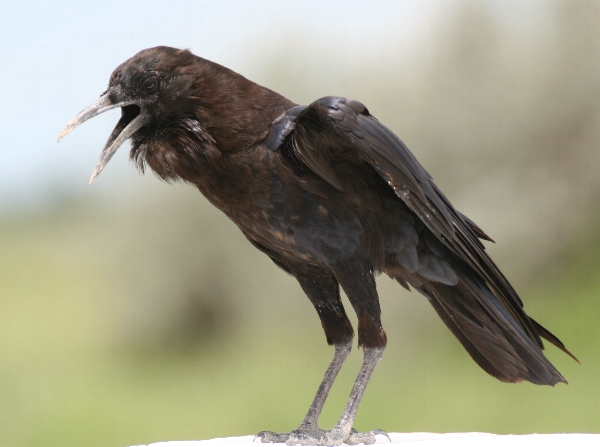
Adult Cape Crows exhibit a uniform glossy black plumage, with a distinctive long tail that sets them apart from other crow species. They possess a stout bill and powerful legs, which aid in their omnivorous diet. Juveniles are similar in appearance but may display a slightly duller sheen and softer feathers. There is little sexual dimorphism, meaning males and females look alike, which can make field identification challenging without observing size differences. The Cape Crow's flight is characterized by slow, deliberate wingbeats and a pronounced flapping pattern, making its silhouette easy to distinguish against the sky. When perched, they often assume an upright posture, showcasing their long tails and alert demeanor. In the field, they may be confused with the similar-looking Pied Crow, but the latter has a distinct white chest and neck. Observing the long tail and uniform black coloring is key to correctly identifying the Cape Crow.
Having trouble telling birds apart? Upload a photo to our bird identification tool for an instant species match.
Cape Crow Habitat and Range
Preferred Habitat
The Cape Crow inhabits open grasslands, savannas, and agricultural areas, often at elevations from sea level to 2,500 meters. They are adaptable and can also be found in urban environments, where they exploit human resources. Seasonal habitat shifts are minimal as these birds are generally non-migratory, though local movements occur in response to food availability. Despite their adaptability, they prefer areas with open landscapes that offer ample foraging opportunities.
Geographic Range
The Cape Crow's range spans the southern half of Africa, with established populations in South Africa, Namibia, Botswana, Zimbabwe, and Angola. It is a non-migratory species, maintaining a consistent presence in these regions throughout the year. Population densities are highest in open grasslands and agricultural areas, where food resources are abundant. The bird's range does not extend into the northern parts of Africa, primarily due to differences in habitat preferences and climate.
Want to know which birds visit your area? Browse our backyard birds by location guides for region-specific species lists.
What Does the Cape Crow Eat?
The Cape Crow has an omnivorous diet, primarily feeding on insects, small mammals, seeds, and fruits. Seasonal changes influence its diet, with insects being more prevalent during the wet season. These crows are opportunistic feeders, often seen foraging on the ground where they use their strong bills to dig for insects or turn over rocks. They also exhibit scavenging behavior, consuming carrion and food waste in urban areas. Their feeding schedule is diurnal, with peak activity occurring in the early morning and late afternoon.
Cape Crow Behavior and Social Structure
Cape Crows are social birds, often seen in pairs or small family groups. They exhibit strong territorial behavior during the breeding season, with pairs defending their nesting sites vigorously. Courtship displays include complex vocalizations and aerial maneuvers. Outside the breeding season, these crows may form larger flocks, especially around abundant food sources. They are diurnal, with peak activity during morning and late afternoon. In response to predators, Cape Crows are known for their loud alarm calls and mobbing behavior, where groups of crows harass intruders to protect their territory.
Cape Crow Nesting and Reproduction
Cape Crows construct large, cup-shaped nests using twigs and lined with softer materials such as grass and feathers. Nests are typically located high in trees or on power pylons, providing a vantage point and protection from ground predators. The typical clutch size ranges from 3 to 5 eggs, with an incubation period of about 18 to 20 days. Both parents participate in feeding the chicks, which fledge approximately 30 days after hatching. Cape Crows generally raise one brood per year, although in some regions, two broods may occur if conditions are favorable.
Cape Crow Sounds and Vocalizations
The Cape Crow's primary song consists of a series of harsh, croaking caws, often delivered from a perch. These calls serve to establish territory and communicate with mates or flock members. Alarm calls are distinct, rapid, and repetitive, used to alert others of potential threats. During the dawn chorus, Cape Crows are active vocalizers, contributing to the morning symphony with their loud and resonant calls. Their vocal range is less varied than some other corvids, focusing more on volume and repetition.
Interesting Facts About the Cape Crow
- 1The Cape Crow can use tools, a trait that highlights their intelligence and problem-solving abilities.
- 2In South Africa, Cape Crows have been observed using passing cars to crack open nuts.
- 3These crows have a wingspan of approximately 85 cm, aiding in their efficient flight over open landscapes.
- 4Cape Crows often engage in playful behavior, including aerial acrobatics and object manipulation.
- 5The crow's long tail not only aids in flight but also serves as a balance when foraging on the ground.
- 6Cape Crows can recognize individual human faces and remember them for years.
- 7Despite their intelligence, Cape Crows have a relatively short lifespan in the wild, averaging 15 years.
Cape Crow Conservation Status
Currently, the Cape Crow is listed as Least Concern by the IUCN, with a stable population trend. However, habitat destruction and pesticide use pose potential threats. Conservation efforts focus on habitat preservation and promoting sustainable agricultural practices. Historically, the population has remained stable due to the bird's adaptability and resilience in various environments.
Other Corvidae Species


Birds Similar to the Cape Crow
These species are often confused with the Cape Crow due to similar appearance or overlapping range.
