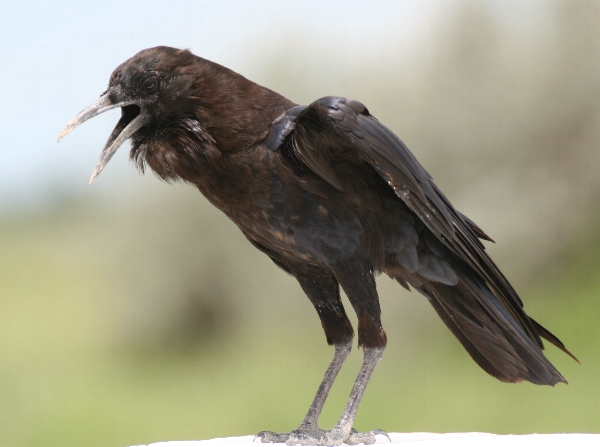
Corvus calvus
Corvus calvus
Order: Passeriformes / Family: Corvidae
About the Corvus calvus
The Corvus calvus, commonly known as the Asian pied crow, is a member of the Corvidae family and is renowned for its striking appearance and intelligence. This bird inhabits a variety of landscapes across the Indian subcontinent, Southeast Asia, and parts of Southeast Asia, thriving in both forests and urban areas. The Asian pied crow plays a critical role in its ecosystem as a scavenger, helping to keep environments clean by consuming a wide range of organic waste and carrion. Its presence in urban settings highlights its adaptability and resourcefulness, often seen mingling with other corvid species and avian fauna. This crow is primarily a resident species, although some populations may exhibit local movements in response to food availability or environmental conditions. Throughout the year, the Corvus calvus engages in a variety of behaviors that underscore its intelligence. It has been observed using tools to access food, a trait shared with few other bird species. Additionally, the bird has a complex social structure, often forming loose flocks that can be seen foraging together. Breeding season varies across its range but generally occurs during the warmer months, with pairs exhibiting strong territoriality during this time. The Corvus calvus also contributes significantly to seed dispersal, as it often feeds on fruits and inadvertently aids in their propagation across its habitat. This bird's adaptability to different environments makes it an important species for studies on avian ecology and behavior. Despite its broad range, the Asian pied crow faces challenges from habitat loss and urbanization, which threaten its natural habitats. Conservation efforts are crucial to ensure the continued survival of this ecologically significant species.
The Corvus calvus belongs to the family Corvidae, within the order Passeriformes. These birds typically live typically 10-15 years, with a maximum recorded of 20 years..
How to Identify a Corvus calvus
The Asian pied crow, Corvus calvus, is easily recognizable due to its glossy black plumage and contrasting white areas on its wings and belly. One of its most distinctive features is its bare, pale skin on the head, which gives it a unique appearance among corvids. The adult crow typically measures 50 to 55 centimeters in length, with a wingspan ranging from 85 to 100 centimeters. Males and females appear similar, although males may be slightly larger. Juveniles resemble adults but have a duller plumage and less pronounced head skin. In flight, the Asian pied crow's silhouette is characterized by broad wings and a moderately long tail, making it easy to spot against the sky. Its perching posture is upright, often seen surveying its surroundings from a high vantage point. While similar in size to the house crow (Corvus splendens), the Asian pied crow's bald head and more extensive white markings help distinguish it. Observers should note the crow's loud, harsh calls, which can aid in identification even when the bird is not visible.
Having trouble telling birds apart? Upload a photo to our bird identification tool for an instant species match.
Corvus calvus Habitat and Range
Preferred Habitat
The Corvus calvus thrives in a variety of habitats, including deciduous and evergreen forests, agricultural lands, and urban areas. It is commonly found in the lowlands but can also inhabit montane regions up to 2,000 meters in elevation. This crow shows a remarkable ability to adapt to human-altered environments, often seen in cities and towns where it exploits available food resources. During the breeding season, the Asian pied crow shows a preference for nesting in taller trees, often near water sources. Its adaptability to different habitats allows it to maintain stable populations even in the face of habitat changes. In rural settings, the crow can often be observed foraging in fields and along roadsides, taking advantage of the open spaces and diverse food availability.
Geographic Range
The Asian pied crow, Corvus calvus, has a wide range across the Indian subcontinent, extending into southern China and Southeast Asia, including countries like Thailand, Myanmar, and Vietnam. It is a resident species in most of its range, though some populations may engage in short-distance movements in search of food or suitable breeding sites. The highest population densities occur in fertile agricultural regions and urban centers where food sources are abundant. In contrast, its presence is less pronounced in densely forested areas, where it competes with other corvid species. The crow's adaptability allows it to thrive in both rural and urban settings, often overlapping with the distribution of other crow species.
Want to know which birds visit your area? Browse our backyard birds by location guides for region-specific species lists.
What Does the Corvus calvus Eat?
The Corvus calvus is an omnivore, with a diet that varies depending on the availability of food sources. Its primary diet consists of insects, small mammals, and carrion. The crow is also known to consume fruits, seeds, and human refuse, especially in urban areas. During the breeding season, it may increase its intake of protein-rich food to support the development of its young. Foraging occurs throughout the day, with peaks in activity during the early morning and late afternoon. The crow often uses its strong bill to dig into the ground or turn over debris in search of food. It exhibits opportunistic feeding behavior, taking advantage of whatever food sources are available in its environment. In agricultural areas, it may also feed on grains and small vertebrates, sometimes leading to conflicts with farmers.
Corvus calvus Behavior and Social Structure
The Asian pied crow displays a range of complex social behaviors, often seen in small groups or loose flocks. It is a highly intelligent bird, capable of problem-solving and using tools to access food. Territorial during the breeding season, pairs defend their nesting sites vigorously, often chasing away intruders. Courtship involves a series of displays, including vocalizations and mutual preening. Outside the breeding season, the crow is more social, forming larger flocks that forage together. In response to predators, the crow may engage in mobbing behavior, where multiple individuals harass the threat to drive it away. Its daily activity patterns involve alternating periods of foraging and resting, with peak activity during the cooler parts of the day.
Corvus calvus Nesting and Reproduction
The nesting habits of the Corvus calvus involve constructing large stick nests in tall trees, often near water. Nests are built by both members of a pair and lined with softer materials like grass and feathers. Clutch size typically ranges from 3 to 5 eggs, which are pale green with brown markings. Incubation lasts about 18 to 21 days, primarily by the female, with the male providing food. After hatching, both parents feed the chicks, which fledge approximately 30 to 35 days after hatching. The Asian pied crow may raise one or two broods per year, depending on environmental conditions and food availability. Parental investment is high, with both sexes involved in feeding and protecting the young.
Corvus calvus Sounds and Vocalizations
The vocalizations of the Asian pied crow are varied and include a range of harsh caws and croaks. Its primary song consists of a series of repeated caws, with each note lasting about a second. The pitch is generally low, and the quality is rough, making it a distinctive sound in its environment. Alarm calls are sharper and more urgent, used to alert others to potential threats. During the dawn chorus, the crow's calls are more frequent, serving both territorial and social functions. Compared to other crow species, the Asian pied crow's calls are louder and more resonant, aiding in communication across long distances.
Interesting Facts About the Corvus calvus
- 1The Asian pied crow can use sticks and other objects as tools to access food, demonstrating high levels of intelligence.
- 2This crow species is known for its adaptability, thriving in urban environments where other birds may struggle.
- 3The Corvus calvus has a unique bald patch on its head, setting it apart from other members of the Corvidae family.
- 4Observations indicate that the Asian pied crow can mimic sounds from its environment, including human-made noises.
- 5In some cultures, the Asian pied crow is considered a symbol of adaptability and intelligence, often featured in folklore.
Corvus calvus Conservation Status
The IUCN currently lists the Corvus calvus as a species of Least Concern, with stable population trends across most of its range. Despite its adaptability, the crow faces threats from habitat loss due to urbanization and agricultural expansion. Conservation efforts focus on preserving natural habitats and mitigating human-wildlife conflict, particularly in regions where the crow's foraging habits may impact agriculture. Historical population changes have been minimal, but ongoing monitoring is essential to ensure that the species remains secure in the face of environmental changes.
Other Corvidae Species


Birds Similar to the Corvus calvus
These species are often confused with the Corvus calvus due to similar appearance or overlapping range.