
Chaplin's Barbet
Lybius chaplini
Order: Piciformes / Family: Lybiidae

Wikimedia Commons
About the Chaplin's Barbet
The Chaplin's Barbet (Lybius chaplini) holds a unique place in ornithology as Zambia's only endemic bird species. Named after Sir Francis Drummond Chaplin, this bird is revered not just for its rarity but also for its striking plumage and distinctive calls. Ecologically, Chaplin's Barbet plays a vital role in its native savanna ecosystems. Its presence indicates healthy, mature woodlands, as it relies on such habitats for both feeding and nesting. The bird predominantly occupies the Kafue Basin and the surrounding regions in south-central Zambia. Here, it is found in open woodlands dominated by fig trees, which provide both food and nesting sites. The barbet's preference for fig trees makes it a crucial seed disperser, aiding in the propagation of these vital trees across the landscape. During the dry season, when food resources are limited, the Chaplin's Barbet exhibits a fascinating behavioral shift, becoming more nomadic and forming small flocks to find food. However, during the breeding season, which coincides with the rainy season from November to March, these birds become highly territorial. They engage in elaborate courtship displays and defend their nesting sites vigorously. This seasonal behavior ensures that their young have access to abundant food resources, which are crucial for successful rearing. Despite its restricted range, the Chaplin's Barbet is a species of significant ecological value. Its role in seed dispersal supports a wide array of plant and animal life, maintaining the health and diversity of the ecosystems it inhabits.
The Chaplin's Barbet belongs to the family Lybiidae, within the order Piciformes. These birds typically live average 5-8 years with a maximum recorded of 10 years..
How to Identify a Chaplin's Barbet
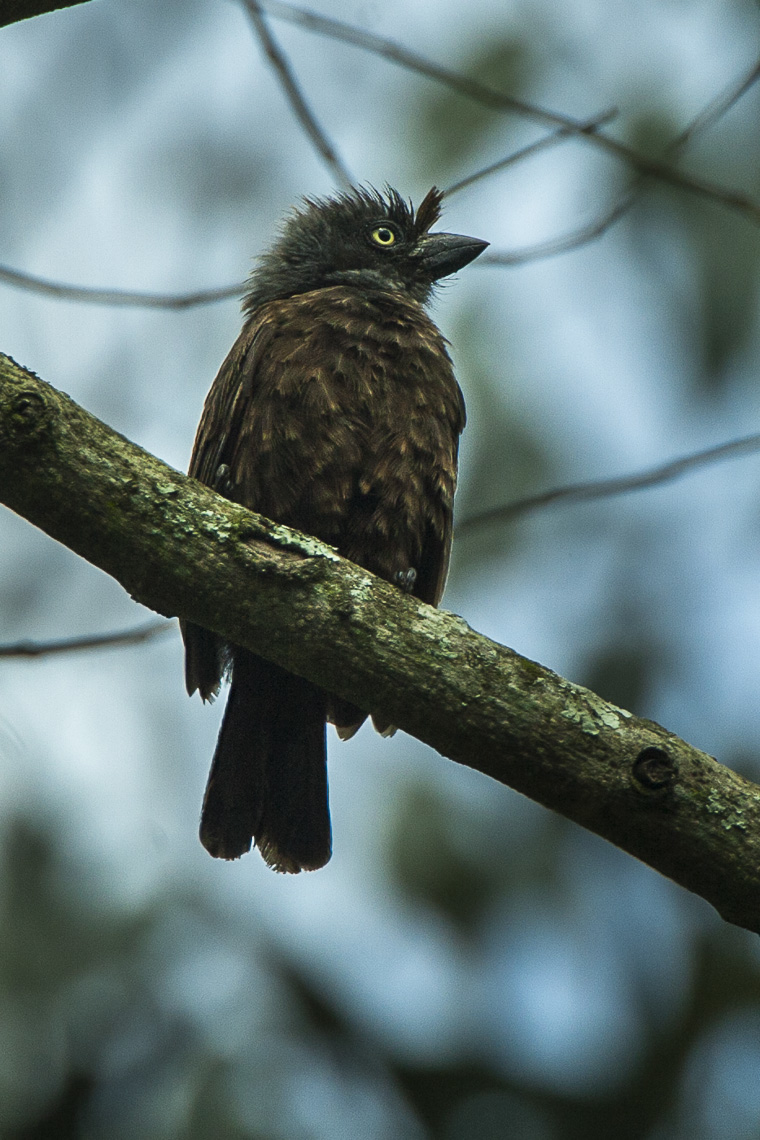
The Chaplin's Barbet is immediately recognizable by its distinctive black and white plumage. Adult birds display a predominantly white head and underparts, contrasted sharply by a glossy black back and wings. Around the face, a notable black mask extends over the eyes, giving the bird an unmistakable appearance. Juvenile barbets exhibit a duller version of this plumage, with more muted tones of black and white, lacking the striking contrast seen in adults. Unlike many bird species, there is little sexual dimorphism in Chaplin's Barbets; males and females look alike, both possessing the characteristic coloration. In terms of size, the Chaplin's Barbet reaches about 20 centimeters in length, making it a medium-sized barbet. Its stout bill is adapted for its frugivorous diet, particularly well-suited to consuming figs. In flight, the bird presents a distinctive silhouette with its broad wings and short tail. When perching, the Chaplin's Barbet often adopts an upright stance, accentuating its robust build. While it can sometimes be confused with other barbet species within the same range, the Chaplin's Barbet's unique coloration and specific geographic distribution help in its identification.
Having trouble telling birds apart? Upload a photo to our bird identification tool for an instant species match.
Chaplin's Barbet Habitat and Range
Preferred Habitat
Chaplin's Barbet primarily inhabits the mixed miombo woodlands and open savannas of Zambia. These regions are characterized by the presence of fig trees, which are crucial for the bird's survival. The barbet typically resides at elevations ranging from 900 to 1,500 meters, thriving in areas where its preferred tree species are abundant. Unlike some other species, Chaplin's Barbet shows little tendency to venture into urban areas, preferring the quiet and undisturbed nature of rural landscapes. During the wet season, the bird remains in its home range, taking advantage of the increased availability of food. However, in drier periods, it may exhibit some local movement in search of sustenance, though it rarely strays far from its preferred habitat. The bird's reliance on specific tree species makes it an indicator of habitat health, reflecting the condition of the broader ecosystem it inhabits.
Geographic Range
Chaplin's Barbet is endemic to Zambia, with its range confined to the south-central part of the country, particularly within the Kafue Basin. This restricted distribution makes it one of the few truly endemic birds of Zambia, enhancing its conservation importance. The barbet is primarily a resident species, with no significant long-distance migrations observed. However, it does display some local movements within its range, particularly in response to seasonal changes in food availability. These movements are usually limited to nearby areas within its established territory. The density of Chaplin's Barbet populations tends to be higher in regions where fig trees, its primary food source, are abundant. Despite its limited range, the bird is generally found in small, stable populations throughout its habitat.
Want to know which birds visit your area? Browse our backyard birds by location guides for region-specific species lists.
What Does the Chaplin's Barbet Eat?
The diet of Chaplin's Barbet revolves predominantly around fruit, with figs being the primary component. These birds are frugivorous, relying heavily on the fruiting cycles of fig trees to provide sustenance. In addition to figs, they consume a variety of other fruits and berries available within their habitat. During the wet season, when fruits are plentiful, Chaplin's Barbets are often observed feeding in small groups, making the most of the abundant resources. In contrast, during the dry season, they may expand their diet to include insects, providing a necessary protein boost when fruit is scarce. The barbet employs a direct foraging strategy, using its strong bill to pluck fruits from branches. Its feeding schedule is largely diurnal, with peak activity occurring in the early morning and late afternoon when temperatures are cooler.
Chaplin's Barbet Behavior and Social Structure
Chaplin's Barbet exhibits intriguing social and territorial behaviors. Outside the breeding season, these birds often gather in small family groups, displaying a sense of community. However, during the breeding season, which spans from November to March, they become highly territorial. Males engage in vocal duels to proclaim territory boundaries, while both sexes participate in courtship rituals that include mutual preening and synchronized calls. Flocking behavior is more common in non-breeding periods when they may form loose associations to forage. In terms of daily activity, Chaplin's Barbet is primarily diurnal, being most active during the cooler parts of the day. When faced with predators, these birds utilize alarm calls to alert conspecifics, often retreating to dense foliage for cover. Overall, their behavior reflects a balance between social interaction and territoriality, driven by seasonal changes and ecological pressures.
Chaplin's Barbet Nesting and Reproduction
Chaplin's Barbets are cavity nesters, often utilizing natural tree cavities or abandoned woodpecker holes for breeding purposes. They prefer sites high in trees, providing safety from ground-dwelling predators. The nesting season aligns with the rainy season, ensuring a rich supply of food for the growing chicks. A typical clutch consists of 2 to 4 eggs, with an incubation period of approximately 14 days. Both parents share the responsibility of incubation and feeding the young, highlighting their cooperative breeding nature. After hatching, the chicks remain in the nest for about 4 weeks before fledging. Parental care extends beyond fledging, with adults continuing to feed and protect the young until they become independent. Chaplin's Barbet generally raises one brood per year, although favorable conditions may occasionally allow for a second.
Chaplin's Barbet Sounds and Vocalizations
The Chaplin's Barbet is known for its distinctive vocalizations, which include a series of melodious, flute-like notes. The primary song, often delivered from a prominent perch, consists of a rhythmic sequence that can be described as 'too-too-too.' These songs play a crucial role in maintaining territory boundaries during the breeding season. In addition to its song, the barbet produces a variety of call notes, ranging from short, sharp 'tock' sounds to rapid twittering used in social interactions. Alarm calls are harsher, serving to alert other birds of potential threats. During the dawn chorus, Chaplin's Barbet is particularly vocal, contributing to the symphony of sounds that characterize its woodland habitat.
Interesting Facts About the Chaplin's Barbet
- 1Chaplin's Barbet is the only bird endemic to Zambia, making it a national treasure.
- 2This species was named after Sir Francis Chaplin, a colonial administrator in Africa.
- 3Chaplin's Barbet relies heavily on fig trees, both for food and nesting sites.
- 4The bird's melodious calls are a characteristic feature of Zambia's woodlands.
- 5Chaplin's Barbet serves as an important seed disperser for fig trees in its habitat.
- 6It forms small family groups, reflecting a strong social structure outside breeding season.
- 7Despite its rarity, Chaplin's Barbet is surprisingly resilient to minor habitat disturbances.
Chaplin's Barbet Conservation Status
Chaplin's Barbet is currently classified as Near Threatened by the IUCN, primarily due to its restricted range and habitat loss. The population trend appears stable, yet ongoing threats like deforestation and land conversion pose significant risks. Conservation efforts focus on habitat protection, particularly the preservation of fig tree populations crucial for the barbet's survival. Community-based initiatives in Zambia aim to raise awareness and promote sustainable land use practices. Historically, the population has fluctuated with changes in land use patterns, making ongoing conservation actions vital for the bird's future.
Other Lybiidae Species


Birds Similar to the Chaplin's Barbet
These species are often confused with the Chaplin's Barbet due to similar appearance or overlapping range.
