
Gray-throated Barbet
Gymnobucco bonapartei
Order: Piciformes / Family: Lybiidae
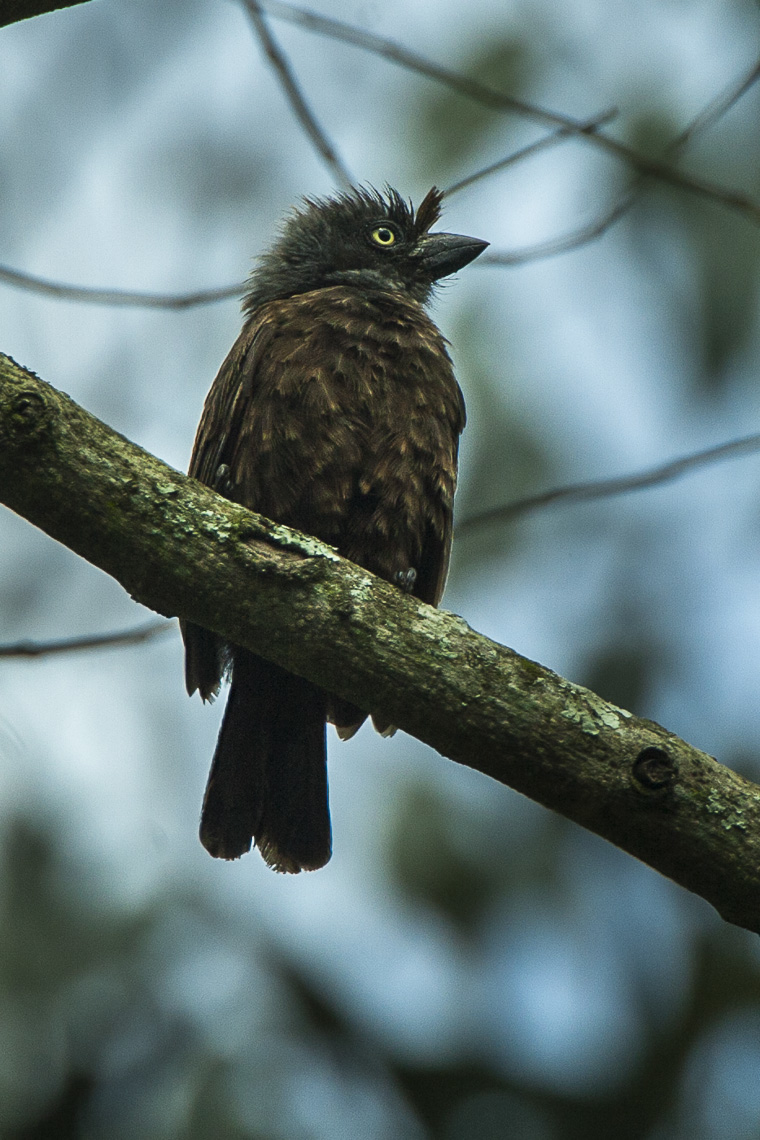
Wikimedia Commons
About the Gray-throated Barbet
The Gray-throated Barbet (Gymnobucco bonapartei) is a captivating member of the Lybiidae family, well-known for its squat appearance and distinctive gray throat. This species thrives in the dense tropical forests of Central Africa, where its presence plays a crucial role in the ecosystem as both a seed disperser and insect controller. Often occupying the humid lowland forests, the Gray-throated Barbet is found from Cameroon to the Democratic Republic of Congo, favoring the deep, verdant canopy that offers abundant fruits and insects.
This barbet species exhibits a tenacious and adaptive nature, often seen in small groups foraging for food. Its ecological significance extends beyond mere aesthetics; the Gray-throated Barbet contributes to forest regeneration through seed dispersion, ensuring the proliferation of various plant species. Its preference for figs and other fruits makes it an essential participant in maintaining the balance of its habitat's flora.
The Gray-throated Barbet's role in the ecosystem also includes regulating insect populations, as it consumes various insects, thus aiding in pest control. Seasonal behaviors of the Gray-throated Barbet reveal a bird well-adapted to its environment, with breeding typically occurring during the wet season when food is plentiful, ensuring the survival of its offspring. As an integral part of the forest ecosystem, the Gray-throated Barbet's presence is a testament to the rich biodiversity of the African tropics.
The Gray-throated Barbet belongs to the family Lybiidae, within the order Piciformes. These birds typically live averages 4-7 years, with some individuals living longer in optimal conditions..
How to Identify a Gray-throated Barbet
The Gray-throated Barbet is a medium-sized bird, measuring approximately 20 centimeters in length. Its most distinguishing feature is its slate-gray throat, which contrasts sharply with its olive-brown back and wings. The breast and belly are also gray, providing the bird with a uniform appearance that is easily recognizable in its forest habitat. The bill is short and stout, designed for fruit consumption, with a slight hook at the tip, aiding in the capture of insects.
Juvenile Gray-throated Barbets resemble adults but have duller plumage, lacking the distinct contrast between the gray throat and the rest of the body. Males and females are similar in appearance, making visual sex differentiation challenging without careful observation. The Gray-throated Barbet's short tail and broad wings give it a distinctive silhouette in flight, often seen as a direct, purposeful flier with quick, shallow wingbeats.
In comparison to other species like the Bearded Barbet, the Gray-throated Barbet lacks the bright red and black coloration, making it less conspicuous but no less interesting. Its perching posture is upright and alert, often on branches within the mid-canopy where it remains vigilant for predators and rivals.
Having trouble telling birds apart? Upload a photo to our bird identification tool for an instant species match.
Gray-throated Barbet Habitat and Range
Preferred Habitat
The Gray-throated Barbet primarily inhabits dense, humid lowland forests across Central Africa. It thrives in regions with abundant fruiting trees, such as figs, which are crucial to its diet. This species is typically found at elevations ranging from sea level to about 1,200 meters, rarely venturing into higher altitudes unless food scarcity forces such movement.
Habitually, the Gray-throated Barbet prefers the seclusion of primary forests, although it can adapt to secondary growth areas and forest edges, demonstrating some resilience to habitat change. While it is generally absent from urban areas, it may occasionally be spotted in rural settings where forest patches remain intact. There is little evidence of significant seasonal habitat shifts, though minor movements might occur in response to fruit availability.
Geographic Range
The Gray-throated Barbet's range includes much of Central Africa, where it is a resident bird with no significant migratory patterns. It breeds across countries such as Cameroon, Gabon, the Republic of Congo, and the Democratic Republic of the Congo. These areas provide the ideal humid forest environment this species requires.
While the range is relatively stable, the population density varies, with hotspots in regions where forest conditions remain undisturbed. It tends to avoid areas of significant human disturbance, which can lead to localized declines in population density. The Gray-throated Barbet's presence in a region often indicates a healthy, biodiverse ecosystem.
Want to know which birds visit your area? Browse our backyard birds by location guides for region-specific species lists.
What Does the Gray-throated Barbet Eat?
The diet of the Gray-throated Barbet is predominantly frugivorous, with figs forming a substantial part of its diet. It also consumes a variety of other fruits, ensuring a diverse intake of nutrients. During certain seasons, the diet may shift to include more insects, particularly when feeding young, as the protein-rich insects provide essential nutrients for growing chicks.
Foraging typically occurs in the mid to upper canopy, where the bird employs its stout bill to pluck fruits and capture insects. Its technique is opportunistic, often joining mixed-species feeding flocks to maximize food intake. The Gray-throated Barbet's foraging schedule is diurnal, with peak activity during the early morning and late afternoon hours when it is cooler and food is most plentiful.
Gray-throated Barbet Behavior and Social Structure
The Gray-throated Barbet is generally social, often seen in small groups or pairs. Its social structure is flexible, with temporary flocks forming around abundant food sources. Territorial behavior is notable during the breeding season, when pairs defend their nesting sites aggressively against conspecifics and other species.
Courtship displays involve mutual preening and vocalizations, strengthening pair bonds. This species is primarily diurnal, with activity peaks at dawn and dusk when foraging and social interactions intensify. In response to predators, the Gray-throated Barbet exhibits evasive flight and alarm calls, alerting nearby conspecifics to danger. Its daily routine revolves around foraging, resting, and socializing, with periods of relative quiet during the hottest parts of the day.
Gray-throated Barbet Nesting and Reproduction
Gray-throated Barbets nest in tree cavities, often excavated by the birds themselves or reused from other species. The nesting site is typically located in the mid-canopy to avoid ground predators. Nest construction involves lining the cavity with leaves and small twigs, providing a soft base for the clutch.
The breeding season coincides with the wet season, with a typical clutch size of two to four eggs. Incubation lasts around 13-15 days, with both parents sharing the duties. After hatching, the chicks remain in the nest for about 25-30 days, receiving constant care and feeding from both parents. The number of broods per year usually depends on food availability, but typically one to two broods are raised annually.
Gray-throated Barbet Sounds and Vocalizations
The primary song of the Gray-throated Barbet is a series of monotonous, rhythmic calls, often described as 'tuk-tuk-tuk,' each note evenly spaced. These calls serve as territorial and contact signals between mates and group members. Additionally, the barbet emits sharp, single-note alarm calls when disturbed or threatened, alerting other birds to potential danger.
During the dawn chorus, the Gray-throated Barbet's calls are more frequent, filling the forest with its distinct rhythm. This vocalization pattern is essential for maintaining social bonds and establishing territory boundaries within the dense forest environment.
Interesting Facts About the Gray-throated Barbet
- 1The Gray-throated Barbet can excavate its own nesting cavities, a rarity among barbets.
- 2This species often participates in mixed-species flocks, enhancing its foraging efficiency.
- 3The Gray-throated Barbet's stout bill is specially adapted for a diet rich in fruits.
- 4Despite its drab appearance, the Gray-throated Barbet plays a vital role in seed dispersal.
- 5Unlike many birds, the Gray-throated Barbet exhibits little sexual dimorphism, making male and female identification challenging.
- 6The species thrives in primary forests, indicating its preference for undisturbed environments.
- 7Gray-throated Barbets are known for their persistent vocalizations, crucial for social cohesion.
Gray-throated Barbet Conservation Status
The Gray-throated Barbet is currently classified as Least Concern by the IUCN, with a relatively stable population trend. However, habitat destruction due to logging and agricultural expansion poses significant threats. Conservation efforts focus on preserving primary forests and promoting sustainable land-use practices. Historically, the population has remained stable in large, undisturbed habitats, but localized declines have occurred where forest fragmentation is severe. Continued monitoring and habitat protection are crucial to ensure the survival of this species in its natural range.
Other Lybiidae Species


Birds Similar to the Gray-throated Barbet
These species are often confused with the Gray-throated Barbet due to similar appearance or overlapping range.

