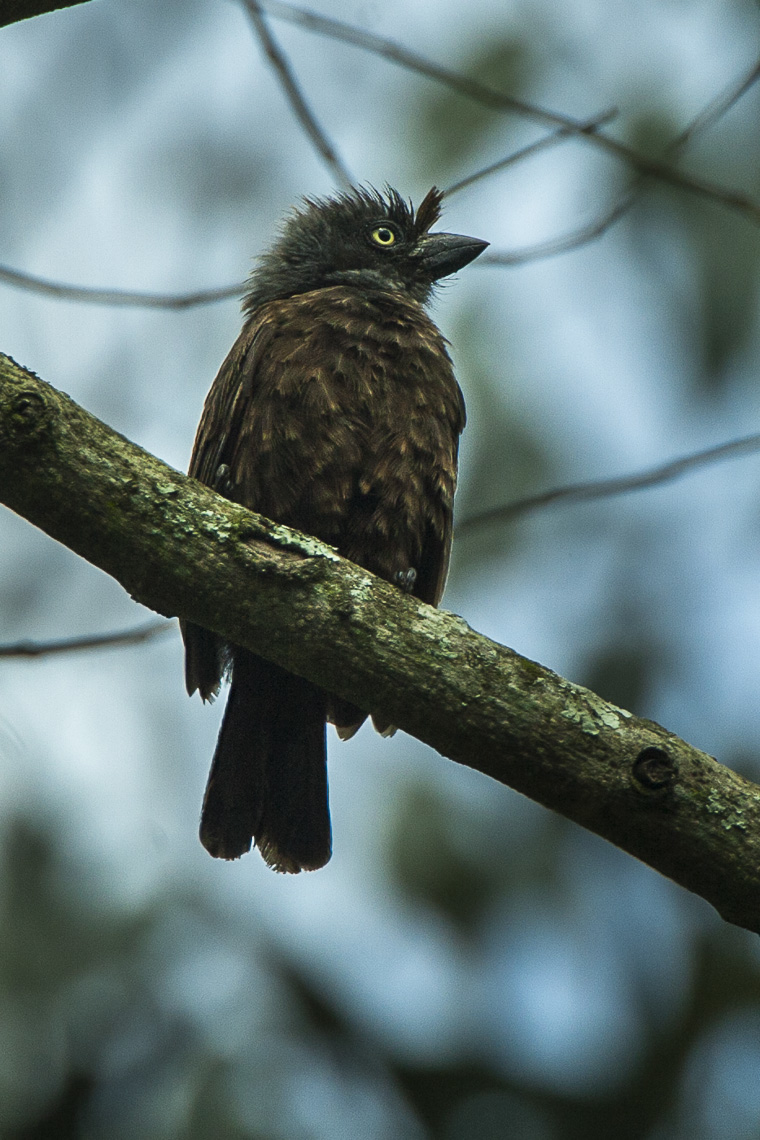
Grey-headed Barbet
Gymnobucco cinereiceps
Order: Piciformes / Family: Lybiidae

Wikimedia Commons
About the Grey-headed Barbet
The Grey-headed Barbet (Gymnobucco cinereiceps) is a fascinating bird species belonging to the family Lybiidae, a group known for their stout bodies and large heads. This bird is prevalent in the central regions of Africa, occupying countries such as the Democratic Republic of the Congo, Uganda, and Rwanda. Its presence is important for the ecological health of forested areas, as it plays a role in seed dispersal due to its fruit-based diet. The Grey-headed Barbet is particularly associated with lowland tropical forests, where dense foliage provides both food and shelter. During the rainy season, these barbets are especially active, as the abundance of fruit leads to increased feeding opportunities.
In terms of ecological significance, the Grey-headed Barbet assists in maintaining the balance of its habitat. By feeding on a wide variety of fruits, it aids in the propagation of numerous plant species. This symbiotic relationship is crucial in promoting plant diversity, which in turn supports a myriad of other wildlife. While primarily frugivorous, the Grey-headed Barbet occasionally augments its diet with insects, providing a natural form of pest control.
Seasonal behaviors of the Grey-headed Barbet include changes in vocal activity. During the breeding season, which coincides with the peak fruiting periods of many trees, their calls become more frequent and varied. This increased vocalization helps in territory establishment and mate attraction. The species is non-migratory, and thus, its presence in these regions remains stable throughout the year. Observations indicate that their population density can fluctuate based on food availability, which is directly tied to seasonal cycles in the forest.
The Grey-headed Barbet belongs to the family Lybiidae, within the order Piciformes. These birds typically live average 9 years with a maximum recorded of 13 years..
How to Identify a Grey-headed Barbet
The Grey-headed Barbet is a medium-sized bird, measuring approximately 18-20 cm in length. Its most distinguishing feature is its gray head, which contrasts sharply with the olive-green body. The bill is large and robust, characteristic of barbets, adapted for fruit consumption. Adult barbets display a uniform gray coloration on the head, with slightly darker shades along the crown. The back and wings are olive-green, which provides excellent camouflage among the forest foliage.
Juvenile Grey-headed Barbets are generally duller in appearance, with more muted grays and greens. The bill in juveniles is also less developed, appearing slimmer and lighter in color compared to adults. Sexual dimorphism is minimal in this species, as males and females share similar plumage and size, making it challenging to differentiate between them in the field.
The Grey-headed Barbet can be confused with other barbets in its range, such as the Yellow-spotted Barbet. However, the latter species has distinct yellow markings on the head, which are absent in the Grey-headed Barbet. In flight, the barbet's wings appear rounded, and its flight is direct and purposeful, typical of many fruit-eating birds. When perched, it often adopts an upright posture, showing off its stout body and broad breast.
Having trouble telling birds apart? Upload a photo to our bird identification tool for an instant species match.
Grey-headed Barbet Habitat and Range
Preferred Habitat
The Grey-headed Barbet predominantly inhabits lowland tropical rainforests, where it frequents both primary and secondary growth. These forests offer a rich source of food and nesting opportunities. The barbet is commonly found at elevations up to 1200 meters, though it is more abundant in the lower forest strata where fruiting trees are plentiful.
In addition to dense forests, the Grey-headed Barbet occasionally ventures into forest edges and open woodlands. It is adaptable to varying forest densities, although it shows a strong preference for areas with a diverse range of fruit-bearing plants. The barbet does not typically inhabit urban areas, preferring the seclusion and resource abundance of rural forested regions.
During the dry season, the barbet may shift its habitat slightly within the forest to areas where fruit remains available, showcasing its adaptability to seasonal changes. However, it remains largely within its forested territories year-round, given its non-migratory nature.
Geographic Range
The Grey-headed Barbet's breeding range is primarily located within the central African belt, extending across several countries including the Democratic Republic of the Congo, Uganda, Rwanda, and parts of Burundi. This species is non-migratory, maintaining its presence within these regions throughout the year.
Populations are particularly dense in the Ituri Forest of the Democratic Republic of the Congo and the Kibale Forest in Uganda, where the habitat conditions are optimal. In these areas, the availability of fruiting trees supports larger groups of barbets, making them a common sight for birders and researchers alike.
Despite its relatively stable range, the Grey-headed Barbet's presence can be patchy, often dependent on local habitat conditions such as forest cover and fruit abundance. It does not undergo long-distance migrations, but rather local movements within forested regions to exploit seasonal food resources.
Want to know which birds visit your area? Browse our backyard birds by location guides for region-specific species lists.
What Does the Grey-headed Barbet Eat?
The diet of the Grey-headed Barbet is primarily frugivorous, focusing heavily on the fruits available within its forest habitat. It consumes a wide variety of fruiting plants, including figs, berries, and drupes. During the rainy season, when fruits are abundant, the barbet's diet consists almost exclusively of these resources.
In periods when fruit is less available, the Grey-headed Barbet supplements its diet with insects, such as beetles and caterpillars, providing necessary protein. This dietary flexibility is crucial for its survival during leaner times, particularly in the dry season when fruiting trees are less prolific.
The barbet employs a foraging technique that involves perching quietly in the canopy while scanning for ripe fruit. Once located, it uses its strong bill to pluck the fruit, often swallowing smaller pieces whole. This method is efficient and allows the bird to consume significant quantities of food throughout the day, which it typically does in the early morning and late afternoon when temperatures are cooler.
Grey-headed Barbet Behavior and Social Structure
The Grey-headed Barbet exhibits a range of social behaviors, often seen in small groups of three to five individuals. These birds exhibit mild territoriality, with pairs or small groups defending feeding and nesting areas from intruders.
Courtship displays involve vocalizations and physical displays where the male engages in a series of calls to attract a mate. Once paired, the barbet remains monogamous for the breeding season, with both sexes participating in nesting duties.
The species displays a diurnal activity pattern, with peak activity occurring in the early morning and late afternoon. During these times, they are most vocal and active, foraging for food and engaging in social interactions. When faced with potential predators, such as raptors, the Grey-headed Barbet may emit sharp alarm calls to alert others, while seeking cover in dense foliage.
Although not as social as some other bird species, the Grey-headed Barbet does occasionally join mixed-species flocks, particularly outside the breeding season. This behavior likely aids in predator avoidance and increases foraging efficiency.
Grey-headed Barbet Nesting and Reproduction
The Grey-headed Barbet prefers to nest in natural cavities found in trees, often selecting sites that offer protection from predators and weather elements. These cavities are usually located several meters above the ground, providing security for the eggs and chicks.
The barbet's nesting process involves both the male and female, who work together to prepare the nest site. Clutch size typically ranges from two to four eggs, with the female incubating them for about 14 to 16 days. During this period, the male assists by providing food and defending the territory.
Once the chicks hatch, both parents take part in feeding and caring for the young. The fledging period lasts approximately 25 to 30 days, after which the chicks become independent and disperse from the nesting area. The Grey-headed Barbet generally raises one to two broods per year, depending on food availability and environmental conditions.
Grey-headed Barbet Sounds and Vocalizations
The Grey-headed Barbet's primary song is a series of rapid, repetitive notes that are somewhat metallic in quality. This song is often used during the breeding season for mate attraction and territory establishment.
In addition to its song, the barbet produces a variety of call notes, including a sharp 'chuk-chuk' sound used for communication between individuals. Alarm calls are harsher and more abrupt, serving to alert others of potential danger.
During the dawn chorus, the Grey-headed Barbet is particularly vocal, contributing to the early morning soundscape of the forest. Its calls are less melodious than some other birds but are distinctive enough to be identified by experienced birders.
Interesting Facts About the Grey-headed Barbet
- 1The Grey-headed Barbet can consume up to 1.5 times its body weight in fruit each day during peak feeding periods.
- 2This species is known to occasionally join mixed-species foraging flocks, benefiting from increased foraging success.
- 3Grey-headed Barbets have been observed using their strong bills to excavate nest cavities in softer wood, showcasing their adaptability.
- 4Unlike many other birds, the Grey-headed Barbet remains vocal throughout the year, not just during breeding seasons.
- 5The Grey-headed Barbet's call is one of the most distinctive sounds of the central African forests, often heard before the bird is seen.
- 6Despite its preference for dense forests, the Grey-headed Barbet is adaptable and can thrive in secondary growth forests.
- 7Both parents share the responsibility of rearing young, making them attentive and cooperative caregivers.
Grey-headed Barbet Conservation Status
The Grey-headed Barbet currently holds a status of Least Concern on the IUCN Red List, indicating that it is not at immediate risk of widespread decline. However, habitat loss due to deforestation poses a long-term threat to its populations, particularly as logging activities encroach upon its forested habitats. Conservation efforts for the Grey-headed Barbet focus primarily on habitat preservation and sustainable forestry practices. Protecting significant areas of tropical forests in central Africa is crucial to maintaining the species' stable population trends. Historically, the Grey-headed Barbet has shown resilience to habitat changes, although its future depends on continued conservation actions to mitigate the impacts of human activities. Monitoring population trends and habitat conditions remains a priority for conservationists working in the region.