Chestnut-crowned Becard
Pachyramphus castaneus
Order: Passeriformes / Family: Cotingidae
Wikimedia Commons
About the Chestnut-crowned Becard
The Chestnut-crowned Becard, Pachyramphus castaneus, occupies a significant ecological niche in the neotropical forests of South America. This medium-sized passerine plays a crucial role as both a predator and a seed disperser within its ecosystem. Found predominantly in the humid, lowland forests of countries like Brazil, Colombia, and Venezuela, this species contributes to the biodiversity and health of its habitat. Its presence in these forests indicates a stable, mature environment, which is essential for the myriad of species that share its home. Pachyramphus castaneus is particularly active during the breeding season, usually from September to December, when it engages in complex courtship behaviors to secure a mate. Outside of the breeding season, this becard may be seen foraging alone or in pairs, blending seamlessly into the canopy as it searches for insects and fruits. Its ecological role extends beyond simple predation; by consuming a variety of fruits, the Chestnut-crowned Becard aids in seed dispersal, contributing to the regeneration and maintenance of its forest environment. This process is vital in promoting plant diversity and ensuring the continued health of the forest ecosystem. Its adaptability to different forest types, including secondary growth and edge habitats, makes it a resilient species, capable of surviving in environments experiencing moderate human impact. However, its dependence on forested areas also makes it susceptible to habitat loss, a growing concern in regions where deforestation for agriculture and urbanization is prevalent. Thus, the Chestnut-crowned Becard serves as both a symbol of the rich biodiversity of South American forests and a reminder of the need for conservation efforts to protect these critical habitats.
The Chestnut-crowned Becard belongs to the family Cotingidae, within the order Passeriformes. These birds typically live average 5-7 years, with a max recorded of 11 years..
How to Identify a Chestnut-crowned Becard
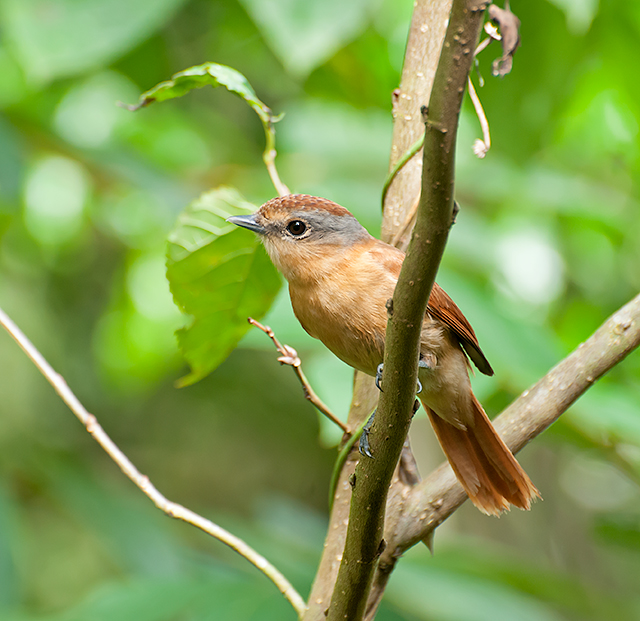
The Chestnut-crowned Becard is distinguished by its striking chestnut crown, which stands out against its generally dark plumage. Adult males typically exhibit a more vivid crown color compared to females, whose crown may appear slightly duller. The rest of the plumage is predominantly gray to black, with subtle white markings on the wings and tail, providing a contrasting backdrop to the chestnut crown. Juveniles resemble the females but with a more muted overall color palette, lacking the fully developed crown coloration. In flight, the Chestnut-crowned Becard displays a relatively short tail and rounded wings, contributing to its agile maneuverability through dense foliage. Its perching posture is slightly hunched, often with its head held lower than its shoulders, giving it a distinctive silhouette compared to similar species. The becard's compact size and unique coloration can sometimes lead to confusion with other forest birds, such as the related Black-capped Becard, but its chestnut crown is a reliable differentiator. Observers should note the bird's preference for perching quietly in the mid to upper canopy, often remaining motionless for extended periods.
Having trouble telling birds apart? Upload a photo to our bird identification tool for an instant species match.
Chestnut-crowned Becard Habitat and Range
Preferred Habitat
The Chestnut-crowned Becard primarily inhabits tropical and subtropical forests, thriving in lowland and foothill environments up to elevations of about 1,500 meters. These birds show a preference for humid forest regions, often within primary and secondary growth forests. They adapt well to edge habitats, where forest meets open areas, and can occasionally be found in semi-urban environments with sufficient tree cover. Despite their adaptability, they are less commonly found in open grasslands or completely urbanized areas. Seasonal habitat shifts are minimal, as these birds tend to remain in forests year-round, though they may adjust their altitude slightly in response to food availability and breeding requirements. Their presence in mixed-species flocks during non-breeding seasons highlights their adaptability within their chosen habitats.
Geographic Range
The Chestnut-crowned Becard's range spans a broad swath of northern and central South America, extending from the eastern slopes of the Andes in Colombia and Ecuador to the expansive Amazon basin in Brazil and Peru. It is most commonly observed in Brazil, where its population density is notably higher in the Amazonian lowlands. Unlike many migratory species, the Chestnut-crowned Becard tends to be a year-round resident across much of its range, with only local movements related to breeding or food availability. It is notably absent from the southernmost parts of South America and the high-altitude regions of the Andes. Population densities vary, with more stable numbers in protected areas like national parks and reserves, where habitat disturbance is minimal.
Want to know which birds visit your area? Browse our backyard birds by location guides for region-specific species lists.
What Does the Chestnut-crowned Becard Eat?
The diet of the Chestnut-crowned Becard is diverse, primarily consisting of insects and a variety of fruits. During the breeding season, insects such as beetles, caterpillars, and spiders become more prominent in its diet, providing the necessary protein for rearing young. The becard employs a sit-and-wait foraging technique, often capturing prey by darting from a perch. In non-breeding seasons, fruits form a significant portion of its diet, aiding in seed dispersal. It favors small to medium-sized fruits, often consuming those from species like figs and berries. This seasonal dietary flexibility allows the becard to exploit different food resources as they become available, ensuring its survival in diverse forest environments.
Chestnut-crowned Becard Behavior and Social Structure
The Chestnut-crowned Becard exhibits a fascinating array of behaviors, particularly during the breeding season. Males engage in elaborate courtship displays, showcasing their vibrant crown to attract females. These displays often involve complex vocalizations and aerial acrobatics. Socially, the becard tends to be solitary or found in pairs, occasionally joining mixed-species flocks outside of the breeding season. Territorial behavior is pronounced, with males defending their breeding territories vigorously against intruders. The becard's response to predators includes a range of alarm calls and evasive flight maneuvers. Daily activity patterns revolve around foraging and feeding during the cooler morning and late afternoon hours, with periods of rest during the midday heat.
Chestnut-crowned Becard Nesting and Reproduction
The Chestnut-crowned Becard constructs a unique, pendant-shaped nest, often suspended from the fork of a tree branch. These nests are crafted primarily from plant fibers, moss, and spider silk, providing a secure environment for eggs and chicks. Nests are typically located at mid-canopy level, offering protection from ground predators. A typical clutch consists of two to three eggs, with an incubation period of approximately 14 to 17 days. Both parents share incubation duties and subsequent feeding of the chicks. Fledging occurs about 20 days after hatching, with young birds remaining under parental care for a further few weeks. The species generally raises one to two broods per year, depending on environmental conditions.
Chestnut-crowned Becard Sounds and Vocalizations
The Chestnut-crowned Becard is known for its distinctive song, a series of clear, melodious notes that rise and fall in pitch. This song is often delivered from a concealed perch within the forest canopy, serving as both a territorial claim and an attraction for mates. In addition to its primary song, the becard produces a variety of call notes, including sharp 'chip' sounds and more complex, modulated whistles. Alarm calls are shorter and more abrupt, designed to alert others to potential threats. During the dawn chorus, the becard's vocalizations are particularly prominent, contributing to the rich tapestry of sounds in its forest habitat.
Interesting Facts About the Chestnut-crowned Becard
- 1The Chestnut-crowned Becard can consume over 20 different fruit species, promoting forest diversity.
- 2Its pendant-shaped nest design helps protect against rain and predators, showcasing unique adaptation.
- 3Both male and female Chestnut-crowned Becards contribute to nest building, showing cooperative behavior.
- 4Despite being primarily a forest bird, the becard has adapted to some human-altered landscapes.
- 5The becard's courtship display includes impressive aerial maneuvers, a spectacle for birdwatchers.
- 6Chestnut-crowned Becards are known to join mixed-species flocks, enhancing their foraging efficiency.
- 7Their ability to adapt to secondary growth forests aids in their survival amid deforestation threats.
Chestnut-crowned Becard Conservation Status
The Chestnut-crowned Becard is currently listed as Least Concern by the IUCN, reflecting its relatively stable population across much of its range. However, ongoing threats such as deforestation, habitat fragmentation, and agricultural expansion pose significant risks to its long-term survival. Conservation efforts are focused on habitat preservation, particularly in biodiversity hotspots within the Amazon basin. Historically, the species has maintained stable populations, but localized declines in heavily deforested areas highlight the need for continued conservation initiatives. Protecting large tracts of forest and promoting sustainable land-use practices are essential for ensuring the species' future.