
Chocolate-backed Kingfisher
Halcyon badia
Order: Coraciiformes / Family: Alcedinidae
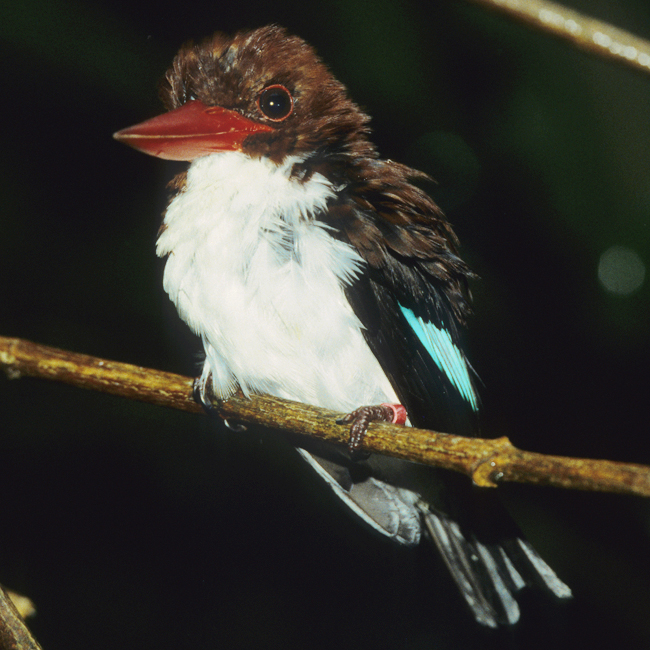
Wikimedia Commons
About the Chocolate-backed Kingfisher
The Chocolate-backed Kingfisher (Halcyon badia) is a captivating bird species belonging to the Alcedinidae family, known for its unique appearance and distinct ecological role within the forest ecosystems of West and Central Africa. This bird is primarily found in dense, lowland rainforests, where it plays a crucial role as both predator and prey within the food web. Its presence is a key indicator of forest health, given its reliance on pristine environments. The bird's striking chocolate-brown upperparts contrast vividly with its white underparts, creating a visual spectacle against the deep greens of its habitat. Its distribution spans countries such as Sierra Leone, Liberia, Ivory Coast, Ghana, Nigeria, and the Democratic Republic of the Congo, where it inhabits the humid equatorial regions. The Chocolate-backed Kingfisher is non-migratory, maintaining residence within its preferred habitat year-round. However, there may be minor local movements in response to seasonal changes in food availability. During the breeding season, its territorial calls echo through the dense canopy, serving as a reminder of its presence. It plays a significant ecological role by controlling insect populations, thus maintaining a balance within its ecosystem. Its diet primarily consists of insects, small reptiles, and occasionally amphibians, which it captures with precision using its powerful bill. This feeding behavior not only helps regulate prey populations but also provides a source of nourishment for the kingfisher during the demanding breeding period. The Chocolate-backed Kingfisher is also integral to the cultural and natural heritage of the regions it inhabits. Local communities hold this bird in high regard, often associating it with various myths and traditions. It is considered a symbol of the rich biodiversity found in African forests, contributing to the continent's natural charm. Despite its ecological and cultural significance, the Chocolate-backed Kingfisher faces challenges due to habitat destruction and fragmentation. Deforestation for agriculture, logging, and human settlement threatens the pristine environments it depends on. Conservation efforts are essential to ensure the survival of this species and the preservation of the forests it calls home. Organizations and researchers are increasingly focusing on habitat protection and restoration initiatives to safeguard the future of the Chocolate-backed Kingfisher and the myriad of other species that share its habitat.
The Chocolate-backed Kingfisher belongs to the family Alcedinidae, within the order Coraciiformes. These birds typically live average 10 years, with a maximum recorded of 13 years..
How to Identify a Chocolate-backed Kingfisher
The adult Chocolate-backed Kingfisher is distinguished by its chocolate-brown upperparts, including the head, back, and wings, while its underparts are a striking white. The contrast between the rich brown and stark white makes it one of the more visually striking members of its family. Juveniles resemble adults but may have slightly duller plumage. Males and females share similar coloration, making them difficult to distinguish in the field based solely on appearance. However, during the breeding season, behavioral cues such as courtship feeding can aid in gender identification. In flight, the kingfisher's broad wings and short tail create a distinct silhouette when viewed against the canopy. Its perching posture is often upright, with a slight forward tilt, characteristic of kingfishers. While perched, it remains alert, scanning for prey with its keen vision. The Chocolate-backed Kingfisher can be confused with other kingfishers in its range, such as the Blue-breasted Kingfisher, but its unique color palette serves as a reliable field mark. The lack of any blue or green in its plumage helps prevent confusion with these similarly sized birds.
Having trouble telling birds apart? Upload a photo to our bird identification tool for an instant species match.
Chocolate-backed Kingfisher Habitat and Range
Preferred Habitat
Chocolate-backed Kingfishers inhabit dense, lowland rainforests across West and Central Africa, thriving in humid environments with ample canopy cover. These forests provide the ideal microhabitats for foraging and nesting. The kingfisher is most commonly found at elevations from sea level up to 1200 meters, though it generally prefers lower elevations. Unlike many bird species, it does not show significant urban presence, preferring undisturbed forest environments. Seasonal shifts in habitat use are minimal, as it remains within forested areas year-round, though it may make slight movements to exploit local food resources.
Geographic Range
The Chocolate-backed Kingfisher's range extends across the lush forests of West and Central Africa. It is resident in countries such as Sierra Leone, Liberia, Ivory Coast, Ghana, Nigeria, and the Democratic Republic of the Congo. This bird prefers humid, equatorial regions where forest canopies provide necessary cover and resources. Unlike migratory species, the Chocolate-backed Kingfisher remains in its range throughout the year, relying on the forest's rich resources. Areas like Ghana's Kakum National Park and Nigeria's Cross River National Park serve as population density hotspots due to their protected status and abundant habitat.
Want to know which birds visit your area? Browse our backyard birds by location guides for region-specific species lists.
What Does the Chocolate-backed Kingfisher Eat?
The diet of the Chocolate-backed Kingfisher primarily consists of insects, small reptiles, and occasionally amphibians. It exhibits a sit-and-wait hunting strategy, perching silently before swooping down to capture prey with its robust bill. Insects such as grasshoppers and beetles form the bulk of its diet, while lizards and frogs serve as secondary food sources. During the wet season, when insect activity peaks, the kingfisher's diet becomes predominantly insectivorous. Its feeding schedule aligns with prey availability, often targeting active insects during the cooler morning and late afternoon hours.
Chocolate-backed Kingfisher Behavior and Social Structure
The Chocolate-backed Kingfisher is a solitary bird, often observed alone or in pairs during the breeding season. It exhibits strong territorial behavior, with males fiercely defending their chosen nesting sites through vocal displays and physical confrontations. Courtship involves elaborate displays, including aerial chases and gift-giving, where the male presents prey to the female. Outside the breeding season, the kingfisher maintains a low profile, blending into the dense foliage. Its response to predators includes remaining motionless to evade detection. Daily activity patterns revolve around feeding, with increased activity in the early morning and late afternoon.
Chocolate-backed Kingfisher Nesting and Reproduction
Chocolate-backed Kingfishers nest in tree cavities, often utilizing natural hollows or holes excavated by other animals. They prefer locations well-concealed within dense forest canopies to protect against predators. The clutch size typically ranges from 2 to 4 eggs, with both parents sharing incubation duties over a period of about 18 to 20 days. After hatching, the chicks remain in the nest for approximately 24 to 28 days before fledging. Both parents participate in feeding and caring for the young, ensuring their rapid growth and development. Generally, the species raises one brood per year.
Chocolate-backed Kingfisher Sounds and Vocalizations
The primary song of the Chocolate-backed Kingfisher consists of a series of high-pitched, melodious whistles that resonate through the forest. These whistles vary in pitch and rhythm, often accelerating during courtship. The bird's call notes include sharp 'kik-kik' sounds, used for communication between mates or as a territorial warning. Alarm calls are more abrupt and harsh, serving to alert others to potential threats. During the dawn chorus, its melodious whistles blend with the cacophony of the forest, marking its presence in the early morning hours.
Interesting Facts About the Chocolate-backed Kingfisher
- 1The Chocolate-backed Kingfisher was first described by naturalists in the mid-19th century, reflecting its long-noted presence in African forests.
- 2Despite its vibrant appearance, the kingfisher's ability to remain motionless makes it surprisingly difficult to spot in dense foliage.
- 3This kingfisher's powerful bill is not only for catching prey but also plays a role in excavating nesting cavities in softer woods.
- 4Although named for its chocolate-brown coloration, this kingfisher is more closely related to the blue and green kingfishers of the forest canopy.
- 5Researchers have noted that the Chocolate-backed Kingfisher's vocalizations can vary slightly between regions, indicating potential adaptation to local acoustics.
- 6The Chocolate-backed Kingfisher shows a strong preference for undisturbed forest interiors, avoiding edges and fragmented habitats.
- 7This species is considered a flagship for conservation efforts in West and Central African forest ecosystems, symbolizing the need for habitat preservation.
Chocolate-backed Kingfisher Conservation Status
Currently, the Chocolate-backed Kingfisher holds a status of Least Concern according to the IUCN. However, its population trend is decreasing, primarily due to habitat loss and fragmentation from logging and agricultural expansion. Conservation efforts focus on protecting forest habitats and establishing reserves, which are crucial for maintaining its population. Historical data suggest that while the species was once more widespread, current threats necessitate ongoing monitoring and habitat protection to prevent further declines.
Other Alcedinidae Species


Birds Similar to the Chocolate-backed Kingfisher
These species are often confused with the Chocolate-backed Kingfisher due to similar appearance or overlapping range.

