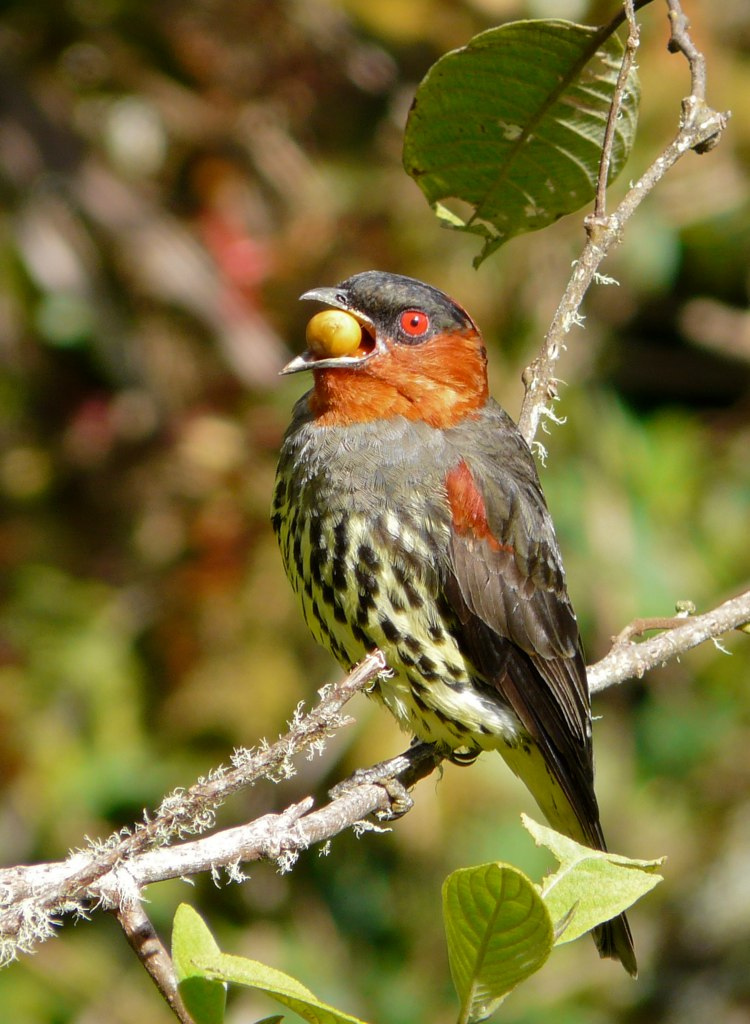
Cinereous Becard
Pachyramphus rufus
Order: Passeriformes / Family: Cotingidae

Wikimedia Commons
About the Cinereous Becard
The Cinereous Becard (Pachyramphus rufus) is a fascinating member of the Cotingidae family, displaying unique characteristics that make it a subject of interest among ornithologists and bird enthusiasts. Found primarily in the subtropical and tropical forests of South America, this bird inhabits regions stretching from eastern Brazil through Paraguay and into northern Argentina. Its presence in these biodiverse areas highlights its ecological significance as both a predator and prey within the food chain.
The Cinereous Becard plays a crucial role in its ecosystem, particularly in the control of insect populations. By feeding on a variety of arthropods, it helps maintain a balance, which indirectly supports the health of the plant communities within its habitat. This bird also contributes to seed dispersal, which facilitates plant regeneration and forest health. Its preference for forested regions underscores the importance of preserving these habitats, not only for the Cinereous Becard itself but also for the myriad of species that share its home.
Observations of the Cinereous Becard reveal fascinating behaviors, such as its seasonal movements in response to food availability. Although generally sedentary, some populations exhibit altitudinal migration, moving to lower elevations during colder months. This adaptability ensures the bird's survival across various forest types, from dense lowland rainforests to montane cloud forests. Its presence signals a well-functioning ecosystem, making the Cinereous Becard a valuable indicator species for conservationists.
The bird's significance extends beyond its ecological roles. It captivates birdwatchers with its striking appearance and intriguing behaviors, such as its cooperative breeding system. These traits draw attention to the need for continued research and conservation efforts, ensuring that the Cinereous Becard continues to thrive in its native habitats and serves as a testament to the richness of South American biodiversity.
The Cinereous Becard belongs to the family Cotingidae, within the order Passeriformes. These birds typically live average 4-6 years; max recorded 9 years.
How to Identify a Cinereous Becard
The Cinereous Becard is easily recognized by its rufous plumage, which is most prominent on its back and wings. Adult males and females exhibit similar coloration, although females may appear slightly duller. The bird's underparts are a lighter gray, providing a subtle contrast to its more vibrant upper body. Its stout, hooked bill is characteristic of the becard family, aiding in the capture of insects.
Juvenile Cinereous Becards can be distinguished from adults by their more subdued coloration, which lacks the full intensity of rufous found in mature birds. They also exhibit a less pronounced contrast between their upper and lower parts. Identifying these juveniles requires careful observation, especially in the dense foliage where they often reside.
While similar in size to other becards, the Cinereous Becard's distinctive plumage and vocalizations help differentiate it from species like the Barred Becard. In flight, the Cinereous Becard's compact body and relatively short tail are evident, and its perching posture, with a slightly hunched appearance, further aids identification. These field marks are essential for birders seeking to distinguish the Cinereous Becard in its natural habitat.
Having trouble telling birds apart? Upload a photo to our bird identification tool for an instant species match.
Cinereous Becard Habitat and Range
Preferred Habitat
The Cinereous Becard inhabits a range of forest types, primarily occupying subtropical and tropical moist lowland forests. It is commonly found in the Atlantic Forest of eastern Brazil, a biodiversity hotspot, as well as in Paraguay and northern Argentina. These regions provide the dense canopy cover and abundant insect life that the bird requires.
This species is often found at elevations ranging from sea level up to 1,500 meters, adapting well to both lowland and montane environments. Seasonal shifts in habitat usage may occur as the Cinereous Becard follows food availability, particularly during periods of insect scarcity.
While primarily a forest dweller, the Cinereous Becard occasionally ventures into more open areas, such as forest edges and secondary growth, where it can exploit additional food resources. Its presence in urban and rural environments is limited, as it prefers the extensive cover and food resources of denser forested areas.
Geographic Range
The Cinereous Becard's range is centered in South America, extending from the eastern regions of Brazil through parts of Paraguay and into northern Argentina. Its distribution is largely confined to the Atlantic Forest biome, where it is a year-round resident.
Although not migratory in the traditional sense, certain populations exhibit altitudinal movements, relocating to lower, warmer elevations during the cooler months. This behavior ensures access to food resources throughout the year and minimizes the challenges posed by seasonal changes in climate.
Population density tends to be highest in areas with intact forest cover, reflecting the species' reliance on dense, mature forests for nesting and feeding. These hotspots of abundance highlight the importance of conservation efforts aimed at preserving large tracts of forest habitat across its range.
Want to know which birds visit your area? Browse our backyard birds by location guides for region-specific species lists.
What Does the Cinereous Becard Eat?
The Cinereous Becard primarily feeds on insects, playing a vital role in controlling arthropod populations within its habitat. Its diet includes a wide variety of insects, such as beetles, caterpillars, and grasshoppers, which it captures using its strong, hooked bill.
During certain seasons, particularly when insect availability decreases, the Cinereous Becard may supplement its diet with small fruits and berries. This dietary flexibility allows it to exploit different food sources and adapt to changes in food availability.
The bird employs a range of foraging techniques, including gleaning insects from foliage and engaging in short, agile flights to snatch prey in mid-air. This active foraging behavior occurs throughout the day, although peak feeding times often coincide with the early morning and late afternoon when insect activity is heightened.
Cinereous Becard Behavior and Social Structure
The social structure of the Cinereous Becard is intriguing, often involving cooperative breeding practices where multiple individuals contribute to the rearing of young. This behavior enhances reproductive success and is a key aspect of its life history strategy.
Territorial behavior is commonly observed, with pairs or small groups defending breeding territories against conspecifics. Courtship displays involve vocalizations and displays of plumage, which help strengthen pair bonds and secure mates.
Flocking behavior is not typical of the Cinereous Becard, as it tends to maintain smaller, more cohesive groups. This contrasts with some other passerines that form larger flocks. When confronted by predators, the Cinereous Becard exhibits a range of defensive behaviors, including alarm calls that alert others to potential threats.
Daily activity patterns include periods of intense foraging interspersed with rest and preening. These behaviors ensure that the Cinereous Becard remains in optimal condition for breeding and territory defense.
Cinereous Becard Nesting and Reproduction
The Cinereous Becard constructs a cup-shaped nest, often placed in the fork of a tree or amidst dense foliage to provide concealment from predators. The nest is primarily composed of twigs, leaves, and other plant materials, providing a sturdy structure for the eggs.
Preferred nesting locations include areas with abundant canopy cover, which offers protection from weather and predators. Clutch size typically ranges from two to three eggs, which are incubated by both parents over a period of approximately two weeks.
Fledging occurs roughly 16 to 18 days after hatching, with parental care continuing for several weeks to ensure the young develop the necessary skills for survival. The Cinereous Becard may produce more than one brood per year, depending on environmental conditions and resource availability, which enhances its reproductive success.
Cinereous Becard Sounds and Vocalizations
The primary song of the Cinereous Becard is a series of clear, melodious whistles, with a rhythmic pattern that is easily recognizable. These vocalizations play a crucial role in territory establishment and mate attraction.
In addition to its song, the Cinereous Becard produces a variety of call notes, including soft 'chup' sounds used in communication between individuals. Alarm calls are sharp and piercing, effectively alerting other birds to the presence of predators.
During the dawn chorus, the Cinereous Becard's song is more frequent and pronounced, contributing to the vibrant soundscape of the forest. Its vocal repertoire is an essential component of its behavioral ecology, facilitating interactions with conspecifics and other species.
Interesting Facts About the Cinereous Becard
- 1The Cinereous Becard can be found at elevations up to 1,500 meters, showcasing its adaptability to different forest environments.
- 2Despite its vibrant plumage, the Cinereous Becard often goes unnoticed due to its preference for dense canopy cover.
- 3The Cinereous Becard's breeding season can vary by region, influenced by local climate and food availability.
- 4This bird's strong bill is specially adapted for capturing a wide range of insect prey, including hard-shelled beetles.
- 5Cooperative breeding in the Cinereous Becard involves non-breeding individuals assisting in raising the young, an unusual trait among passerines.
- 6The Cinereous Becard contributes to forest health not only by controlling insects but also by dispersing seeds through its fruit consumption.
- 7Its melodic song is a common component of the dawn chorus in South American forests, adding to the biodiversity's acoustic tapestry.
Cinereous Becard Conservation Status
The International Union for Conservation of Nature (IUCN) currently lists the Cinereous Becard as a species of Least Concern, indicating that its populations are relatively stable. However, ongoing habitat loss poses a significant threat, particularly in regions experiencing deforestation for agriculture and urban development. Conservation efforts focus on preserving and restoring forest habitats, which are crucial for the long-term survival of the Cinereous Becard. Protected areas and reserves play a vital role in safeguarding these environments from further degradation. Historically, the Cinereous Becard has maintained stable populations, but continued monitoring is essential to detect any potential declines. Public awareness and community involvement in conservation initiatives are also important in ensuring the preservation of this remarkable bird.