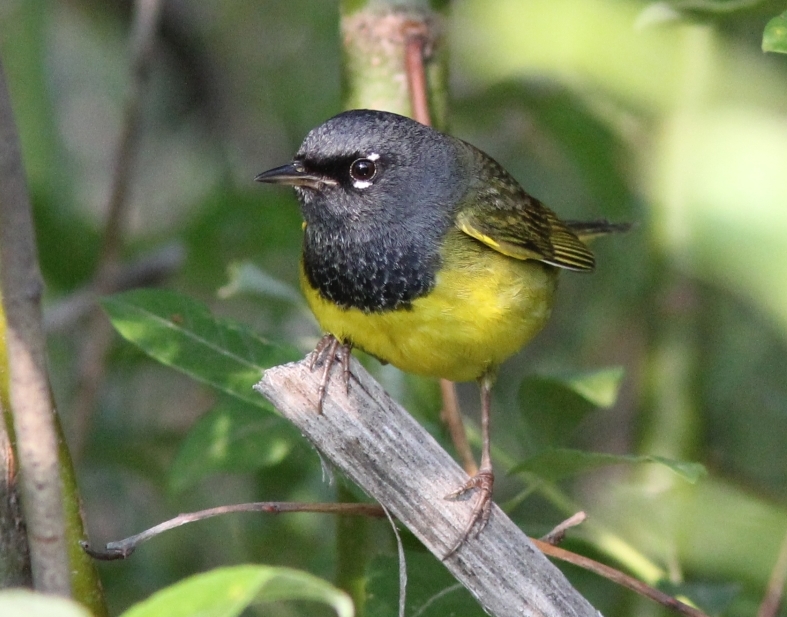
Connecticut Warbler
Oporornis agilis
Order: Passeriformes / Family: Parulidae

Wikimedia Commons
About the Connecticut Warbler
The Connecticut Warbler, Oporornis agilis, is a secretive and elusive bird renowned for its reclusive habits and distinctive appearance. This small songbird belongs to the Parulidae family and is often considered a prized sighting for birders due to its shy demeanor and tendency to remain hidden in dense foliage. The Connecticut Warbler primarily inhabits northern forest regions, particularly within the boreal forests of Canada and the northern United States. Its ecological role in these ecosystems is significant, as it participates in insect population control and serves as a prey species for larger predators.
The Connecticut Warbler migrates seasonally, breeding in the dense, wet forests of Canada, particularly in provinces like Ontario and Quebec, and parts of the northern United States such as Minnesota and Michigan. During the breeding season, the bird is known for its preference for lowland spruce forests and deciduous woodlands, where it can find ample cover and food resources. As winter approaches, the warbler undertakes an arduous migration to South America, with primary wintering grounds in the Amazon Basin, specifically in countries like Brazil and Colombia.
Throughout the year, the Connecticut Warbler plays a vital role in maintaining the health of its ecosystem. During the breeding season, it helps control insect populations, particularly those of forest pests, thus contributing to forest health. Additionally, it serves as a prey species for raptors and other larger birds, fitting neatly into the complex web of forest life. The bird's migration habits also highlight the importance of international conservation efforts, as it relies on habitats across two continents.
Its elusive nature, combined with its distinct migratory patterns, makes the Connecticut Warbler a subject of interest for ornithologists and birdwatchers alike. Understanding the habits and habitats of Oporornis agilis is crucial for preserving its populations and ensuring the continued health of the ecosystems it inhabits.
The Connecticut Warbler belongs to the family Parulidae, within the order Passeriformes. These birds typically live average lifespan is around 5 years, with a maximum recorded at 8 years..
How to Identify a Connecticut Warbler
Identifying the Connecticut Warbler can be challenging, given its tendency to stay hidden in dense underbrush. Adult Connecticut Warblers feature olive-brown upperparts and a gray hood extending from the face to the upper chest. One of their most defining characteristics is the bold white eye-ring, which stands out prominently against the gray hood. The underparts are typically a soft yellow, though this can vary slightly with lighting conditions.
Juvenile Connecticut Warblers often show a more muted appearance, with less defined contrast between the gray hood and olive body, and sometimes their eye-ring appears less distinct. Both males and females share similar plumage, making sex differentiation challenging without close observation. During the breeding season, males may be slightly more vibrant in their yellow underparts, but this is subtle and requires careful observation.
Despite their distinctive eye-ring, Connecticut Warblers can be confused with other warblers, such as the Mourning Warbler and the Nashville Warbler. However, the Mourning Warbler lacks the pronounced eye-ring, while the Nashville Warbler has a more prominent yellow underbody and a different song. In flight, the Connecticut Warbler presents a compact silhouette, with rapid, fluttering wingbeats, and tends to keep low to the ground or within the tree canopy, making it a challenge to observe in open flight.
Having trouble telling birds apart? Upload a photo to our bird identification tool for an instant species match.
Connecticut Warbler Habitat and Range
Preferred Habitat
The Connecticut Warbler is primarily associated with boreal forests, favoring dense, wet habitats rich in undergrowth. During the breeding season, it seeks regions with abundant ground cover, such as the lowland spruce forests of Ontario and Quebec, or the mixed deciduous forests of the northern United States. These habitats offer the necessary protection and food sources for raising young.
While it prefers forested environments, the Connecticut Warbler is also adaptable to various elevations within its breeding range, typically found at lower elevations where the forest understory is dense. As a migratory bird, it shifts habitats seasonally, moving to tropical forests in the Amazon Basin during the winter months.
In these wintering grounds, the warbler inhabits humid lowland forests, often in areas with dense foliage that provides both food and protection. Though it primarily prefers rural settings with little human disturbance, it can occasionally be found in urban green spaces during migration, though such sightings are rare.
Geographic Range
The Connecticut Warbler exhibits a distinct migratory pattern, breeding in North America and wintering in South America. During the breeding season, its range covers parts of Canada, including Ontario, Quebec, Manitoba, and parts of the northern United States like Minnesota, Wisconsin, and Michigan. Within these regions, it is particularly associated with wetland forests and dense underbrush areas.
The migration of the Connecticut Warbler is a remarkable journey, with the bird traveling thousands of miles to reach its wintering grounds. The primary migration corridor runs through the eastern United States, with birds often stopping over in locations such as the Appalachian Mountains and the east coast woodlands. During these migrations, the warbler may be observed in transient habitats, including urban parks and rural forests.
Once in South America, the Connecticut Warbler primarily winters in the Amazon Basin, with significant populations in Brazil and Colombia. Here, the bird inhabits tropical forests rich in biodiversity, where it can find suitable foraging conditions. Despite its wide range, sightings outside these core areas are rare, making it a species primarily associated with specific habitats and geographic locations.
Want to know which birds visit your area? Browse our backyard birds by location guides for region-specific species lists.
What Does the Connecticut Warbler Eat?
The Connecticut Warbler's diet primarily consists of insects and other small invertebrates, which it forages for methodically in the dense underbrush of its forest habitats. During the breeding season, it consumes a variety of insects, including caterpillars, beetles, and spiders, which are abundant in the boreal and deciduous forests it inhabits.
As a ground forager, the warbler employs a unique technique, hopping slowly and deliberately through the underbrush while using its sharp eyesight to detect prey. It often flicks its wings and tail to flush out insects hiding in the foliage. During migration and in its wintering grounds, the Connecticut Warbler's diet may expand to include small fruits and seeds, particularly when insect populations are less abundant.
The bird's feeding schedule is primarily diurnal, with most foraging activity occurring in the early morning and late afternoon when insect activity is at its peak. This feeding pattern allows the warbler to maximize its energy intake while avoiding the heat of the midday sun.
Connecticut Warbler Behavior and Social Structure
The Connecticut Warbler is known for its solitary and secretive behavior, often remaining hidden within the dense foliage of its forest habitat. During the breeding season, males establish territories through song, a distinctive musical trill that can be heard echoing through the forest. This territorial behavior is crucial for attracting mates and deterring rival males.
Courtship displays are subtle, with males often performing visual displays, such as wing and tail flicking, to attract females. Once a pair bond is established, the pair works together to defend their territory and raise their young. The Connecticut Warbler is not particularly social outside of the breeding season, typically foraging alone or in loose association with other warbler species during migration.
In response to predators, the Connecticut Warbler relies on its camouflage and elusive nature, often remaining motionless or slipping quietly into dense cover to avoid detection. This behavior, combined with its preference for dense habitats, makes it a challenging bird to observe in the wild. Its daily activity patterns revolve around foraging, with peak activity occurring during the cooler parts of the day.
Connecticut Warbler Nesting and Reproduction
The Connecticut Warbler constructs a ground nest, often placing it in dense vegetation or at the base of a shrub or tree. The nest is a simple cup-like structure, constructed from grasses, leaves, and other plant materials, providing excellent camouflage from predators.
The female typically lays a clutch of 3 to 5 eggs, which she incubates for about 11 to 13 days. During this period, the male may assist by bringing food to the female, though she is primarily responsible for incubation. Once the eggs hatch, both parents participate in feeding the nestlings, bringing a steady supply of insects and invertebrates to the young.
Fledging occurs approximately 10 to 12 days after hatching, with young birds leaving the nest but remaining under parental supervision for several weeks. The Connecticut Warbler typically raises one brood per year, given its northern breeding range and the short summer season. This reproductive strategy is common among boreal songbirds, balancing the demands of migration with the need to successfully rear young.
Connecticut Warbler Sounds and Vocalizations
The Connecticut Warbler's primary song is a series of clear, flute-like notes, delivered in a deliberate and steady rhythm. This song can be likened to a series of ringing chimes or bells, with a distinctive quality that makes it stand out in the forest soundscape. Males use their song primarily during the breeding season to establish territories and attract mates.
In addition to its song, the Connecticut Warbler emits various call notes, including sharp chips and soft whistles. These calls serve both as contact calls between mates and as alarm calls to warn of potential threats. During the dawn chorus, the warbler's song is particularly prominent, often beginning well before sunrise and continuing into the early morning.
Unlike some other warbler species, the Connecticut Warbler is less vocal outside the breeding season, making its vocalizations a key identification feature during the spring and summer months.
Interesting Facts About the Connecticut Warbler
- 1The Connecticut Warbler was first described in 1812 and was named for the state where it was initially discovered.
- 2Despite its name, it rarely breeds in Connecticut, with its primary breeding range located further north.
- 3The Connecticut Warbler migrates over 4,000 miles between its breeding and wintering grounds.
- 4This warbler is known for its elusive nature, often remaining hidden in dense vegetation, making it a challenge to spot.
- 5The Connecticut Warbler is one of the few ground-nesting warblers, using dense underbrush for nest placement.
- 6Its song is often one of the last heard in the boreal forest as other warblers complete their breeding cycles.
- 7During migration, the Connecticut Warbler can be found in a variety of transient habitats, including urban parks.
Connecticut Warbler Conservation Status
The Connecticut Warbler is currently listed as Least Concern by the IUCN, though its population trend is declining. Habitat loss, particularly in its breeding and wintering grounds, poses a significant threat to its populations. Boreal forest logging and conversion of Amazonian rainforest to agriculture are primary concerns. Conservation efforts focus on protecting critical habitats, both in North America and South America, through initiatives that promote sustainable land use and forest conservation. Historically, the Connecticut Warbler's population has fluctuated with habitat availability, highlighting the need for ongoing monitoring and conservation advocacy. Public awareness campaigns and international cooperation are vital in ensuring the long-term survival of this elusive warbler, as its migratory nature requires coordinated conservation efforts across multiple countries.
Other Parulidae Species


Birds Similar to the Connecticut Warbler
These species are often confused with the Connecticut Warbler due to similar appearance or overlapping range.