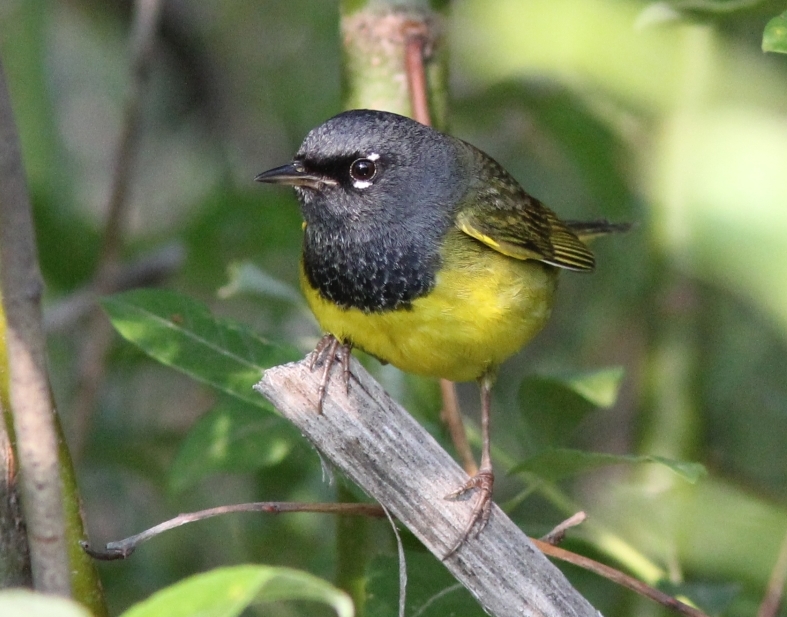
Mourning Warbler
Geothlypis philadelphia
Order: Passeriformes / Family: Parulidae

Wikimedia Commons
About the Mourning Warbler
The Mourning Warbler, Geothlypis philadelphia, is a small songbird that captivates birdwatchers with its striking appearance and elusive nature. This warbler belongs to the Parulidae family, a group known for their vibrant plumage and melodic songs. Within their preferred habitats, Mourning Warblers play a critical role in insect population control, particularly during their breeding season, when their dietary needs increase. They primarily inhabit the dense undergrowth of deciduous and mixed forests, where they find ample cover and food resources. Geographically, their breeding range extends across the northeastern United States and southern Canada, including regions such as the Great Lakes area, New England, and the Canadian Maritimes. In these locations, they prefer moist, forested environments with thick understory vegetation, often near water sources. During the breeding season, these warblers engage in behaviors that are both fascinating and vital to their reproductive success. Males establish territories and protect them vigorously from rivals, using their distinctive song as a tool for both mate attraction and territory defense. As the breeding season concludes, Mourning Warblers embark on long migrations to their wintering grounds in Central America. Their journey takes them through a variety of landscapes, showcasing their adaptability to different environments. During migration, they often stop in woodlands, shrubby areas, and even urban parks, where they refuel for the next leg of their journey. The Mourning Warbler's ecological role extends beyond insect predation. As they migrate and forage, they inadvertently contribute to seed dispersal and pollination, which are crucial processes for maintaining healthy ecosystems. Their presence in diverse habitats across their range highlights the interconnectedness of ecosystems and the importance of preserving natural spaces for migratory species. Overall, the Mourning Warbler serves as a reminder of the beauty and complexity of avian life, as well as the ongoing need for conservation efforts to ensure the survival of these vibrant creatures in an ever-changing world.
The Mourning Warbler belongs to the family Parulidae, within the order Passeriformes. These birds typically live average lifespan is 4-5 years with a maximum recorded of 7 years..
How to Identify a Mourning Warbler
Adult Mourning Warblers exhibit a distinctive plumage that aids in their identification. Males are particularly striking with their gray hoods, which contrast sharply with their olive-green backs and wings. Their bright yellow underparts provide a vivid splash of color that is characteristic of the species. Females and juveniles are more subdued in appearance, lacking the gray hood and presenting a more uniform olive and yellow coloration. This dimorphism helps in distinguishing males from females in the field. Juveniles often have faint eye rings and a more mottled appearance, which can lead to confusion with other warbler species. When observing Mourning Warblers, it is crucial to note their posture and behavior. They often perch low in dense vegetation, making them difficult to spot. Their flight is characterized by rapid wing beats interspersed with short glides, a pattern that is common among small passerines. In terms of similar species, the Connecticut Warbler can be mistaken for the Mourning Warbler, but the former has a more pronounced eye ring and a different song. Observers should pay close attention to these subtle differences to make an accurate identification.
Having trouble telling birds apart? Upload a photo to our bird identification tool for an instant species match.
Mourning Warbler Habitat and Range
Preferred Habitat
Mourning Warblers prefer habitats with dense undergrowth and ample cover. They are commonly found in deciduous and mixed forests, often in areas that have experienced disturbance, such as those recovering from logging or natural events like storms. These conditions create the thick understory vegetation that the species favors. Elevation-wise, they can be found from lowland areas to mid-elevation forests, particularly in the Appalachian region. During migration, they adapt to a wider range of habitats, including shrubby fields, forest edges, and even urban green spaces. Seasonal shifts are evident as they move from breeding habitats in the north to wintering areas in Central America, where they continue to seek dense shrubbery and forest edges. While they generally avoid developed urban areas, they may occasionally be found in parks or gardens that provide sufficient cover and food.
Geographic Range
The breeding range of the Mourning Warbler spans the northeastern United States and southern Canada. They are widely distributed in states like New York, Pennsylvania, and the New England region, as well as Canadian provinces such as Ontario, Quebec, and the Maritimes. During migration, they travel through the eastern United States, utilizing various stopover sites to rest and feed. This journey takes them to their wintering grounds in Central America, including countries like Honduras, Nicaragua, and Costa Rica. Within these regions, they are less commonly observed due to their preference for dense, shrubby areas. Despite this broad range, population densities are patchy, with hotspots occurring in areas with abundant suitable habitat. Understanding their migratory corridors and seasonal movements is crucial for conservation efforts, as these pathways are essential for their survival.
Want to know which birds visit your area? Browse our backyard birds by location guides for region-specific species lists.
What Does the Mourning Warbler Eat?
Mourning Warblers primarily feed on insects and other arthropods, which they glean from foliage and vegetation. Their diet includes caterpillars, beetles, spiders, and flies, providing a vital service in controlling pest populations. During the breeding season, their energy demands increase, leading to a higher consumption of protein-rich prey. As seasons change and they migrate, their diet becomes more varied, incorporating berries and other small fruits when available. This dietary flexibility aids in their survival across diverse habitats. Mourning Warblers employ a foraging technique known as foliage gleaning, where they deftly pick insects from leaves and branches. This method allows them to exploit their preferred habitats effectively. They typically forage at dawn and dusk, times when insect activity is high and predation risk is lower.
Mourning Warbler Behavior and Social Structure
Mourning Warblers exhibit intriguing behaviors that reflect their adaptability and social structure. During the breeding season, males establish territories that they defend vigorously through song and display. Their territorial behavior includes chasing intruders and engaging in aerial displays. Courtship involves males singing persistently to attract females, often while perched in dense cover. Once paired, they show strong pair bonds, with both sexes participating in nesting and rearing of young. Mourning Warblers are generally solitary outside the breeding season, although they may form loose flocks during migration. This flocking behavior provides safety in numbers and enhances foraging efficiency. In response to predators, they exhibit alarm calls and evasive maneuvers, often diving into dense vegetation for cover. Their daily activity patterns include periods of intense foraging interspersed with rest, a strategy that conserves energy while maximizing food intake.
Mourning Warbler Nesting and Reproduction
Mourning Warblers construct cup-shaped nests using grass, leaves, and other plant materials. These nests are typically located close to the ground, concealed within dense shrubs or low branches. The female primarily builds the nest and lays a clutch of 3-5 eggs, which she incubates for about 12 days. During this period, the male provides food and protection. After hatching, both parents are involved in feeding the chicks, which fledge approximately 10-12 days after hatching. Mourning Warblers generally raise one brood per year, though they may attempt a second if conditions allow. Their choice of nesting site and materials reflects their adaptation to environments that provide both concealment and proximity to food resources, crucial for the survival of their young.
Mourning Warbler Sounds and Vocalizations
The primary song of the Mourning Warbler is a rich, melodic series of phrases that can be described as 'chirry-chirry-chirry-chorry-chorry.' This song is delivered with a distinctive rhythm and a clear, ringing quality. It serves both to establish territory and to attract a mate. In addition to their song, Mourning Warblers produce various call notes that are sharp and metallic, used for communication between mates and as alarm signals. During the dawn chorus, their song stands out among the cacophony of other bird calls, making it a key identifier for birdwatchers. The song's structure and pitch are similar to those of other warblers, but careful listening can discern the unique pattern of the Mourning Warbler.
Interesting Facts About the Mourning Warbler
- 1The Mourning Warbler is named for its hooded appearance, which resembles the traditional attire of mourners.
- 2They are one of the later warblers to arrive on their breeding grounds, typically appearing in late May.
- 3Despite their vibrant appearance, their secretive nature makes them a challenging bird to observe in the wild.
- 4Mourning Warblers have a strong preference for habitats that have been recently disturbed or regenerated.
- 5Their migration can cover thousands of miles, showcasing impressive navigational skills.
- 6The species was first described in 1789 by the German naturalist Johann Friedrich Gmelin.
- 7They can live up to 8 years in the wild, although most have shorter life spans due to predation and environmental factors.
Mourning Warbler Conservation Status
The Mourning Warbler is currently listed as Least Concern by the IUCN, with a stable population trend across its range. However, habitat loss due to deforestation and land-use changes poses a significant threat to their breeding and wintering habitats. Conservation efforts focus on preserving and restoring forested areas with thick understory vegetation, which are critical for their survival. Historical population changes indicate fluctuations due to habitat availability, emphasizing the need for ongoing monitoring. Collaborative efforts between countries in their migratory range are essential to ensure that the Mourning Warbler's habitat needs are met throughout its life cycle.
Other Parulidae Species


Birds Similar to the Mourning Warbler
These species are often confused with the Mourning Warbler due to similar appearance or overlapping range.