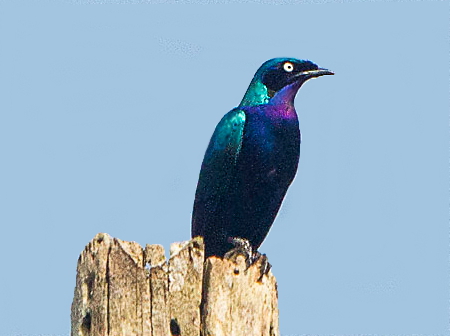
Copper-tailed Starling
Hylopsar cupreocauda
Order: Passeriformes / Family: Sturnidae

Wikimedia Commons
About the Copper-tailed Starling
The Copper-tailed Starling (Hylopsar cupreocauda) is a medium-sized bird belonging to the family Sturnidae. Known for its striking coppery tail feathers, this bird is native to the dense tropical forests of West Africa, specifically in countries such as Sierra Leone, Liberia, and Ivory Coast. The Copper-tailed Starling plays an essential role in maintaining the ecological balance within its habitat. By consuming a diverse diet of insects and fruits, it contributes to pest control and seed dispersal. As a member of the passerine order, it exhibits a complex social structure and vocal communication system. During the breeding season, this starling becomes particularly noticeable due to its vibrant plumage and elaborate courtship displays. The Copper-tailed Starling is an important species for birdwatchers and researchers alike, as it provides insight into the health of tropical forest ecosystems. Its presence in a region often indicates a well-preserved environment, as it requires dense canopy cover and a rich diversity of food sources. This bird is also a subject of interest for ornithologists who study the impacts of habitat fragmentation and climate change on forest-dependent species. The Copper-tailed Starling's adaptability to different forest types, from primary to secondary growth, allows it to maintain its population despite some environmental pressures. However, deforestation and habitat degradation pose ongoing threats to its survival, emphasizing the need for conservation efforts to protect its natural habitat. Seasonal behaviors of the Copper-tailed Starling include migrations within its range in response to food availability and breeding conditions. During the wet season, when insect populations peak, the starling's foraging activities intensify to provide for its young. In contrast, the dry season sees these birds congregating in larger flocks, often moving to more open areas where food resources are accessible. These seasonal movements highlight the starling's adaptability and its importance as an ecological indicator in its native range.
The Copper-tailed Starling belongs to the family Sturnidae, within the order Passeriformes. These birds typically live estimated at 5-7 years, with some individuals reaching up to 9 years..
How to Identify a Copper-tailed Starling
The Copper-tailed Starling is easily identified by its metallic copper tail, which contrasts with its predominantly glossy green plumage. Adult birds exhibit a vibrant sheen that can appear turquoise or blue-green under certain lighting conditions. Juveniles, however, display duller colors, lacking the full intensity of the mature birds, and their tails may not yet have the complete coppery tone. In terms of sexual dimorphism, males and females appear quite similar, although males might show slightly more iridescence and a longer tail. One must carefully observe the tail color to distinguish it from similar species such as the Splendid Starling, which lacks the distinct copper coloration. In flight, the Copper-tailed Starling's silhouette is characterized by a relatively short tail and broad wings, which aid in its agile maneuvering through dense foliage. When perched, this starling adopts an upright posture, often flicking its tail and wings, especially when displaying or communicating with others. The bird's sharp bill and keen eyes aid in locating food, contributing to its effective foraging strategy.
Having trouble telling birds apart? Upload a photo to our bird identification tool for an instant species match.
Copper-tailed Starling Habitat and Range
Preferred Habitat
The Copper-tailed Starling thrives in tropical and subtropical moist broadleaf forests, favoring areas with dense canopy cover. These habitats provide essential resources such as food and nesting sites. The bird is predominantly found at low elevations, often below 1,000 meters, where the forest is most lush. Although primarily a forest dweller, it can occasionally be spotted in secondary growth and forest edges. During certain times of the year, particularly in the dry season, the starling may venture into more open areas such as savannas or agricultural fields, where it forms larger flocks. Its adaptability to various forest types makes it a resilient species, though it still prefers undisturbed habitats for breeding and shelter. The Copper-tailed Starling's presence in urban areas is uncommon, as it relies heavily on the resources provided by forest ecosystems.
Geographic Range
The breeding range of the Copper-tailed Starling spans the tropical regions of West Africa, including countries like Sierra Leone, Liberia, and Ivory Coast. It occupies a relatively small geographic area compared to other starling species, making it somewhat specialized in its habitat preferences. This bird is a resident species, meaning it does not undertake long-distance migrations like some other starlings. However, it does exhibit local movements within its range in response to seasonal changes in food availability. The Copper-tailed Starling tends to concentrate in areas with abundant fruiting trees and insect populations, often forming loose colonies in regions with optimal conditions. Despite its limited range, population densities can be quite high in suitable habitats, with the bird playing a significant role in the local ecosystem. The starling's dependence on specific forest types makes it vulnerable to habitat destruction, emphasizing the need for targeted conservation efforts in its native range.
Want to know which birds visit your area? Browse our backyard birds by location guides for region-specific species lists.
What Does the Copper-tailed Starling Eat?
The Copper-tailed Starling primarily feeds on insects and fruits, showcasing a versatile diet that varies with the seasons. During the wet season, insects such as beetles, caterpillars, and ants become the mainstay of its diet, providing essential protein for breeding and rearing young. The starling employs a variety of foraging techniques, including gleaning from foliage, hovering to catch prey, and occasionally following army ant swarms to capture fleeing insects. In the dry season, when insect abundance decreases, the Copper-tailed Starling shifts its diet to include more fruits and berries. It is particularly fond of figs and other fleshy fruits, which provide much-needed energy and moisture. This dietary flexibility allows the starling to thrive in its forest environment, ensuring a consistent food supply throughout the year. The starling's feeding schedule typically involves morning and late afternoon activities, capitalizing on the cooler parts of the day for foraging.
Copper-tailed Starling Behavior and Social Structure
The Copper-tailed Starling is a social bird, often found in small flocks outside the breeding season. Its social structure is complex, with individuals forming loose colonies during the breeding season to maximize resource sharing. Territorial behavior becomes evident during this time, as males aggressively defend their nesting sites through song and display. Courtship displays are particularly elaborate, involving a combination of vocalizations and physical gestures, such as wing spreading and tail fanning, to attract mates. Flocking patterns change with the seasons; during the dry season, larger aggregations form, sometimes joining other starling species to exploit food resources. The Copper-tailed Starling is diurnal, with peak activity occurring in the early morning and late afternoon. It exhibits a range of vocal behaviors, using a repertoire of calls for communication within the flock. When faced with predators, the starling relies on both vocal alarms and mobbing behavior to deter threats. Its adaptability to group living provides increased protection against predators, as there are more eyes to spot potential dangers.
Copper-tailed Starling Nesting and Reproduction
The Copper-tailed Starling typically nests in tree cavities, either natural or those excavated by other species such as woodpeckers. These cavities provide a secure environment for raising young. The starling lines its nest with grasses, leaves, and feathers to create a comfortable and insulated space. Clutch size usually ranges from two to four eggs, with the female primarily responsible for incubation over a period of about two weeks. Both parents partake in feeding the chicks, which fledge approximately three weeks after hatching. The fledging period is critical, as young birds must quickly learn to forage and evade predators. The Copper-tailed Starling often raises two broods per year, particularly if environmental conditions are favorable. Parental roles are well-defined, with males sometimes assisting in defending the nesting territory and providing food for the female and chicks.
Copper-tailed Starling Sounds and Vocalizations
The Copper-tailed Starling's primary song is a melodious series of whistles and trills, often delivered from a high perch. The rhythm is varied and can include both low-pitched warbles and high-pitched notes, creating a complex and pleasing soundscape. Call notes are sharp and serve as communication signals within the flock, often used to coordinate movements or alert others to potential threats. Alarm calls are more strident, designed to warn of predators and prompt a collective defensive response. During the dawn chorus, the starling's song is particularly prominent, contributing to the vibrant acoustic environment of its forest home. The sound can be compared to a blend of fluty whistles mixed with harsher, chattering notes, reminiscent of other tropical starling species.
Interesting Facts About the Copper-tailed Starling
- 1The Copper-tailed Starling's iridescent plumage appears to change color depending on the angle of light, ranging from green to blue.
- 2This starling is known to follow army ant swarms, capturing insects and other small creatures that attempt to escape the ants.
- 3Despite its vibrant appearance, the Copper-tailed Starling remains well-camouflaged in the forest, blending with the dappled sunlight.
- 4The species' ability to adapt to both primary and secondary forests has allowed it to survive in areas affected by human activity.
- 5Copper-tailed Starlings are important seed dispersers, aiding in the regeneration of forest areas by spreading seeds over wide distances.
- 6The starling's song repertoire can include up to 20 different sound variations, showcasing its vocal adaptability.
- 7During the breeding season, these starlings may engage in cooperative breeding, with non-breeding individuals helping to raise young.
Copper-tailed Starling Conservation Status
The Copper-tailed Starling is currently classified as Least Concern by the IUCN, but its population trend is declining due to habitat loss and deforestation. The primary threat to this species is the degradation of its forest habitat, driven by logging, agriculture, and human settlement expansion. Conservation efforts focus on protecting remaining forest areas and promoting sustainable land-use practices. In recent decades, the starling's range has contracted slightly, emphasizing the need for ongoing monitoring and habitat restoration initiatives. While it remains relatively common within its preferred range, ongoing environmental pressures could lead to further declines if not addressed.
Other Sturnidae Species


Birds Similar to the Copper-tailed Starling
These species are often confused with the Copper-tailed Starling due to similar appearance or overlapping range.