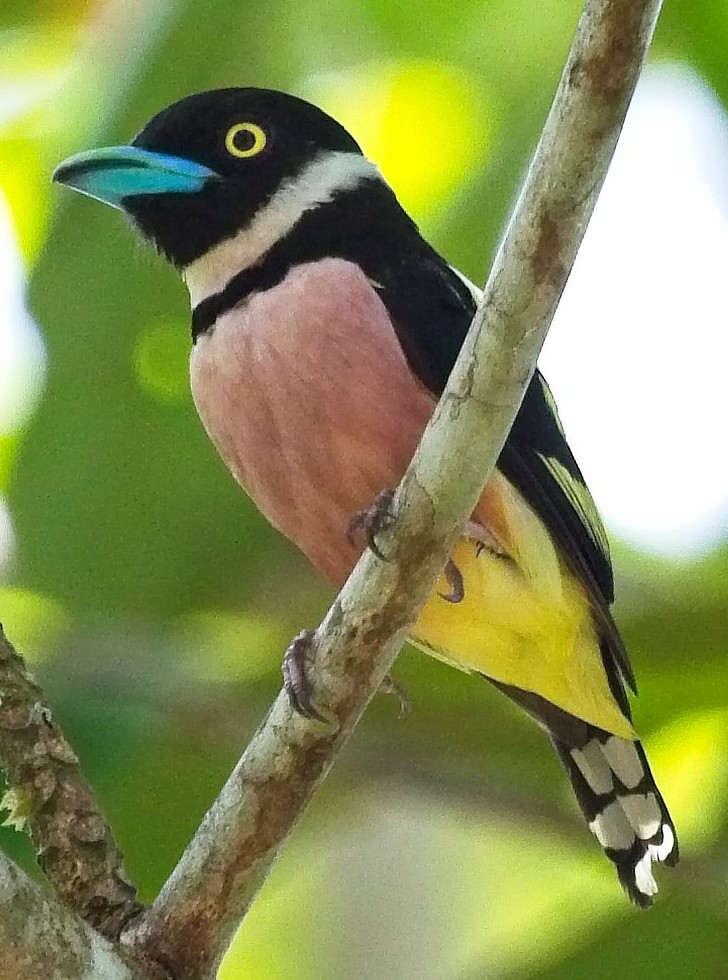
Temminck's Broadbill
Corydon temminckii
Order: Passeriformes / Family: Eurylaimidae
About the Temminck's Broadbill
Temminck's Broadbill, known scientifically as Corydon temminckii, is a striking bird belonging to the family Eurylaimidae. This mid-sized bird, often found in the lush lowland and montane forests of Southeast Asia, stands out with its vivid coloration and unique vocalizations. Its range extends from southern Thailand through the Malay Peninsula to Borneo and Sumatra, thriving primarily in tropical and subtropical moist broadleaf forests. As a key component of its ecosystem, Temminck's Broadbill plays a role in seed dispersal and the control of insect populations. Its presence is often a sign of healthy forest ecosystems, making it a valuable indicator species for conservationists monitoring habitat integrity.
The ecological significance of Temminck's Broadbill cannot be overstated. As a frugivore and insectivore, it consumes a wide variety of fruits and arthropods, thus participating actively in the food chain. During the breeding season, typically from March to August, these birds become especially active, with males engaging in elaborate courtship displays to attract females. Outside the breeding season, they may form small, loose flocks, which helps them in foraging and offers protection against predators. Their colorful presence and intriguing behaviors make them a favorite among bird watchers and researchers alike, and they contribute to the biodiversity of the regions they inhabit.
Temminck's Broadbill's preferred habitats include primary and secondary forests, where dense canopies provide ample cover and food resources. They exhibit some degree of altitudinal migration, often moving to lower elevations during the non-breeding season. This seasonal movement helps them exploit different ecological niches and ensures their survival during food-scarce periods. Their adaptability to various forest types and altitudes highlights their resilience, even as they face habitat destruction due to logging and agricultural expansion. Conservation efforts are crucial in preserving the habitats of Temminck's Broadbill, ensuring that this captivating bird continues to thrive in its natural environment.
The Temminck's Broadbill belongs to the family Eurylaimidae, within the order Passeriformes. These birds typically live average 6-8 years with a maximum recorded of 10 years.
How to Identify a Temminck's Broadbill
The Temminck's Broadbill is unmistakable with its vivid green plumage, broad, flat bill, and a striking combination of blue and black markings. Adult males and females exhibit similar plumage, making gender identification in the field challenging without behavioral context. However, juveniles can be distinguished by their duller coloration and less pronounced blue and black markings, which gradually intensify as they mature. The bill is a defining feature, not only wide but also slightly hooked, adapted for its diverse diet of fruits and insects.
In flight, Temminck's Broadbill displays a short, rounded silhouette, with rounded wings and a slightly elongated tail. This shape is typical of the broadbill family, allowing for agile maneuvering through dense foliage. Perching, they often sit upright on branches, their bright plumage providing a stark contrast against the surrounding greenery. This posture aids in camouflage when observed from above but makes them conspicuous from below.
Though similar in color to some other forest birds, such as leafbirds and green pigeons, the Temminck's Broadbill is distinct due to its unique bill and the specific pattern of blue and black on its head and wings. Observers should note these key features to prevent confusion with other species.
Having trouble telling birds apart? Upload a photo to our bird identification tool for an instant species match.
Temminck's Broadbill Habitat and Range
Preferred Habitat
Temminck's Broadbill thrives in the dense canopies of tropical and subtropical moist broadleaf forests. It prefers primary forests but can also inhabit well-preserved secondary forests. In Southeast Asia, these birds are frequently encountered in lowland forests up to elevations of about 1,500 meters. They are most commonly found in regions with high humidity and ample rainfall, which support the lush vegetation they rely on for food and shelter.
During the non-breeding season, Temminck's Broadbill may descend to lower elevations, taking advantage of different food resources and microclimates. While they are primarily forest dwellers, their presence in semi-urban areas is rare, and they do not generally adapt well to heavily disturbed habitats. Thus, their distribution is closely tied to the availability of intact forest environments, making them vulnerable to habitat loss.
Efforts to preserve these habitats are essential for maintaining the population of Temminck's Broadbill. As forests continue to face threats from deforestation and agricultural expansion, conservationists emphasize the importance of protecting both lowland and montane forest ecosystems.
Geographic Range
The range of Temminck's Broadbill extends across several key regions in Southeast Asia, including southern Thailand, the Malay Peninsula, Sumatra, and Borneo. These regions offer the dense forest habitats essential for their survival. In Thailand, they are found primarily in the southern provinces, where intact forest habitats remain. The Malay Peninsula provides a significant portion of their range, with populations concentrated in both Malaysia and southern Thailand.
In addition to the Malay Peninsula, Temminck's Broadbill is also present in the large forested areas of Sumatra and Borneo. These islands offer suitable habitats within their expansive primary and secondary forests. The broadbill does not undergo long-distance migrations; instead, it exhibits altitudinal movements within its range, particularly in response to food availability and climatic conditions.
Population density tends to be highest in areas with minimal human disturbance and rich, diverse forest ecosystems. Conservation areas and national parks in these regions often serve as strongholds for the species. The broadbill's restricted range highlights its vulnerability to habitat destruction, underscoring the importance of targeted conservation actions in these key areas.
Want to know which birds visit your area? Browse our backyard birds by location guides for region-specific species lists.
What Does the Temminck's Broadbill Eat?
Temminck's Broadbill has a varied diet that includes a mix of fruits and insects, making it both a frugivore and insectivore. This dietary flexibility allows it to exploit different food resources throughout the year, depending on availability. Primary food sources include figs and other small fruits, which they pluck with precision using their specialized bills.
In addition to fruits, Temminck's Broadbill consumes a range of arthropods, including caterpillars, beetles, and spiders. These are typically gleaned from leaves and branches, demonstrating the bird's adept foraging skills. During the breeding season, the demand for protein-rich insects increases, providing necessary nutrition for growing chicks.
Foraging typically occurs in the early morning and late afternoon, coinciding with periods of peak insect activity. This schedule helps the broadbill maximize its energy intake while avoiding the heat of midday. By participating in both seed dispersal and insect population control, Temminck's Broadbill plays a crucial role in maintaining the ecological balance of its forest habitat.
Temminck's Broadbill Behavior and Social Structure
Temminck's Broadbill is known for its social and often gregarious behavior. While they are not highly territorial outside the breeding season, they do defend their nesting areas vigorously. During this period, males engage in elaborate courtship displays, which include vocalizations and visual displays to attract females. These courtship rituals strengthen pair bonds and are a critical aspect of their reproductive success.
Flocking behavior is common among Temminck's Broadbills, especially outside the breeding season. They often form small, loose groups, which can include other broadbill species and even different bird families, such as babblers. This flocking provides advantages in foraging efficiency and predator detection. The broadbills communicate constantly through a series of calls, maintaining group cohesion and alerting each other to threats.
Their daily activity patterns are bimodal, with peaks in activity during the cooler parts of the day, such as early morning and late afternoon. These periods are optimal for foraging and social interactions. In response to predators, Temminck's Broadbills rely on their cryptic plumage and swift flight to evade capture, often retreating into dense foliage where they are less visible.
Temminck's Broadbill Nesting and Reproduction
Temminck's Broadbill constructs its nest in a unique, pendant style, often hanging from the branches of trees in dense forests. These nests are intricately woven from moss, leaves, and plant fibers, providing both camouflage and protection from the elements. The preferred nesting sites are typically located 5 to 15 meters above the ground, ensuring safety from ground-dwelling predators.
The breeding season for Temminck's Broadbill generally occurs from March to August. During this time, a pair will lay a clutch of 2 to 3 eggs. The eggs are incubated primarily by the female, with the male occasionally assisting. Incubation lasts about 18 to 20 days, after which the chicks hatch and are reared by both parents.
Fledging occurs approximately 20 to 25 days post-hatching, with the young birds remaining with their parents for several weeks as they learn to forage independently. Temminck's Broadbill typically raises one brood per year, although in optimal conditions, a second brood may be attempted. The parental investment in nest building and chick rearing highlights the species' commitment to ensuring the survival of their offspring.
Temminck's Broadbill Sounds and Vocalizations
The vocalizations of Temminck's Broadbill are distinctive, consisting of a series of melodious whistles and trills. Their primary song, often heard during the breeding season, is a rhythmic sequence of clear, high-pitched notes that rise and fall in a musical cadence. This song serves both to establish territory and to attract mates.
In addition to their primary song, Temminck's Broadbills produce softer call notes, often used in communication with flock members or as contact calls between mates. Alarm calls, which are sharper and more abrupt, are utilized to alert others to the presence of predators.
During the dawn chorus, Temminck's Broadbill contributes a rich tapestry of sound to the forest soundscape, their calls blending with those of other species. Their musical quality and variety of vocalizations make them a delight to hear, providing a sonic signature of the vibrant forest ecosystem they inhabit.
Interesting Facts About the Temminck's Broadbill
- 1Temminck's Broadbill is named after the Dutch naturalist Coenraad Jacob Temminck, a pioneer in ornithology.
- 2The broadbill's nest is often suspended from thin branches, making it difficult for predators to reach.
- 3Temminck's Broadbill uses its wide bill not only for eating but also for intricate nest construction.
- 4Despite their vivid green plumage, Temminck's Broadbills can blend into their surroundings remarkably well.
- 5The species' scientific name, Corydon temminckii, reflects its unique taxonomic placement among broadbills.
- 6Temminck's Broadbill can be found at elevations up to 1,500 meters, showcasing its adaptability to various forest habitats.
- 7The bird's diet shifts seasonally, with a higher intake of insects during breeding season to support chick development.
Temminck's Broadbill Conservation Status
Temminck's Broadbill is currently listed as Least Concern by the IUCN, indicating that it is not immediately threatened with extinction. However, the species faces significant challenges due to habitat loss and fragmentation, primarily driven by logging and agricultural expansion. Despite its current status, conservationists express concern over ongoing habitat destruction, which could impact the broadbill's population in the long term. Efforts to preserve Temminck's Broadbill focus on protecting its critical forest habitats. This includes the establishment and management of protected areas, as well as reforestation initiatives aimed at restoring degraded lands. Monitoring programs are also in place to track population trends and assess the effectiveness of conservation measures. Historically, the broadbill's population has remained relatively stable, but continued vigilance is necessary to ensure that it does not decline. Public awareness campaigns emphasize the importance of biodiversity and the need to preserve the unique ecosystems that support species like Temminck's Broadbill.
Other Eurylaimidae Species


Birds Similar to the Temminck's Broadbill
These species are often confused with the Temminck's Broadbill due to similar appearance or overlapping range.