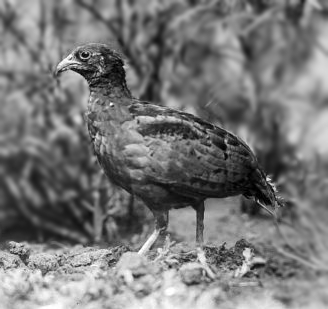
Crested Partridge
Rollulus rouloul
Order: Galliformes / Family: Phasianidae

Wikimedia Commons
About the Crested Partridge
The Crested Partridge (Rollulus rouloul) resides predominantly in the dense tropical rainforests of Southeast Asia, particularly in areas like the Malay Peninsula, Sumatra, and Borneo. This bird belongs to the family Phasianidae and is a unique member of the Galliformes order, known for its vibrant and distinctive appearance. The Crested Partridge plays a crucial role in its ecosystem. As a seed disperser, it aids in maintaining the health and diversity of its native forests. Its ground-dwelling habits make it an integral part of the forest floor's ecological dynamics, contributing to the breakdown of organic material through its foraging activities. During the breeding season, which coincides with the monsoon period, the Crested Partridge displays fascinating behaviors. Males engage in courtship displays characterized by loud calls and visual exhibitions of their vivid red crests and iridescent green plumage. The species exhibits year-round territorial behavior, with pairs staying in close proximity to their established territories. The seasonal abundance of food resources during the wet season facilitates breeding, while the dry season sees a more solitary lifestyle. Although primarily terrestrial, the Crested Partridge can be observed roosting in low branches or shrubs to avoid ground predators. Their activities chiefly occur during dawn and dusk, taking advantage of cooler temperatures and reduced predation risk. The bird's adaptation to life on the forest floor includes strong legs for walking and scratching through leaf litter, essential for locating insects and seeds. The Crested Partridge's presence in a rainforest signals a healthy, undisturbed ecosystem, as it thrives away from human-altered landscapes. Its preference for primary forests makes it susceptible to habitat loss, a growing concern in Southeast Asia due to logging and agricultural expansion. Conservation efforts focus on protecting large tracts of contiguous rainforest to ensure the survival of this and other forest-dependent species. Understanding the Crested Partridge's role and behavior in its environment offers valuable insights into the complex web of tropical forest ecology.
The Crested Partridge belongs to the family Phasianidae, within the order Galliformes. These birds typically live approximately 8-10 years in the wild..
How to Identify a Crested Partridge
The Crested Partridge, also known as the Roul-roul Partridge, is unmistakable due to its vibrant and diverse coloration. Adult males are particularly striking, featuring a prominent red crest atop a black head. Their bodies showcase iridescent green plumage that shimmers in sunlight, while the underparts are a deep maroon. Females, in contrast, possess a more subdued appearance with a greenish-brown plumage and lack the male's red crest, which provides them with better camouflage in the dense forest undergrowth. Juveniles resemble females but are duller, with less pronounced coloration. A key identification feature is the bright red eye-ring found in both sexes, which stands out against their darker head feathers. The species' short tail and rounded wings are adapted for their preferred terrestrial lifestyle, allowing quick escapes into thick vegetation rather than long-distance flights. Confusion with other species is rare due to these distinctive features. However, their shy nature often means that birders may hear the Crested Partridge before seeing it, as they emit soft cooing and drumming sounds while moving through the forest. Observing their traditional head-bobbing movement and short, low flights can also assist in identification.
Having trouble telling birds apart? Upload a photo to our bird identification tool for an instant species match.
Crested Partridge Habitat and Range
Preferred Habitat
The Crested Partridge thrives in lowland primary rainforests, where dense vegetation provides both food and cover. It prefers areas with thick undergrowth and abundant leaf litter, which offer ample foraging opportunities. Found at elevations up to 1,200 meters, this bird is most commonly associated with the lush forests of the Malay Peninsula, Sumatra, and Borneo. Seasonal habitat shifts are minimal since the Crested Partridge is non-migratory, relying on the stable climate provided by tropical rainforests. Unlike some other forest birds, it rarely ventures into disturbed areas or secondary forests, highlighting its dependence on pristine environments. Although primarily a forest species, it occasionally adapts to forest edge habitats, especially when primary forests are encroached upon. Urban presence is virtually nonexistent due to its specific habitat needs.
Geographic Range
The Crested Partridge is native to the tropical regions of Southeast Asia, with a range that includes the Malay Peninsula, Sumatra, and Borneo. Its distribution is largely determined by the availability of suitable lowland rainforest habitats, which are increasingly threatened by human activities. This species does not undertake long-distance migrations and remains within its tropical range throughout the year. Regions like Thailand and parts of Myanmar also host populations of the Crested Partridge, although these are less dense compared to the core areas. In these habitats, population densities can vary significantly, with hotspots often found in protected areas where deforestation is limited. The species' reliance on primary forest makes it a key indicator of habitat health. Despite its broad range, localized populations may experience isolation due to habitat fragmentation, impacting genetic diversity and long-term survival prospects.
Want to know which birds visit your area? Browse our backyard birds by location guides for region-specific species lists.
What Does the Crested Partridge Eat?
The Crested Partridge primarily feeds on seeds, fruits, and small invertebrates found on the forest floor. Its diet varies seasonally, taking advantage of the abundance of fallen fruits and seeds during the wet season. In drier periods, insects and other small invertebrates become more important dietary components. This bird employs a foraging technique that involves scratching the forest floor with its strong legs to uncover hidden food items. It occasionally feeds on small snails, grubs, and beetles, which provide essential protein. The Crested Partridge's feeding schedule is mainly crepuscular, with peak activity during the early morning and late afternoon when temperatures are cooler. This schedule helps it avoid the heat of the day and reduces exposure to predators. The bird's ability to exploit a wide range of food sources ensures its survival in the diverse and dynamic rainforest ecosystem.
Crested Partridge Behavior and Social Structure
Crested Partridges exhibit a complex social structure, typically forming monogamous pairs that defend a territory throughout the year. These territories are vigorously defended, with males displaying their vibrant crests and engaging in low-frequency vocalizations to ward off intruders. Courtship displays are elaborate, involving a series of calls, wing flicks, and crest displays designed to attract a mate. During non-breeding seasons, they may be seen in small family groups, although they generally do not form large flocks. The Crested Partridge is primarily terrestrial, spending most of its time on the forest floor. It reacts to predators with a combination of quick, fluttering escapes into dense underbrush and an alarm call that alerts other birds. Daily activities are concentrated around foraging and territorial defense, with periods of rest during the hottest parts of the day. This species relies on camouflage and stillness to evade detection, blending into the forest floor foliage when threatened.
Crested Partridge Nesting and Reproduction
The Crested Partridge constructs a simple yet effective nest, typically on the ground among dense vegetation. The nest consists of a shallow scrape lined with leaves and twigs, providing a degree of insulation and camouflage. Preferred nesting sites are often near fallen logs or dense thickets, offering protection from predators. Clutch size generally ranges from four to six eggs, which are incubated primarily by the female. The incubation period lasts about 18 to 19 days, after which the chicks hatch and are precocial, meaning they are relatively mature and mobile from birth. Both parents take on the role of nurturing and protecting the young, guiding them to food sources and teaching them essential foraging skills. The fledging period is relatively short, with chicks gaining independence within a few weeks. Typically, the Crested Partridge raises only one brood per year, with breeding timed to coincide with peak food availability.
Crested Partridge Sounds and Vocalizations
The Crested Partridge is known for its distinctive vocalizations, which include a series of low-frequency coos and soft drumming sounds that resonate through the forest. These calls serve as both communication between mates and territorial signals. The primary song consists of a rhythmic sequence that can be described as a series of descending notes, each delivered with a deep, resonant quality. Alarm calls are sharper and more urgent, designed to alert other birds to potential danger. During the dawn chorus, the Crested Partridge's calls blend with the ambient sounds of the rainforest, contributing to the overall acoustic environment. Its vocalizations are not as melodious as songbirds but are crucial for maintaining territory and social bonds.
Interesting Facts About the Crested Partridge
- 1The Crested Partridge's unique red crest is not just for show - it plays a vital role in communication and mating displays.
- 2Despite its vibrant colors, the Crested Partridge can be surprisingly difficult to spot due to its preference for dense underbrush.
- 3The species is one of the few ground-dwelling birds that roost in trees, a behavior that helps avoid predators at night.
- 4Crested Partridges are known for their rapid, low flights, which allow them to quickly escape threats without gaining much altitude.
- 5Unlike many birds, Crested Partridges do not migrate, relying instead on the year-round resources of their rainforest habitat.
- 6Their diet includes a surprising variety of foods, from seeds and fruits to small snails and beetles, showcasing their adaptability.
- 7Crested Partridges play a crucial ecological role by dispersing seeds throughout the forest, aiding in plant regeneration.
Crested Partridge Conservation Status
The Crested Partridge is currently listed as Near Threatened on the IUCN Red List, with populations showing a decreasing trend. The primary threat to this species is habitat loss due to deforestation and land conversion for agriculture. Logging activities in Southeast Asia have significantly reduced the availability of suitable habitats. Conservation efforts focus on protecting remaining primary forests and establishing new reserves to ensure habitat connectivity. Historically, the population has been more robust, but ongoing habitat degradation poses a significant risk. Efforts to curb illegal logging and promote sustainable land use practices are essential to safeguarding the future of the Crested Partridge. Collaborative initiatives involving local communities and international conservation organizations aim to mitigate the detrimental impacts of human activities on this species.
Other Phasianidae Species


Birds Similar to the Crested Partridge
These species are often confused with the Crested Partridge due to similar appearance or overlapping range.