
Long-billed Partridge
Rhizothera longirostris
Order: Galliformes / Family: Phasianidae
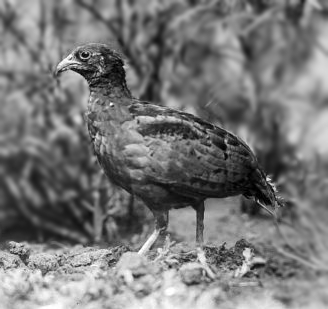
Wikimedia Commons
About the Long-billed Partridge
The Long-billed Partridge, known scientifically as Rhizothera longirostris, is a fascinating member of the Phasianidae family. This bird is primarily found in the lush, tropical rainforests of Southeast Asia, specifically in countries such as Malaysia, Thailand, and Indonesia. It thrives in these dense, humid habitats, which offer ample cover and food resources. The species' elongated bill is a distinctive adaptation, allowing it to probe the forest floor for insects and small invertebrates, its primary food sources.
In terms of ecological significance, the Long-billed Partridge plays a vital role in its ecosystem. As a ground-dwelling bird, it contributes to soil aeration and seed dispersal, helping maintain the health of the forest floor. Additionally, it serves as prey for larger predators, thus being an integral part of the food web.
Seasonally, this partridge may exhibit slight shifts in behavior, although it tends to remain relatively sedentary, given its reliance on specific habitat conditions. Unlike migratory species, the Long-billed Partridge does not undertake long-distance movements but may adjust its range slightly in response to food availability and other environmental factors. Despite its elusive nature and preference for dense cover, this bird's presence is a reliable indicator of a healthy forest ecosystem.
This bird's significance extends beyond its ecological role, as it holds cultural importance in some regions. Local communities may regard the Long-billed Partridge as a symbol of the natural richness of their homeland, emphasizing the need for conservation efforts to protect these vital habitats.
The Long-billed Partridge belongs to the family Phasianidae, within the order Galliformes. These birds typically live approximately 8-12 years in the wild..
How to Identify a Long-billed Partridge
Identifying the Long-billed Partridge involves observing several key field marks. Adults display a predominantly brown plumage, which provides excellent camouflage against the forest floor's leaf litter. The bird's long, slightly curved bill is its most distinctive feature, setting it apart from other partridge species. This adaptation is particularly useful for probing soil and leaf litter in search of food.
Juvenile Long-billed Partridges resemble adults but may have slightly duller plumage and a less pronounced bill. When comparing males and females, there is little sexual dimorphism in plumage, although males tend to be slightly larger. Observers may occasionally confuse this species with the related Crestless Fireback, but the latter lacks the distinctive long bill and exhibits a more pronounced crest.
In flight, the Long-billed Partridge presents a compact silhouette with rounded wings and a short tail. Its flight is typically low and direct, often restricted to short bursts through the underbrush. When perching, this bird tends to adopt a crouched posture, blending seamlessly with its surroundings and making visual detection challenging.
Having trouble telling birds apart? Upload a photo to our bird identification tool for an instant species match.
Long-billed Partridge Habitat and Range
Preferred Habitat
The Long-billed Partridge inhabits primary and secondary tropical rainforests, thriving in dense undergrowth where cover is abundant. It is typically found at elevations ranging from lowland areas up to 1500 meters, although most sightings occur below 1000 meters. This bird favors areas with a thick layer of leaf litter, which aids its foraging activities.
Throughout the year, the Long-billed Partridge remains within forested regions, showing little inclination to venture into urban or highly disturbed environments. Seasonal habitat shifts are minimal, as the bird's diet and nesting habits are closely tied to specific forest conditions, which provide both food and protective cover. Consequently, conservation of these habitats is crucial for the survival of this species.
Geographic Range
The Long-billed Partridge's range is confined to Southeast Asia, with populations primarily located in Malaysia, Thailand, and the islands of Borneo and Sumatra in Indonesia. It is a non-migratory species, remaining within its established range throughout the year. This limited geographic distribution makes it particularly susceptible to habitat loss and fragmentation.
Within its range, the Long-billed Partridge is most frequently found in regions with intact rainforest ecosystems. Population densities tend to be higher in areas where human disturbance is minimal, and where large tracts of forest remain. The bird's sedentary nature means it relies heavily on localized regions that offer suitable habitat, and any further reduction in these areas could have significant impacts on its populations.
Want to know which birds visit your area? Browse our backyard birds by location guides for region-specific species lists.
What Does the Long-billed Partridge Eat?
The diet of the Long-billed Partridge primarily consists of insects and small invertebrates, which it finds by probing the forest floor with its elongated bill. This bird is known for its efficient foraging technique, using its bill to overturn leaf litter and access hidden prey. Ants, beetles, and other small arthropods form the bulk of its diet, supplemented by seeds and plant matter when animal prey is scarce.
Seasonal changes in food availability can influence diet composition, but the Long-billed Partridge remains predominantly insectivorous year-round. Foraging occurs mainly during the early morning and late afternoon, times when prey is more active and temperatures are cooler. This bird's ability to exploit a variety of food sources within its habitat contributes to its adaptability and survival.
Long-billed Partridge Behavior and Social Structure
The Long-billed Partridge exhibits a range of interesting behaviors that reflect its adaptation to forest life. It is primarily a solitary or pair-living bird, with little evidence of flocking behavior outside of the breeding season. Territories are maintained by both males and females, who use vocalizations and displays to assert their presence and ward off intruders.
Courtship displays involve males showcasing their plumage and engaging in vocal duets with females. These displays strengthen pair bonds and facilitate successful breeding. During the day, the Long-billed Partridge is most active during the cooler parts of the morning and late afternoon, spending the hottest hours resting in shaded areas.
The bird's response to predators is to rely on its camouflage, remaining motionless when potential threats are near. If disturbed, it may take short, rapid flights to escape and seek cover. Its keen sense of hearing and ability to remain silent aid in avoiding detection by predators.
Long-billed Partridge Nesting and Reproduction
The nesting habits of the Long-billed Partridge are closely tied to the forest floor, where it constructs a simple nest hidden within dense vegetation or among fallen leaves. The nest comprises a shallow depression lined with leaves and soft plant materials, providing a concealed environment for the eggs.
A typical clutch consists of 4 to 6 eggs, which both parents incubate over a period of approximately 18 to 21 days. After hatching, the chicks are precocial, leaving the nest shortly after birth but remaining under the watchful care of the parents. The fledging period lasts around three weeks, with both parents playing active roles in feeding and protecting the young.
This species typically raises one brood per year, though favorable conditions may allow for a second. The reliance on specific nesting habitats underscores the importance of forest conservation for the Long-billed Partridge's reproductive success.
Long-billed Partridge Sounds and Vocalizations
The Long-billed Partridge's vocalizations are distinctive and serve important communication functions within its dense forest habitat. Its primary song is a series of soft, rhythmic whistles that can carry through the undergrowth, often described as having a melodious quality. These calls are typically used to establish territory and communicate between mates.
In addition to its song, the Long-billed Partridge produces a variety of call notes, including sharp clucks and low-pitched whistles, which can serve as alarm signals when predators are near. During the dawn chorus, these birds become particularly vocal, contributing to the rich soundscape of the rainforest.
Interesting Facts About the Long-billed Partridge
- 1The Long-billed Partridge's bill can measure up to 4 centimeters, making it one of the longest among partridges.
- 2Unlike many partridges, the Long-billed Partridge is not known for its flight skills, preferring to stay grounded.
- 3This bird's call can be heard up to 100 meters away, making it easier to detect by sound than sight.
- 4The Long-billed Partridge's diet shifts slightly seasonally, with more plant matter consumed in the dry season.
- 5Despite its elusive nature, the Long-billed Partridge is a key indicator species for forest health.
- 6The species' preference for dense cover makes it one of the more challenging partridges to observe in the wild.
- 7Conservation areas that protect the Long-billed Partridge also benefit a host of other forest species.
Long-billed Partridge Conservation Status
The Long-billed Partridge currently holds a conservation status of Near Threatened according to the IUCN Red List. Its population is experiencing a decreasing trend, primarily due to habitat loss and degradation caused by logging, agricultural expansion, and human settlement. The fragmentation of forest habitats poses a significant threat to its survival. Conservation efforts focus on preserving and restoring rainforest areas, with some regions establishing protected reserves to safeguard critical habitats. Continued monitoring of population trends is essential to ensure the species does not move closer to an endangered status.
Other Phasianidae Species


Birds Similar to the Long-billed Partridge
These species are often confused with the Long-billed Partridge due to similar appearance or overlapping range.
