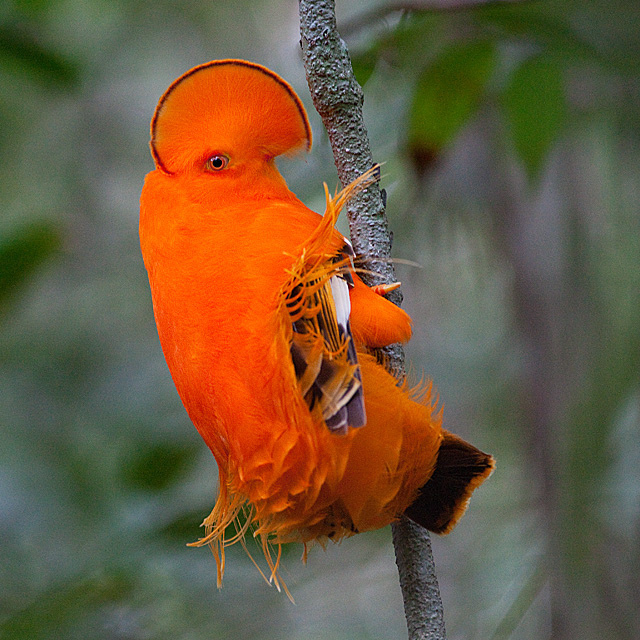
Crimson Fruitcrow
Haematoderus militaris
Order: Passeriformes / Family: Cotingidae

Wikimedia Commons
About the Crimson Fruitcrow
The Crimson Fruitcrow, Haematoderus militaris, is an avian marvel dwelling primarily within the lush expanses of the Amazon Basin. This species forms a part of the Cotingidae family, a group known for its flamboyant and often colorful members. As a native to the rainforests of countries like Brazil, Colombia, Venezuela, and Guyana, the Crimson Fruitcrow thrives in the dense canopy and understory. Its brilliant red plumage serves not only as a magnificent visual spectacle but also plays a role in mating displays and social interactions. This bird is significant within its habitat for its role in seed dispersal, a critical ecological function that supports forest regeneration. Typically, the Crimson Fruitcrow can be found flitting through the forest canopy, where it feeds on a variety of fruits and occasionally insects, contributing to the control of insect populations. The species displays a seasonal variation in behavior, becoming more conspicuous during the breeding season when its calls resonate through the forest. Despite its vivid appearance, the Crimson Fruitcrow remains somewhat elusive due to its preference for the dense, often inaccessible rainforests of its range. Its presence is an indicator of the health of tropical ecosystems, as it requires large, undisturbed tracts of forest to thrive. Conservation of these habitats is crucial, not only for the survival of the Crimson Fruitcrow but also for the myriad of species that share its environment. As deforestation and habitat fragmentation continue to threaten the Amazon, the conservation of the Crimson Fruitcrow serves as a reminder of the intricate connections between species and their habitats.
The Crimson Fruitcrow belongs to the family Cotingidae, within the order Passeriformes. These birds typically live averages 10-12 years, with a maximum recorded of 15 years..
How to Identify a Crimson Fruitcrow
The Crimson Fruitcrow is unmistakable with its vivid crimson plumage that covers most of its body. Adult males exhibit the brightest shades of red, while females and juveniles have slightly duller tones, incorporating hints of brown and orange. The bird's size is notable, with an average length of 34 cm, making it one of the larger cotingids. Its broad wings and long tail are adapted for maneuvering through the dense forest canopy. In flight, the Crimson Fruitcrow's silhouette is distinctive, with its expansive wings and elongated tail creating an elegant outline against the sky. Perched, the bird maintains a regal posture, often holding its head high. There is little risk of confusion with other species due to its unique coloration and size, although its red plumage might superficially resemble the Scarlet Tanager. However, the latter is significantly smaller and found in a different geographical range. The eye of the Crimson Fruitcrow is dark and contrasts sharply with its bright plumage, adding to its striking appearance.
Having trouble telling birds apart? Upload a photo to our bird identification tool for an instant species match.
Crimson Fruitcrow Habitat and Range
Preferred Habitat
The Crimson Fruitcrow inhabits tropical rainforests, favoring the tall, dense canopies typical of the Amazon Basin. It thrives at elevations ranging from sea level up to about 900 meters. The bird prefers undisturbed forests with a rich diversity of fruiting trees, which provide both food and shelter. Seasonal habitat shifts are minimal, as the bird tends to remain within the rainforest year-round, although it may move locally in response to fruit availability. Urban presence is rare, as the Crimson Fruitcrow avoids human-altered landscapes, preferring the seclusion of vast, unbroken forest tracts. Its dependence on such habitats underscores the importance of preserving these ecosystems, which face ongoing threats from deforestation and land conversion.
Geographic Range
The Crimson Fruitcrow's range spans the northern and central regions of South America. It is primarily found in the Amazon Basin, covering countries such as Brazil, Venezuela, Colombia, and Guyana. The species does not engage in long-distance migration, instead residing in its tropical habitat throughout the year. Within its range, the Crimson Fruitcrow prefers areas with high density of fruiting trees, often congregating in regions where food is abundant. Population density tends to be higher in regions with less human disturbance, such as protected national parks like Brazil's Jaú National Park. Despite its wide distribution, the bird's reliance on specific forest habitats makes it vulnerable to habitat loss, necessitating targeted conservation efforts to ensure its continued presence across its range.
Want to know which birds visit your area? Browse our backyard birds by location guides for region-specific species lists.
What Does the Crimson Fruitcrow Eat?
The diet of the Crimson Fruitcrow primarily consists of fruits, making it a vital agent for seed dispersal in its ecosystem. It favors a variety of tropical fruits, such as figs and berries, which are abundant in its rainforest habitat. During the wet season, when fruit availability peaks, the bird feeds more intensively, helping to spread seeds across the forest. In addition to fruits, the Crimson Fruitcrow occasionally consumes insects and small invertebrates, particularly during the breeding season when protein requirements increase. Its foraging technique involves agile movements through the canopy, often plucking fruits directly from branches with its strong beak. The bird typically forages during the early morning and late afternoon, times when it is most active and food is plentiful.
Crimson Fruitcrow Behavior and Social Structure
The Crimson Fruitcrow exhibits a largely solitary lifestyle, although it may form loose associations with other frugivorous birds during feeding. Territorial in nature, males often establish and defend distinct areas, especially during the breeding season, using vocalizations to assert dominance. Courtship displays are elaborate, involving a combination of vocal calls and physical posturing to attract females. Despite its solitary tendencies, the Crimson Fruitcrow is known to participate in mixed-species flocks, particularly when food sources are abundant. In response to predators, the bird employs a strategy of concealment, relying on its ability to blend into the dense foliage of the canopy. The Crimson Fruitcrow is primarily diurnal, with peak activity occurring during cooler parts of the day, aligning with its feeding schedule and reducing exposure to midday heat.
Crimson Fruitcrow Nesting and Reproduction
Crimson Fruitcrows build their nests high in the forest canopy, often using forked branches of large trees for support. The nest is a simple cup structure, constructed from twigs, leaves, and other plant materials, lined with softer materials for insulation. The breeding season typically coincides with the onset of the rainy season, when food is abundant. A typical clutch consists of two to three eggs, which are incubated by the female for about 18 to 20 days. Both parents participate in feeding the chicks, which fledge approximately 25 to 30 days after hatching. The species usually raises one brood per year, although favorable conditions may occasionally allow for a second.
Crimson Fruitcrow Sounds and Vocalizations
The primary song of the Crimson Fruitcrow is a series of melodious, flute-like notes, often delivered from a high perch. These notes vary in pitch and rhythm, creating a captivating auditory display that resonates through the forest. In addition to its song, the bird emits a range of call notes used for communication between individuals. Alarm calls are sharper and more abrupt, serving as warnings of potential threats. During the dawn chorus, the Crimson Fruitcrow's song is particularly prominent, contributing to the rich tapestry of sounds that define its rainforest habitat.
Interesting Facts About the Crimson Fruitcrow
- 1The Crimson Fruitcrow's striking red plumage helps it stand out in the dense rainforest, aiding in mating displays.
- 2Despite its bright colors, the Crimson Fruitcrow remains elusive, often hidden high in the forest canopy.
- 3The species plays a crucial role in seed dispersal, helping to maintain the biodiversity of its rainforest habitat.
- 4Crimson Fruitcrows can live up to 20 years in the wild, provided their habitat remains undisturbed.
- 5The bird's song, a flute-like melody, can be heard echoing through the forest during the early morning hours.
- 6Crimson Fruitcrows have been observed forming mixed-species flocks with other frugivores, enhancing foraging success.
- 7Their nests are built high in the canopy, protecting eggs and chicks from ground-dwelling predators.
Crimson Fruitcrow Conservation Status
The Crimson Fruitcrow is currently listed as Near Threatened by the IUCN, with populations declining due to habitat loss and fragmentation. The primary threat to this species is deforestation, driven by agricultural expansion and logging in the Amazon Basin. Conservation efforts focus on preserving large tracts of rainforest and establishing protected areas to mitigate habitat destruction. Historical population studies suggest a gradual decline, underscoring the urgency of conservation measures. Continued monitoring and habitat restoration are essential to ensure the survival of this striking bird.
Other Cotingidae Species


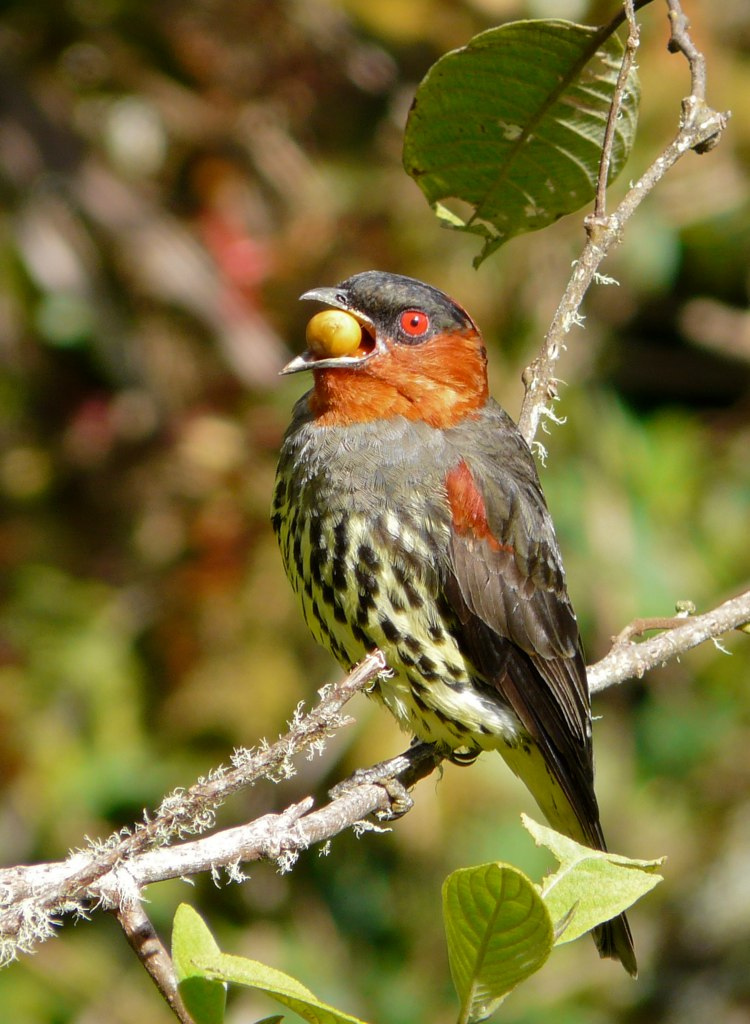

Birds Similar to the Crimson Fruitcrow
These species are often confused with the Crimson Fruitcrow due to similar appearance or overlapping range.