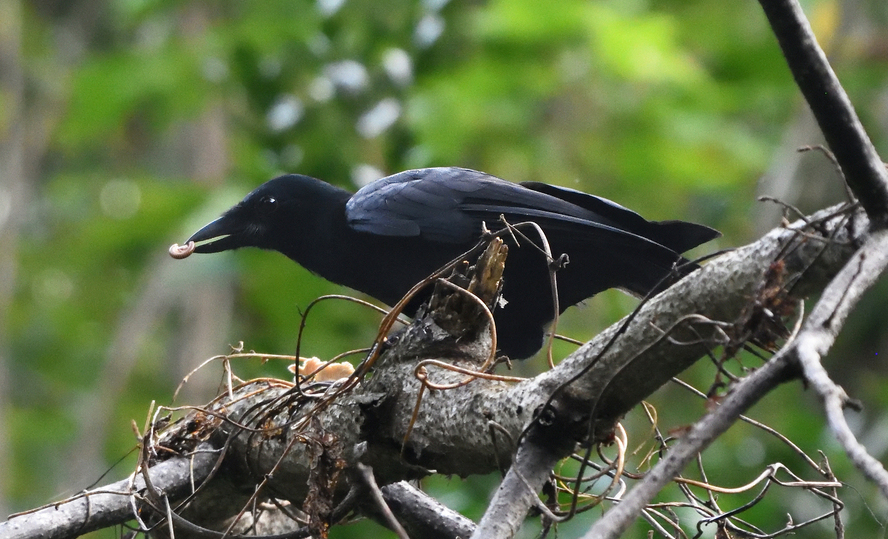
Crow Honeyeater
Gymnomyza aubryana
Order: Passeriformes / Family: Meliphagidae

Wikimedia Commons
About the Crow Honeyeater
The Crow Honeyeater, scientifically known as Gymnomyza aubryana, is an enigmatic bird species endemic to New Caledonia, a small island group in the southwest Pacific Ocean. This medium-sized honeyeater plays a pivotal role in its ecosystem, primarily through its interactions with native flora. With its glossy black plumage and distinctive bright orange wattles, the Crow Honeyeater stands out in the dense forest canopy where it resides. New Caledonia's humid forests provide the perfect backdrop for this bird, which contributes to the pollination and seed dispersal of various plant species. The Crow Honeyeater is considered a key indicator of forest health, as its presence often signifies a well-preserved habitat. Seasonal behaviors are less pronounced in this species, as it remains relatively sedentary throughout the year. However, it may exhibit slight altitudinal movements in response to food availability. The ecological role of the Crow Honeyeater extends beyond its immediate environment as it affects the broader biodiversity of the region. The bird's diet primarily consists of nectar, supplemented by small insects and fruits, which it forages with precision from the forest canopy. This feeding behavior not only aids in pollination but also helps control insect populations. The Crow Honeyeater is a species of significant concern, with its population trend currently facing threats from habitat loss and introduced predators. Conservation efforts are ongoing, with organizations focusing on habitat preservation and predator control to ensure the future survival of this unique avian species. The importance of the Crow Honeyeater within New Caledonia's ecosystem cannot be overstated, making it an invaluable subject of study for ornithologists and conservationists alike.
The Crow Honeyeater belongs to the family Meliphagidae, within the order Passeriformes. These birds typically live average 8 years, with a maximum recorded of 12 years..
How to Identify a Crow Honeyeater
The Crow Honeyeater is notable for its entirely black plumage, which appears almost iridescent in direct sunlight. This coloration provides camouflage within the dense, shadowy forest canopy. One of the most striking features of the Crow Honeyeater is its bright orange facial wattles, which contrast sharply against its dark feathers. These wattles are more pronounced in males, serving as a distinguishing characteristic during breeding displays. Juveniles resemble adults but may have duller plumage and less prominent wattles. Unlike some other honeyeater species, there are no significant size differences between the sexes, both typically measuring around 35-40 cm in length. The Crow Honeyeater's silhouette in flight is marked by broad, rounded wings and a slightly forked tail, which it uses adeptly to maneuver through the forest. When perched, the bird often adopts an upright posture, with its long tail slightly tilted downward. This posture, combined with its distinctive wattles and sleek body, aids in positive identification. While the Crow Honeyeater shares its habitat with other honeyeater species, its unique combination of size, plumage, and facial features makes it unlikely to be confused with any other bird in its range.
Having trouble telling birds apart? Upload a photo to our bird identification tool for an instant species match.
Crow Honeyeater Habitat and Range
Preferred Habitat
The Crow Honeyeater inhabits the humid, tropical forests of New Caledonia, favoring dense, mature forests with a rich understory. These forests, often found at elevations ranging from sea level to 1,500 meters, provide the bird with ample feeding and nesting opportunities. The Crow Honeyeater shows a preference for primary forests but can also be found in secondary growth areas if the structural complexity is preserved. Seasonal habitat shifts are minimal, as the bird remains primarily in its forested environment throughout the year. However, it may move to lower elevations during periods of inclement weather or food scarcity. Urban presence is rare, as the Crow Honeyeater tends to avoid areas heavily altered by human activity. Conservation of suitable forest habitats is crucial for the survival of this species, as deforestation poses a significant threat to its population.
Geographic Range
The Crow Honeyeater is endemic to New Caledonia, located in the southwest Pacific Ocean. Its range is limited to the main island of Grande Terre, where it occupies the forested regions. The bird is non-migratory, spending its entire life within this restricted range. Population density hotspots are primarily found in the central and southern regions of the island, where suitable habitat remains intact. Breeding territories are established within these areas, with individual pairs maintaining and defending their chosen spaces. Due to its limited distribution and specific habitat requirements, the Crow Honeyeater is particularly vulnerable to habitat disturbance. Conservation efforts focus on protecting these core areas to stabilize and potentially increase the population of this rare and unique bird.
Want to know which birds visit your area? Browse our backyard birds by location guides for region-specific species lists.
What Does the Crow Honeyeater Eat?
The diet of the Crow Honeyeater is centered around nectar, which it obtains from a variety of flowering plants within its forest habitat. This nectarivorous diet is supplemented by small insects and fruits, providing a balanced nutritional intake. During the flowering season, the Crow Honeyeater actively forages from flower to flower, using its brush-tipped tongue to extract nectar efficiently. This behavior not only sustains the bird but also facilitates pollination, benefiting the surrounding flora. Insects, caught on the wing or gleaned from foliage, provide an essential protein source, especially during the breeding season when energy demands increase. The foraging technique of the Crow Honeyeater is characterized by its meticulous and deliberate movements, as it methodically searches for food within the canopy. Feeding typically occurs during daylight hours, with peaks in activity observed during the early morning and late afternoon when temperatures are cooler.
Crow Honeyeater Behavior and Social Structure
The Crow Honeyeater exhibits a solitary or paired social structure, with individuals typically seen alone or in breeding pairs. Territorial behavior is pronounced, particularly during the breeding season when males aggressively defend their chosen areas from intruders. This territoriality is displayed through vocalizations and physical displays, such as wing-spreading and wattle-flaring, to deter rivals. Courtship displays are elaborate, involving synchronized flights and vocal duets between pairs. The Crow Honeyeater's response to predators is cautious but assertive, often involving alarm calls and mobbing behavior to drive away potential threats. Daily activity patterns revolve around feeding and territory maintenance, with periods of rest and preening interspersed throughout the day. While not known for forming large flocks, the Crow Honeyeater may occasionally join mixed-species feeding groups, particularly during times of abundant food resources.
Crow Honeyeater Nesting and Reproduction
The nesting habits of the Crow Honeyeater involve building a cup-shaped nest from natural materials such as twigs, leaves, and moss. These nests are often placed high in the canopy, securely anchored to the fork of a tree branch, providing protection from ground-based predators. Clutch size typically consists of two eggs, which are incubated primarily by the female for a period of around 14 to 16 days. During this time, the male may assist by providing food to the female. Once hatched, the chicks are altricial, requiring intensive parental care. Both parents take part in feeding the young, delivering a diet rich in insects and nectar. The fledging period lasts approximately three weeks, after which the juveniles begin to explore their surroundings under the watchful eyes of their parents. The Crow Honeyeater typically raises one brood per year, although favorable conditions may allow for a second.
Crow Honeyeater Sounds and Vocalizations
The vocalizations of the Crow Honeyeater are both distinctive and varied, comprised of a series of melodious whistles and harsher, rasping calls. Its primary song, often delivered from a concealed perch, is a complex sequence of clear, ringing notes that rise and fall in pitch. These songs serve to establish territory and attract mates. In addition to its song, the Crow Honeyeater emits a range of call notes, including sharp alarm calls used to warn of approaching predators. These calls are reminiscent of other honeyeaters, though often more resonant and forceful. During the dawn chorus, the Crow Honeyeater's voice contributes to the rich tapestry of sounds that define the New Caledonian forest, its song carrying through the canopy as daylight breaks.
Interesting Facts About the Crow Honeyeater
- 1The Crow Honeyeater's bright orange wattles are unique within its family, serving as a key feature for identification.
- 2Despite its name, the Crow Honeyeater is not related to crows, but its plumage is similarly black.
- 3Gymnomyza aubryana can be elusive, often heard before it is seen, due to its preference for high canopy levels.
- 4New Caledonia's isolation has led to a high level of endemism, with the Crow Honeyeater being one of its unique avian residents.
- 5The Crow Honeyeater's role as a pollinator makes it an essential component of its ecosystem, aiding in the reproduction of native plants.
- 6Its song, a series of melodious whistles, can be heard echoing through the forest during dawn and dusk.
- 7The Crow Honeyeater's habitat preferences make it a key indicator species for forest health in New Caledonia.
Crow Honeyeater Conservation Status
The Crow Honeyeater is currently classified as Endangered on the IUCN Red List, with its population trend showing a worrying decline. The primary threats to this species include habitat destruction due to logging and land conversion, along with predation by introduced species such as cats and rats. Conservation efforts focus on habitat protection and restoration, with the establishment of protected areas and community-based initiatives to control invasive species. Historical population changes have seen a reduction in range and numbers, prompting increased conservation attention. Ongoing research and monitoring are essential to understanding the ecological needs of the Crow Honeyeater and implementing effective conservation strategies to prevent further decline.
Other Meliphagidae Species


Birds Similar to the Crow Honeyeater
These species are often confused with the Crow Honeyeater due to similar appearance or overlapping range.