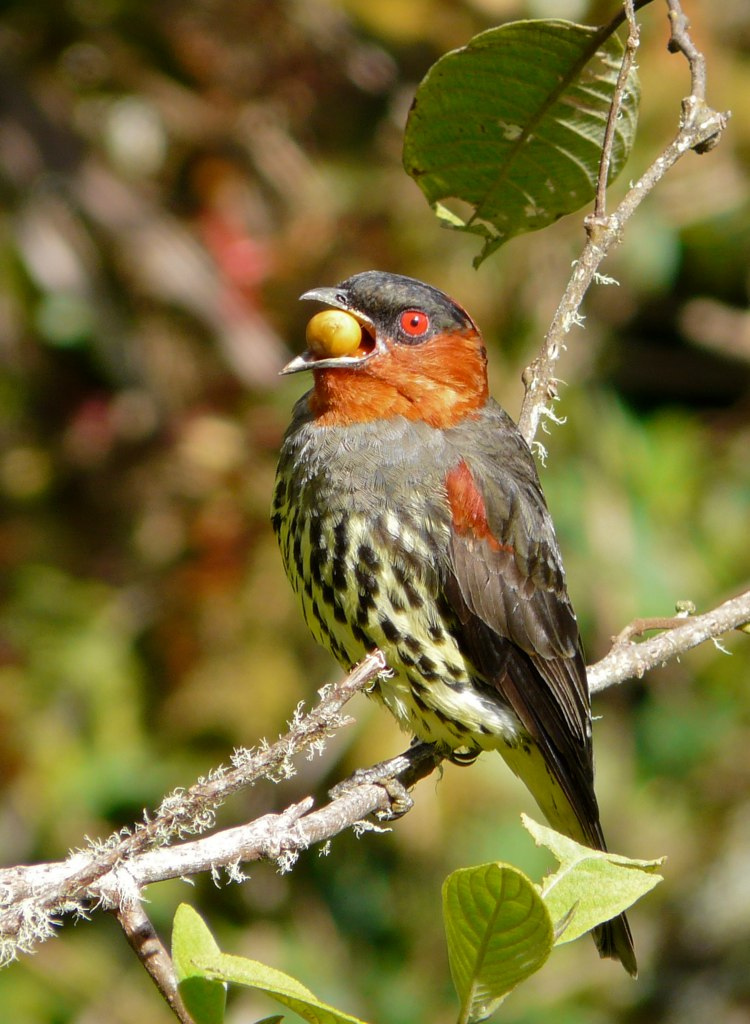
Cryptic Becard
Pachyramphus salvini
Order: Passeriformes / Family: Cotingidae

Wikimedia Commons
About the Cryptic Becard
The Cryptic Becard, scientifically known as Pachyramphus salvini, presents an intriguing study for ornithologists due to its elusive nature and distinctive ecological role within Neotropical forests. This medium-sized songbird, belonging to the Cotingidae family, thrives in the dense understories of tropical forests, where it often remains concealed from the casual observer. Its presence is more frequently noted by its calls than by visual sightings, a testament to its cryptic behavior.
The significance of the Cryptic Becard lies in its adaptability to forest ecosystems, where it contributes to the intricate web of interactions among flora and fauna. It primarily inhabits regions from southern Mexico through Central America, extending to the northwestern parts of South America, including Colombia and Ecuador. This species demonstrates a preference for humid forest environments, often favoring the mid-elevation cloud forests that offer rich biodiversity and complex canopy structures.
Ecologically, the Cryptic Becard plays a role as both a predator and a seed disperser. Its diet, which includes insects and small fruits, enables it to aid in controlling insect populations while facilitating plant reproduction through seed dispersal. Seasonal behaviors are notably affected by food availability, prompting the bird to move locally within its range in search of optimal foraging grounds. During the breeding season, which typically occurs from March to June, the Cryptic Becard becomes more vocally active, participating in complex vocal displays that contribute to mate attraction and territory establishment.
Adaptations to its environment include a muted plumage that offers camouflage against the forest backdrop, aiding in its avoidance of predators. As forests face increasing pressure from human activities such as deforestation and land conversion, the ecological role of the Cryptic Becard underscores the importance of forest conservation efforts in maintaining biodiversity and ecosystem stability.
The Cryptic Becard belongs to the family Cotingidae, within the order Passeriformes. These birds typically live average 5-7 years; max recorded 10 years.
How to Identify a Cryptic Becard
The Cryptic Becard can be identified by its subtle plumage and medium size, measuring approximately 15 cm in length. Adults display a predominantly grayish-brown coloration on their upperparts, which provides effective camouflage among the tree branches. The underparts are paler, with a light gray to whitish tone, and the bird's short, stout bill is adapted for its mixed diet of insects and fruits.
Sexual dimorphism in the Cryptic Becard is minimal, with males and females appearing similar in coloration and size. However, juveniles can be distinguished by their slightly duller plumage and less defined markings, which gradually develop as they mature. The bird's eyes are relatively large, aiding in its search for food in low-light conditions beneath the forest canopy.
In flight, the Cryptic Becard exhibits a characteristic silhouette with rounded wings and a short tail, enabling agile movement through dense foliage. When perching, it often chooses branches with ample cover, maintaining a horizontal posture that maximizes its cryptic appearance. This species could be confused with similar becards and flycatchers, but its specific vocalizations and local habitat preferences assist in accurate identification.
Having trouble telling birds apart? Upload a photo to our bird identification tool for an instant species match.
Cryptic Becard Habitat and Range
Preferred Habitat
The preferred habitat of the Cryptic Becard includes dense, humid forests, often at mid-elevations ranging from 500 to 2000 meters. It thrives in regions where the canopy is complex, providing ample foraging opportunities and shelter. Typical environments include cloud forests, which are characterized by high humidity, frequent mist, and diverse plant species.
While primarily a forest-dweller, the Cryptic Becard exhibits some adaptability to secondary growth forests, particularly where these areas are adjacent to primary forests. It is less commonly found in urban or heavily disturbed areas, where habitat fragmentation poses significant challenges.
Seasonal habitat shifts occur in response to food availability, with the bird moving locally within its range to exploit areas rich in fruits and insects. During the non-breeding season, it may venture into lower elevations, although it remains closely tied to forested habitats.
Geographic Range
The Cryptic Becard's range spans from southern Mexico through Central America, including Belize, Guatemala, Honduras, Nicaragua, Costa Rica, and Panama. It extends into the northwestern regions of South America, notably Colombia and Ecuador. Within these areas, the species occupies a variety of forested environments, particularly favoring moist and montane forests.
The bird does not undertake long-distance migrations, but it exhibits local movements within its range, driven by seasonal changes in food availability. These movements are typically confined to forested areas, maintaining a preference for mid-elevation habitats.
Population density hotspots occur in areas where suitable habitats are abundant and continuous, particularly in well-preserved forest tracts. Deforestation and habitat fragmentation pose significant threats to the bird's range, impacting local population densities and distribution patterns.
Want to know which birds visit your area? Browse our backyard birds by location guides for region-specific species lists.
What Does the Cryptic Becard Eat?
The diet of the Cryptic Becard includes a variety of insects and small fruits, reflecting its role as both a predator and a seed disperser within its forest habitat. Insects, such as beetles, caterpillars, and ants, constitute the primary food source, providing essential proteins for energy and growth.
Seasonal changes in fruit availability influence the bird's diet, prompting it to consume more fruits during periods when insect populations decline. The size of prey typically ranges from small to medium, allowing the bird to exploit a wide array of food resources.
Foraging techniques include gleaning insects from leaves and branches, as well as sallying flights to capture flying insects. The Cryptic Becard often forages alone or in pairs, maintaining a low-profile approach that reduces competition and predation risk. Feeding occurs throughout the day, with peak activity during the early morning and late afternoon.
Cryptic Becard Behavior and Social Structure
The social structure of the Cryptic Becard usually involves solitary individuals or pairs, particularly during the breeding season when territorial behavior becomes pronounced. The species is known for its vocal displays, which play a crucial role in courtship and territory defense. Males engage in singing to attract mates and deter rivals, often from perches well-concealed within the forest canopy.
Territorial disputes can involve prolonged vocal exchanges and occasional physical altercations. The bird's response to predators includes remaining motionless and relying on its cryptic plumage for camouflage. In the face of persistent threats, it may emit alarm calls to alert nearby conspecifics.
Flocking patterns are less common, but Cryptic Becards may occasionally join mixed-species foraging flocks, benefiting from the collective vigilance against predators. Daily activity patterns are diurnal, with most activities centered around foraging and vocalizing during daylight hours.
Cryptic Becard Nesting and Reproduction
Cryptic Becards construct cup-shaped nests using materials such as moss, plant fibers, and leaves, which they position securely in the fork of a tree branch. Nest sites are typically located in the mid to upper canopy, providing protection from ground-based predators.
The clutch size generally consists of 2 to 3 eggs, which the female incubates for approximately 16 to 18 days. During this period, the male may assist by providing food to the incubating female. Once hatched, the chicks are altricial, requiring extensive parental care.
The fledging period lasts about 18 to 22 days, during which both parents are actively involved in feeding and protecting the young. The number of broods per year varies with environmental conditions, but typically one brood is raised annually. Parental roles are shared, with both sexes contributing to nest construction, incubation, and chick rearing.
Cryptic Becard Sounds and Vocalizations
The primary song of the Cryptic Becard consists of a series of melodious whistles, varying in pitch and rhythm, often delivered from concealed perches within the forest. These vocalizations are crucial during the breeding season for attracting mates and establishing territories.
Call notes include shorter, more abrupt sounds, used for communication between mates or signaling alarm. The bird's alarm calls are sharp and insistent, alerting nearby individuals to potential threats.
During the dawn chorus, the Cryptic Becard participates actively, adding its voice to the symphony of forest sounds. Its song, though not as complex as some other songbirds, serves a vital role in maintaining social bonds and deterring competitors.
Interesting Facts About the Cryptic Becard
- 1The Cryptic Becard's subtle plumage allows it to remain nearly invisible in its dense forest habitat, a perfect adaptation for avoiding predators.
- 2Despite being a songbird, the Cryptic Becard's vocal range is less complex compared to many other species, focusing instead on simple yet effective whistles.
- 3Unlike many birds, the Cryptic Becard participates in mixed-species foraging flocks, a strategy that enhances feeding efficiency and predator awareness.
- 4The species' name, 'Cryptic Becard,' highlights its elusive nature, often identified more by its calls than by visual sightings.
- 5The Cryptic Becard's nesting strategy involves building nests high in the canopy, providing safety from many ground-dwelling predators.
Cryptic Becard Conservation Status
The International Union for Conservation of Nature (IUCN) currently lists the Cryptic Becard as Least Concern, with populations considered stable. However, ongoing deforestation and habitat fragmentation pose significant threats to its forest habitat, potentially impacting future populations. Conservation efforts focus on preserving large tracts of forest and promoting sustainable land use practices. Protected areas and reserves are crucial for maintaining viable populations and ensuring the long-term survival of this species. Historical population changes have been closely tied to deforestation rates, emphasizing the need for continued monitoring and habitat restoration initiatives to mitigate potential declines in the future.