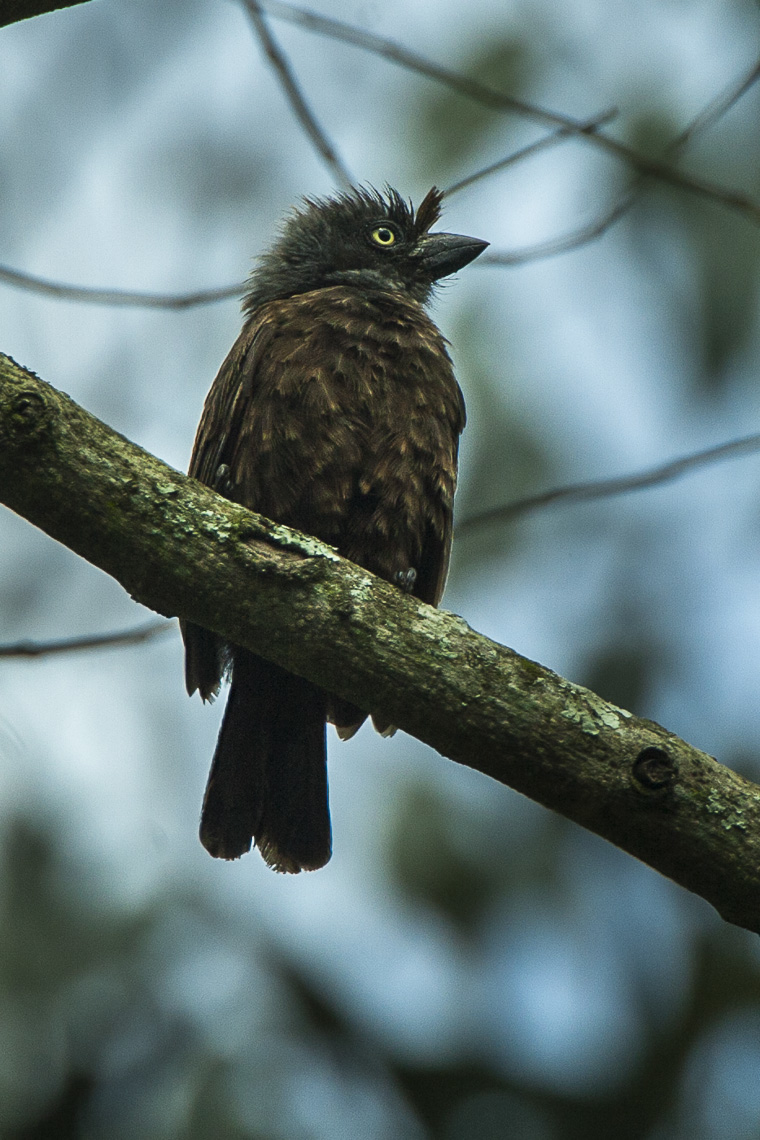
Double-toothed Barbet
Lybius bidentatus
Order: Piciformes / Family: Lybiidae

Wikimedia Commons
About the Double-toothed Barbet
The Double-toothed Barbet (Lybius bidentatus) is a vibrant member of the family Lybiidae, known for its striking appearance and unique vocalizations. This bird is easily recognizable by its bold red and black coloration, a combination that stands out against the lush greenery of its preferred habitats. The species is native to the equatorial regions of Africa, with a range spanning from Senegal in the west to Uganda in the east. It inhabits a variety of forested areas, including both primary and secondary growth forests, as well as wooded savannahs.
The ecological role of the Double-toothed Barbet is significant, as it contributes to seed dispersal and the control of insect populations within its environment. It is known to feed not only on fruits and seeds but also on a variety of insects, making it an important part of the food web. During the breeding season, which varies across its range, the Double-toothed Barbet becomes more vocal, using its calls to establish and defend territories. These birds are often observed engaging in mutual grooming and cooperative behaviors, which strengthen pair bonds and ensure successful rearing of young.
Seasonally, the Double-toothed Barbet exhibits some movement within its range, particularly in response to food availability. During the wet season, when fruits and insects are abundant, they are more sedentary. However, in the dry season, they may move to areas where resources are more plentiful. Despite their vivid colors, these birds can be surprisingly elusive, often detected more easily by their distinctive calls than by sight. They play a critical role in maintaining the balance of their ecosystems, and their presence is often an indicator of forest health.
The Double-toothed Barbet belongs to the family Lybiidae, within the order Piciformes. These birds typically live average 5-10 years with a maximum recorded of 12 years..
How to Identify a Double-toothed Barbet
The Double-toothed Barbet is a medium-sized bird measuring about 20-22 cm in length. Its most distinctive feature is the red plumage on its face and breast, contrasting sharply with the black back and wings. The bird's belly is also red, providing a vibrant splash of color that makes it unmistakable. The species gets its name from the unique double-toothed appearance of its bill, which is slightly hooked and adapted for its mixed diet.
In terms of sexual dimorphism, males and females are quite similar in appearance, though females may be slightly duller in coloration. Juveniles resemble adults but display a more subdued color palette, with less vibrant reds and more muted blacks, making them less conspicuous.
When perched, the Double-toothed Barbet often adopts a horizontal posture, notable for its sturdy build and upright stance. In flight, it exhibits a fast, undulating pattern typical of barbets, with rapid wing beats followed by short glides. This flight pattern, combined with its vocalizations, can help distinguish it from other species in its range, such as the Black-collared Barbet, which lacks the distinctive bill shape.
Having trouble telling birds apart? Upload a photo to our bird identification tool for an instant species match.
Double-toothed Barbet Habitat and Range
Preferred Habitat
The Double-toothed Barbet favors a variety of forested environments, thriving in both primary and secondary forests. It is commonly found in forest edges, clearings, and wooded savannahs. This bird is adaptable to elevations ranging from sea level up to about 1,500 meters, though it is most frequently observed in lowland forests.
While primarily a forest dweller, the Double-toothed Barbet can adapt to human-altered landscapes, sometimes venturing into plantations and gardens where suitable trees and food sources are available. However, it tends to avoid heavily urbanized areas, preferring the quieter, less disturbed environments of rural settings. During different seasons, particularly in response to food availability, these birds may shift their habitat preferences slightly, moving to areas with abundant fruit-bearing trees.
Geographic Range
The Double-toothed Barbet has a wide distribution across the equatorial regions of Africa. It is found from Senegal and Gambia in the west, stretching across to western Kenya and Uganda in the east. Its range includes countries such as Côte d'Ivoire, Ghana, Nigeria, Cameroon, and the Democratic Republic of the Congo.
This species does not undertake long-distance migrations, but it does exhibit localized movements within its range. These movements are generally driven by the availability of food and nesting sites rather than seasonal temperature changes. Population densities vary, with higher concentrations in regions where forests remain intact and food resources are plentiful. Despite its relatively broad range, the Double-toothed Barbet is often patchily distributed, being more common in areas with abundant fruiting trees.
Want to know which birds visit your area? Browse our backyard birds by location guides for region-specific species lists.
What Does the Double-toothed Barbet Eat?
The diet of the Double-toothed Barbet primarily consists of fruits and insects, reflecting its omnivorous feeding habits. Fruit forms a significant part of its diet, with the bird feeding on a variety of species, including figs and berries. The barbet uses its robust bill to pick and manipulate fruits, often consuming them whole or breaking them into smaller pieces.
Insects also feature prominently in its diet, providing essential protein. The barbet forages by gleaning insects from foliage or catching them mid-air during short flights. Its diet shifts somewhat seasonally, with a greater emphasis on fruit consumption during the wet season when these are more abundant. This dietary flexibility allows the Double-toothed Barbet to thrive in diverse environments and contributes to its role as both a seed disperser and a predator of pest insects.
Double-toothed Barbet Behavior and Social Structure
The Double-toothed Barbet exhibits a range of social behaviors, often seen in pairs or small family groups. These birds establish and defend territories using vocalizations and visual displays, with both males and females participating in territorial defense. Their calls are distinct, consisting of a series of deep, resonant notes that can be heard over long distances.
During the breeding season, the Double-toothed Barbet engages in elaborate courtship displays, which include mutual preening and synchronized movements. These behaviors strengthen pair bonds and ensure successful reproduction. The species is generally diurnal, with peak activity occurring during the early morning and late afternoon when they forage for food.
In response to predators, the Double-toothed Barbet relies on its alertness and agility. When threatened, it may remain motionless to avoid detection or take swift flight to the safety of dense foliage. Flocking behavior is more common outside the breeding season, when birds may join mixed-species flocks to enhance foraging success and reduce predation risk.
Double-toothed Barbet Nesting and Reproduction
Nesting for the Double-toothed Barbet involves the excavation of cavities in dead trees or branches, a task shared by both members of the pair. These cavities provide secure sites for laying eggs, typically avoiding ground-level predators. The clutch usually consists of 2 to 4 eggs, which are incubated primarily by the female, although the male may assist occasionally.
The incubation period lasts approximately 13 to 15 days, after which both parents participate in feeding and caring for the chicks. Fledging occurs about 4 weeks after hatching, with young birds being dependent on their parents for a further few weeks before becoming fully independent. The Double-toothed Barbet generally raises one to two broods per year, depending on resource availability and environmental conditions.
Double-toothed Barbet Sounds and Vocalizations
The primary song of the Double-toothed Barbet is a resonant, repetitive hoo-hoo-hoo, with each note lasting about one second. This song serves as both a territorial marker and a call to potential mates. In addition to its song, the barbet produces various call notes, including sharp clucks and softer purrs, used in different social contexts.
Alarm calls are more abrupt and higher-pitched, used to alert conspecifics to the presence of predators. During the dawn chorus, the Double-toothed Barbet is an active participant, contributing its distinctive voice to the symphony of forest sounds. Its calls, reminiscent of a distant horn, can carry over considerable distances, making it easier to locate despite its often concealed presence among dense foliage.
Interesting Facts About the Double-toothed Barbet
- 1The Double-toothed Barbet derives its name from the unique two-pronged projections on its bill, which help it grasp fruit and insects effectively.
- 2This species is known for its cooperative breeding behavior, where family members assist in raising young, enhancing their survival rates.
- 3Double-toothed Barbets are often heard before they are seen due to their loud and distinctive calls that can carry up to 500 meters.
- 4Despite their bright coloration, Double-toothed Barbets can be challenging to spot as they often remain motionless in dense foliage to avoid predators.
- 5The species' vibrant plumage serves not just for attraction but also plays a role in complex social interactions among barbets.
- 6These barbets can excavate their own nest cavities, a skill that helps them avoid competition for nesting sites with other cavity-nesting birds.
- 7The Double-toothed Barbet's diet flexibility allows it to thrive in both primary and secondary forests, making it an important ecological generalist.
Double-toothed Barbet Conservation Status
The Double-toothed Barbet holds a conservation status of Least Concern according to the IUCN Red List. Its population is considered stable, although habitat loss due to deforestation poses a potential threat in parts of its range. Conservation efforts focus on habitat preservation and the protection of forest areas from logging and agricultural expansion. Historically, the Double-toothed Barbet has maintained healthy population levels, benefiting from its adaptability to various forest types. Continued monitoring of its habitat is crucial to ensure that this species remains a vibrant part of Africa's avian biodiversity. Efforts to educate local communities about the importance of forest conservation contribute to the long-term survival of this and other forest-dependent species.