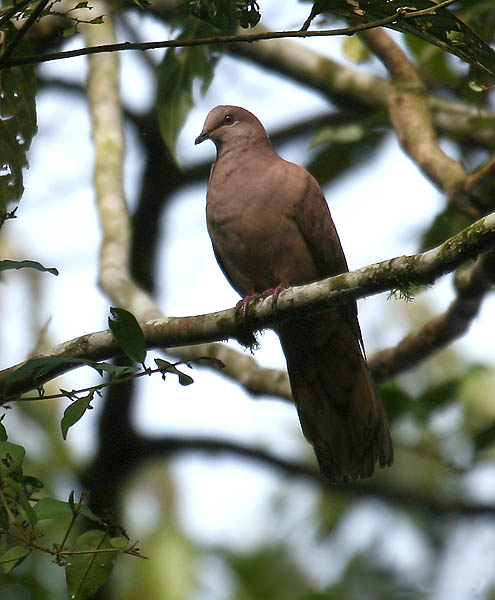
Dusky Pigeon
Patagioenas goodsoni
Order: Columbiformes / Family: Columbidae

Wikimedia Commons
About the Dusky Pigeon
The Dusky Pigeon, scientifically known as Patagioenas goodsoni, is a notable member of the Columbidae family, found predominantly in the lush, dense forests of South America. This medium-sized pigeon is primarily observed in countries such as Colombia, Ecuador, and Peru, where it inhabits lowland and montane forest regions. With its rich, dark plumage, the Dusky Pigeon blends seamlessly into the shadowy undergrowth of its habitat, making it a challenge to spot for even the most seasoned birders.
The Dusky Pigeon plays a vital role in its ecosystem. As a frugivore, it assists in seed dispersal, contributing to the regeneration of forest plant species. This ecological service is crucial for maintaining the health and biodiversity of its forest environment. During the breeding season, the Dusky Pigeon becomes more active, engaging in courtship displays that include a variety of calls and postures to attract a mate.
Seasonal behaviors of the Dusky Pigeon are closely tied to the availability of food resources. During fruiting seasons, these pigeons may be seen in larger numbers as they congregate to exploit abundant food sources. Their movements are generally more local than migratory, though they may shift to different elevations in response to changing food supplies. In regions like the Chocó and Amazonian forests, the Dusky Pigeon's presence is an indicator of healthy, undisturbed habitats.
Despite their somewhat elusive nature, Dusky Pigeons contribute significantly to the avian diversity of their locales. Their presence underscores the importance of conserving South America's tropical forests, as these birds, along with countless other species, rely on these habitats for survival. Conservation efforts in these areas not only protect the Dusky Pigeon but also the myriad of plant and animal species sharing its home.
The Dusky Pigeon belongs to the family Columbidae, within the order Columbiformes. These birds typically live average 5-7 years, max recorded 9 years.
How to Identify a Dusky Pigeon
The Dusky Pigeon is characterized by its medium size and predominantly dark plumage. Adults exhibit a grayish-brown coloration with a subtle purplish sheen on the neck and upper wings, which becomes particularly visible under favorable lighting conditions. Its eyes are typically dark, and the bill is black, offering a stark contrast against its darker feathers.
Juvenile Dusky Pigeons are similar in appearance to the adults, though they may have slightly duller plumage lacking the purplish sheen seen in mature birds. There is little sexual dimorphism in this species, meaning males and females appear quite similar, making it challenging to distinguish between the sexes in the field.
When observing in flight, the Dusky Pigeon displays a steady and direct flight pattern. Its wings appear broad and rounded, a typical feature of pigeons, aiding in maneuverability through dense forest canopies. Perched, the pigeon maintains an upright posture, often remaining still for extended periods, which aids its camouflage in the shaded understory.
Distinguishing the Dusky Pigeon from similar species in its range, such as the Ruddy Pigeon or the Band-tailed Pigeon, can be achieved by noting the darker overall plumage and the lack of prominent tail bands. Its distinctive call also serves as a helpful identification tool, setting it apart from its relatives.
Having trouble telling birds apart? Upload a photo to our bird identification tool for an instant species match.
Dusky Pigeon Habitat and Range
Preferred Habitat
The Dusky Pigeon thrives in lowland and montane tropical forests. It favors undisturbed, mature forests with dense undergrowth, where it can forage for fruit and find suitable nesting sites. Typical habitats include regions such as the western slopes of the Andes and the Amazon basin. These pigeons are generally found at elevations ranging from sea level to about 1,500 meters.
Although primarily forest-dwellers, Dusky Pigeons occasionally venture into adjacent secondary forests and forest edges, especially when searching for food. They are seldom seen in urban environments, preferring the tranquility of rural and remote forested areas. During different seasons, they may shift slightly in elevation, following the availability of fruiting trees.
In some areas, such as the Chocó-Darién moist forests, they are a resident species throughout the year, benefiting from the region's consistent climate and food supply. Their preference for pristine forest habitats makes them sensitive indicators of forest health and biodiversity.
Geographic Range
The range of the Dusky Pigeon spans several South American countries, with its primary distribution in the humid forests of Colombia, Ecuador, and northern Peru. Within these countries, it is most commonly found in regions such as the Chocó biogeographic region and the Amazon basin.
Breeding occurs in these regions, as their forest habitats provide ample resources for nesting and rearing young. The Dusky Pigeon does not undertake long-distance migrations, but it may exhibit local movements, adjusting its range slightly in response to food availability and seasonal changes. These movements are generally limited to shifting between different elevations or forest types within its range.
Population density hotspots for the Dusky Pigeon can be found in areas where mature, undisturbed forests are prevalent. Such regions offer the dense canopy cover and diverse fruiting trees that the species depends on. In recent years, habitat degradation has impacted some parts of its range, underscoring the need for conservation efforts to maintain viable populations across its distribution.
Want to know which birds visit your area? Browse our backyard birds by location guides for region-specific species lists.
What Does the Dusky Pigeon Eat?
The Dusky Pigeon primarily feeds on fruits, making it a frugivore with a diet heavily reliant on the availability of fruiting trees and shrubs within its forest habitat. Common food sources include a variety of native forest fruits such as those from the Lauraceae and Moraceae families. The pigeon uses its strong bill to pluck fruits from branches, often consuming them whole.
Seasonal changes in fruit availability can lead to adjustments in the Dusky Pigeon's diet. During leaner months, it may supplement its diet with seeds and occasionally small invertebrates, although fruits remain the primary component. These pigeons typically forage in the early morning and late afternoon, times when fruiting trees are most accessible and temperatures are cooler.
Foraging behavior includes solitary feeding or joining small groups, particularly when fruiting trees are abundant. The Dusky Pigeon's role as a seed disperser is critical, as it helps maintain the health and regeneration of its forest ecosystem by spreading seeds across the landscape.
Dusky Pigeon Behavior and Social Structure
The social structure of the Dusky Pigeon is relatively solitary, although it may form small flocks when engaging in feeding activities, particularly in areas where fruit is plentiful. Territorial behavior is not strongly developed, but males will defend their chosen nesting sites during the breeding season to secure a safe environment for rearing young.
Courtship displays involve a combination of vocalizations and physical posturing. Males perform a series of cooing calls and may puff up their chests and bow to attract females. Once paired, these pigeons exhibit strong pair bonds, often remaining together throughout the breeding season.
In the presence of predators, the Dusky Pigeon relies on its cryptic plumage and the dense forest environment for protection. It may freeze or quickly retreat into thicker vegetation to avoid detection. Daily activity patterns include active foraging during cooler parts of the day, with periods of rest and preening occurring during the hottest midday hours.
Flocking patterns are generally loose, with individuals maintaining some distance even when feeding together. The Dusky Pigeon's relatively shy nature means it seldom approaches human habitations, preferring the seclusion of its forest home.
Dusky Pigeon Nesting and Reproduction
The Dusky Pigeon constructs a simple platform nest, often made from twigs and leaves. Nesting sites are typically located in dense foliage, providing concealment from predators and harsh weather. The nests are usually situated at moderate heights within trees, ranging from 2 to 10 meters above the ground.
A typical clutch consists of a single egg, occasionally two, which is incubated by both parents. The incubation period lasts approximately 14 to 16 days. Both male and female Dusky Pigeons share the responsibilities of incubation and feeding the chick. Once hatched, the young pigeon remains in the nest for about 10 to 14 days before fledging.
Parental roles are well-defined, with both parents participating in feeding regurgitated food to the chick. The pair may produce one or two broods per year, depending on environmental conditions and food availability. Successful nesting requires a stable environment, as disturbances can lead to nest abandonment or predation.
Dusky Pigeon Sounds and Vocalizations
The primary song of the Dusky Pigeon is a series of low-pitched cooing calls, often described as soft and melodious. These calls are used for communication between mated pairs and during courtship displays. The rhythm of the song is steady, with a quality that can be likened to a gentle, repetitive cooing.
In addition to the primary song, Dusky Pigeons emit call notes that serve as contact calls with other pigeons, especially during feeding or when alerting others to potential threats. Alarm calls are sharper and more urgent, aiding in the warning of nearby flock members.
During the dawn chorus, the Dusky Pigeon's calls contribute to the rich tapestry of sounds that define the forest mornings. The sound is distinctive enough to help birders identify the species even when visual confirmation is challenging.
Interesting Facts About the Dusky Pigeon
- 1The Dusky Pigeon is an important seed disperser, helping to maintain forest diversity by spreading the seeds of various fruiting trees.
- 2Dusky Pigeons are rarely seen in urban areas, preferring the solitude of dense forests where they can find ample food and shelter.
- 3Despite their dark plumage, Dusky Pigeons have a subtle iridescence that becomes visible when sunlight catches their feathers.
- 4The species is primarily sedentary, with local movements influenced by the availability of fruiting trees rather than long migrations.
- 5The Dusky Pigeon contributes to the dawn chorus, adding its melodic coos to the symphony of sounds in tropical forests.
- 6Nesting pairs of Dusky Pigeons often remain together throughout the breeding season, sharing incubation and chick-rearing duties.
- 7The species' presence in an area is a good indicator of forest health, as it relies on undisturbed habitats for survival.
Dusky Pigeon Conservation Status
The Dusky Pigeon is currently listed as Least Concern by the IUCN, with stable population trends observed in most parts of its range. However, ongoing threats such as habitat loss due to deforestation and land conversion for agriculture pose significant risks to its habitats. Conservation efforts focus on protecting large tracts of unfragmented forest, ensuring that populations have access to the necessary resources for survival. Forest reserves and national parks in regions like the Amazon and Chocó are crucial for maintaining healthy populations. Historically, the Dusky Pigeon has faced challenges from habitat degradation, but increased awareness and conservation initiatives have helped mitigate some of these impacts. Continued vigilance and habitat preservation remain essential to prevent future declines.
Other Columbidae Species


Birds Similar to the Dusky Pigeon
These species are often confused with the Dusky Pigeon due to similar appearance or overlapping range.