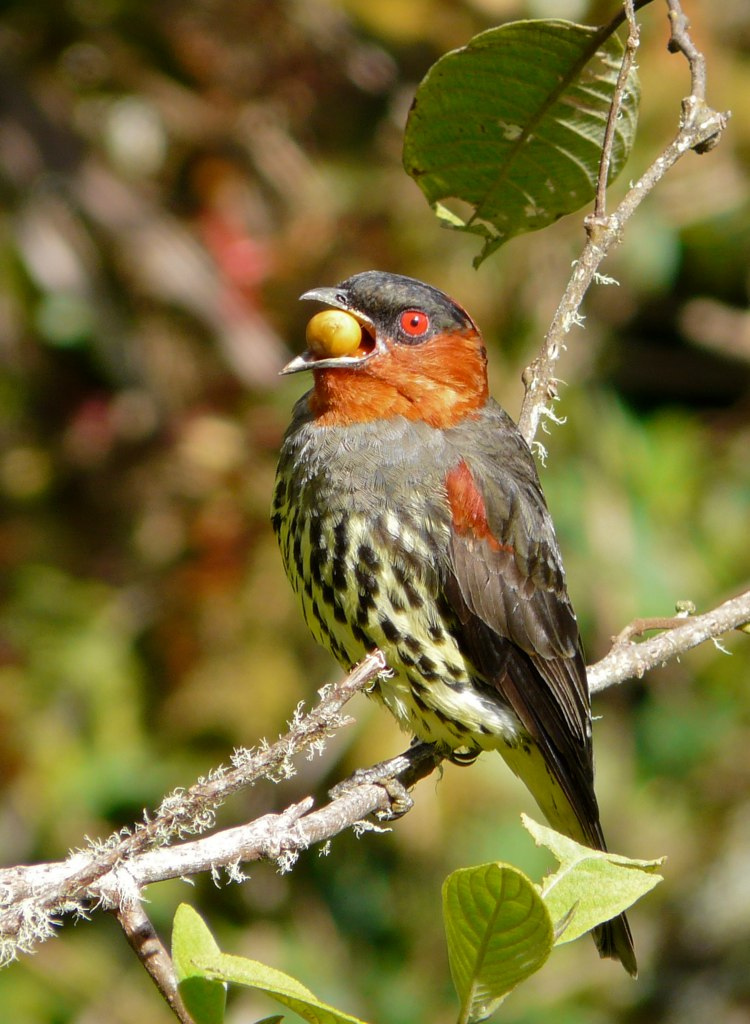
Dusky Purpletuft
Iodopleura fusca
Order: Passeriformes / Family: Cotingidae

Wikimedia Commons
About the Dusky Purpletuft
The Dusky Purpletuft (Iodopleura fusca) is a small passerine bird belonging to the Cotingidae family, known for its presence in the subtropical and tropical moist lowland forests of South America. Found predominantly in Brazil, it also inhabits parts of Guyana and Venezuela. This bird plays a crucial role in its ecosystem, primarily through seed dispersal, as it feeds on a variety of fruits and berries. The Dusky Purpletuft is not only an indicator of healthy forest environments but also a contributor to forest regeneration through the seeds it disperses.
Typically residing in the upper canopy, the Dusky Purpletuft is often heard before it is seen. Its ecological significance extends to its role as an insectivore, helping to control pest populations. As an inhabitant of some of the most biodiverse regions on the planet, the species is integral to maintaining the delicate balance of its ecosystem.
Seasonal behaviors of the Dusky Purpletuft include slight shifts within forest elevations, where it remains a canopy specialist. During the breeding season, which coincides with the rainy season to ensure ample food supply, these birds become more vocal and active, establishing territories and mate pairings. Their ecological role is exacerbated during this period as they take advantage of the abundance of resources to rear their young. Despite their small size, Dusky Purpletufts have a significant impact on their environment, underscoring the importance of conservation efforts aimed at preserving their forest habitats.
The Dusky Purpletuft belongs to the family Cotingidae, within the order Passeriformes. These birds typically live average 5 years with a maximum recorded of 8 years.
How to Identify a Dusky Purpletuft
Adult Dusky Purpletufts exhibit a predominantly grayish-brown plumage with a distinctive purplish-blue crown, providing a subtle yet striking contrast to their otherwise muted feathering. The males and females of the species are similar in appearance, though males may exhibit slightly more vivid crown coloration during the breeding season.
Juvenile Dusky Purpletufts resemble adults but have a duller appearance, lacking the bright crown that characterizes mature individuals. This difference assists in age identification, particularly during the breeding season when younger birds may be seen following adults.
In terms of field marks, the Dusky Purpletuft's small size and short tail are notable, setting it apart from other similar forest birds. Its flight silhouette is compact, with rapid wingbeats and a slightly undulating flight pattern. When perched, the Dusky Purpletuft often maintains a vertical posture, scanning its surroundings for potential food sources. This posture, combined with its soft, warbling calls, makes it a unique presence in the canopy.
Having trouble telling birds apart? Upload a photo to our bird identification tool for an instant species match.
Dusky Purpletuft Habitat and Range
Preferred Habitat
The Dusky Purpletuft is most commonly found in tropical and subtropical moist lowland forests, with a preference for dense canopy areas where it can forage for fruits and insects. It inhabits elevations typically ranging from 0 to 1000 meters, though it is most frequently observed below 600 meters.
This species shows a remarkable affinity for undisturbed primary forests, where it contributes to the ecological dynamics through seed dispersal. While generally absent from urban areas, the Dusky Purpletuft can occasionally be spotted in secondary forests and forest edges, particularly where fruiting trees are abundant.
Seasonal habitat shifts are minimal, as the Dusky Purpletuft remains within its preferred forested environments throughout the year. However, during periods of resource scarcity, it may venture into slightly different forest types in search of food, though this behavior is more opportunistic than migratory.
Geographic Range
The Dusky Purpletuft's range includes the northern and central regions of South America, with the highest population densities found in Brazil. Its presence extends into Venezuela and Guyana, highlighting its preference for the moist lowland forests of these countries.
In Brazil, the bird is most commonly seen in the Amazon Basin, where vast stretches of suitable habitat are available. The species does not exhibit long-distance migratory behavior, opting instead for local movements within its range to exploit seasonal food resources.
Certain areas, such as the Atlantic Forest of Brazil, though outside its main range, may occasionally host these birds, particularly in forest fragments that provide adequate fruiting trees. Population density hotspots include protected areas where primary forest remains intact, underscoring the importance of conservation efforts in maintaining these critical habitats.
Want to know which birds visit your area? Browse our backyard birds by location guides for region-specific species lists.
What Does the Dusky Purpletuft Eat?
The Dusky Purpletuft primarily feeds on a diet of fruits and berries, supplemented by insects and other small invertebrates. This frugivorous diet shifts slightly with seasonal availability, as the bird adjusts its foraging strategy to exploit the abundance of food during the rainy season.
Adept at foraging in the upper canopy, the Dusky Purpletuft employs a technique that involves short flights between branches to pluck ripe fruits and capture insects on the wing. Prey size generally ranges from small flying insects to larger berries, depending on availability.
Feeding typically occurs during the early morning and late afternoon, coinciding with peak insect activity and fruit ripeness. This schedule maximizes the bird's energy intake while minimizing competition with other frugivorous species that may forage during the midday hours.
Dusky Purpletuft Behavior and Social Structure
The Dusky Purpletuft exhibits a complex social structure, often seen in small family groups or pairs. Territorial behavior becomes pronounced during the breeding season, as males assert their dominance through vocal displays and aerial chases.
Courtship displays involve elaborate flight patterns and vocalizations, designed to attract females and establish pair bonds. Once paired, these birds maintain close proximity, often collaborating in foraging and nesting activities.
Flocking behavior is not a typical trait of the Dusky Purpletuft, which prefers the relative solitude of its own territory. When faced with predators, these birds rely on their agility and the dense forest canopy for protection, often taking refuge in the uppermost branches.
Daily activity patterns revolve around foraging and maintaining territory. The Dusky Purpletuft is most active during the cooler hours of dawn and dusk, when it energetically searches for food and interacts with mates.
Dusky Purpletuft Nesting and Reproduction
The Dusky Purpletuft constructs small cup-shaped nests made from twigs, leaves, and lichens, carefully camouflaged among the dense foliage of the canopy. Nests are typically positioned 10-20 meters above the ground, offering protection from ground-dwelling predators.
The clutch size of the Dusky Purpletuft generally comprises two to three eggs, which both parents incubate for a period of approximately 14-16 days. The cooperative nature of their parenting extends to feeding and protecting their young, which fledge roughly 18-21 days post-hatching.
This species usually raises one or two broods per year, with the number often dependent on food availability and environmental conditions. The parental roles are shared, with both male and female participating in nest building, incubation, and feeding of the chicks.
Dusky Purpletuft Sounds and Vocalizations
The primary song of the Dusky Purpletuft is a series of soft, melodious warbles, characterized by a gentle rhythm and a sweet, fluting quality. These songs serve not only to attract mates but also to establish territorial boundaries.
Call notes are typically short and high-pitched, consisting of quick chirps and trills that facilitate communication between mates and family groups. Alarm calls, used to warn of approaching predators, are sharper and more urgent in tone.
During the dawn chorus, the Dusky Purpletuft can often be heard vocalizing persistently, contributing to the symphony of sounds that define the forest at first light. This behavior underscores its presence and vitality within its ecosystem.
Interesting Facts About the Dusky Purpletuft
- 1Despite its name, the Dusky Purpletuft features only a small patch of purplish feathers on its head.
- 2The Dusky Purpletuft's diet primarily consists of fruits, making it an important seed disperser in its ecosystem.
- 3This species is known for its acrobatic foraging behavior, often hanging upside down to reach fruit.
- 4Dusky Purpletufts are rarely seen in open areas, preferring the dense canopy of mature forests.
- 5The bird's soft, melodious call is often one of the first sounds heard in the morning in its native habitats.
- 6Dusky Purpletufts contribute to forest health by controlling insect populations as part of their diet.
- 7The bird's nesting success is closely tied to the availability of fruiting trees in its territory.
Dusky Purpletuft Conservation Status
The Dusky Purpletuft currently holds a status of Least Concern on the IUCN Red List, reflecting a stable population trend across its range. However, the primary threats to this species include habitat loss due to deforestation and fragmentation, particularly in the Amazon Basin. Conservation efforts focus on protecting large tracts of primary forest, which are crucial for the species' survival. Protected areas and national parks play a significant role in maintaining viable populations of the Dusky Purpletuft by ensuring the preservation of its natural habitat. Historically, population changes have been closely linked to the extent of deforestation in its range. Continued efforts to curb forest destruction and promote sustainable land use are essential to safeguard the future of this species.