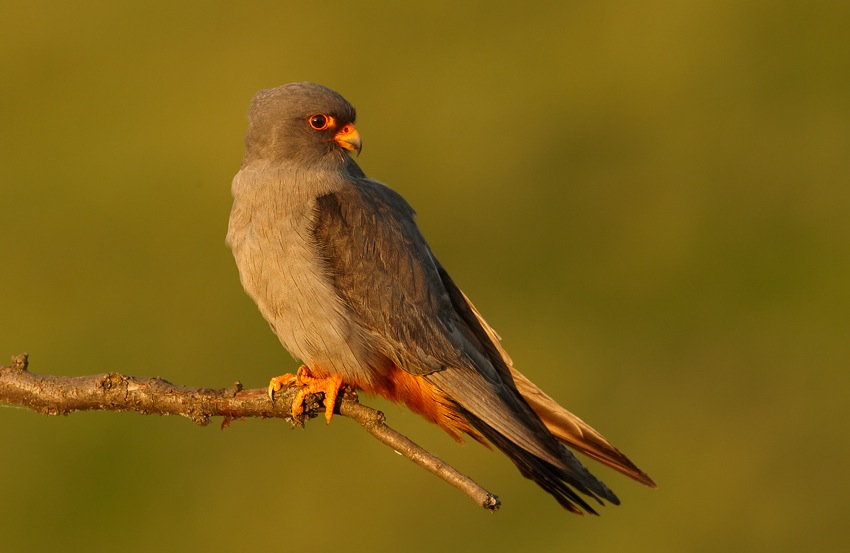
Eurasian Hobby
Falco subbuteo
Order: Falconiformes / Family: Falconidae

Wikimedia Commons
About the Eurasian Hobby
The Eurasian Hobby (Falco subbuteo) is a medium-sized falcon renowned for its swift, agile flight and striking appearance. This bird of prey is widespread across Europe and Asia, often inhabiting open woodlands, savannas, and wetlands. Its name, 'hobby,' is derived from the Old French word 'hobet,' reflecting its status as a prized falconry bird. As a significant predator, the Eurasian Hobby plays an essential ecological role in controlling insect populations, particularly dragonflies and beetles, during the summer months. In addition to capturing insects on the wing, it is adept at hunting small birds, which it catches in mid-air with remarkable precision. This falcon's presence is an indicator of healthy ecosystems, as its diet and breeding success are closely tied to the availability of prey and suitable nesting sites. The Eurasian Hobby is particularly noted for its migratory behavior, with many individuals traveling from Europe and northern Asia to sub-Saharan Africa for the winter. During migration, they often travel in loose flocks, making impressive journeys across vast distances. Their migratory routes are influenced by wind patterns and the availability of prey, showcasing their adaptability to varying environmental conditions. In Europe, the Eurasian Hobby breeds from southern Spain and France to Scandinavia and eastward through Russia. Its breeding season begins in late spring, with courtship and nesting activities taking place as the weather warms. The bird's adaptability to diverse habitats, combined with its migratory nature, allows it to occupy a wide range of environments, from temperate forests to arid savannas. This adaptability is crucial for its survival and success as a species, allowing it to exploit different food sources throughout the year. Despite its widespread distribution, the Eurasian Hobby faces threats from habitat loss and climate change. Conservation efforts focus on preserving natural habitats and ensuring the availability of suitable nesting sites to support stable populations.
The Eurasian Hobby belongs to the family Falconidae, within the order Falconiformes. These birds typically live average 7-10 years with a maximum recorded of 17 years..
How to Identify a Eurasian Hobby
The Eurasian Hobby is a striking bird, identifiable by its sleek silhouette and swift, agile flight. Adults exhibit a blue-gray upper body with dark streaks, while their underparts are pale with distinctive dark streaking. The reddish 'trousers' or thigh feathers, along with a white throat, contrast with the darker plumage, making it relatively easy to identify. Juveniles are browner overall, with a buffish hue on the underparts and less distinct streaking. Although males and females appear similar, females tend to be slightly larger, a common trait among raptors where sexual dimorphism is subtle. The Eurasian Hobby can be confused with other falcons, such as the Peregrine Falcon, but is notably slimmer and more agile in flight. Its flight pattern is characterized by quick, shallow wingbeats and sudden stoops, distinguishing it from other birds of prey. When perched, the Hobby holds a compact posture, often seen on tree branches or utility poles. Its long, pointed wings and square tail are distinctive features that aid in its identification. Observers should note its size, comparable to that of a kestrel, but with much more dynamic aerial maneuvers.
Having trouble telling birds apart? Upload a photo to our bird identification tool for an instant species match.
Eurasian Hobby Habitat and Range
Preferred Habitat
Eurasian Hobbies favor open landscapes with scattered trees, such as woodland edges, wetlands, and savannas. They are frequently found near water bodies, which provide abundant insect prey. In Europe, they inhabit regions from lowland forests to mountainous areas, up to elevations of 2000 meters. During migration, they traverse diverse habitats, including coastal areas and open fields. Urban areas see occasional visits, particularly parks and gardens with ample prey. Seasonal habitat shifts occur as the Hobby moves from breeding grounds in temperate regions to wintering sites in Africa's subtropical savannas.
Geographic Range
The Eurasian Hobby's breeding range spans across Europe and Asia, from the Iberian Peninsula eastward to eastern Siberia. In Europe, it is commonly found in countries like France, Germany, Poland, and the UK, while in Asia, it extends through Russia to China. During winter, the Hobby migrates to sub-Saharan Africa, with large populations settling in countries such as Kenya, Tanzania, and South Africa. Migration corridors are wide, with birds often seen crossing the Mediterranean and traversing the Middle East. Population densities are higher in regions with abundant prey and suitable nesting sites, such as northern Europe and parts of central Asia.
Want to know which birds visit your area? Browse our backyard birds by location guides for region-specific species lists.
What Does the Eurasian Hobby Eat?
Eurasian Hobbies primarily feed on large insects, including dragonflies and beetles, which they catch in mid-air with precision. During late summer, their diet shifts to include small birds, such as swallows and swifts, taking advantage of the abundance of juvenile birds. This shift in diet is crucial as it aligns with the availability of prey during the breeding season. The Hobby employs a dynamic foraging technique, known as hawking, where it captures prey in flight. Prey size can vary, with insects ranging from 2 to 5 centimeters and birds up to 20 centimeters in length. Hobbies often hunt during the early morning and late afternoon, avoiding the midday heat.
Eurasian Hobby Behavior and Social Structure
Eurasian Hobbies exhibit solitary or paired territorial behavior during breeding, fiercely defending their nesting sites. Courtship involves aerial displays, with males performing acrobatic flights to attract females. Vocalizations play a role in pair bonding, with calls exchanged between mates. During migration, Hobbies may gather in loose flocks, benefiting from collective vigilance against predators. Their daily activity peaks during cooler parts of the day, particularly in the morning and evening, when prey is most active. In response to predators, such as larger raptors, Hobbies rely on their agility to evade capture, often performing spectacular aerial maneuvers.
Eurasian Hobby Nesting and Reproduction
Eurasian Hobbies do not build their own nests, instead reusing the abandoned nests of other birds, such as crows or magpies, typically located high in trees. Clutch size ranges from 2 to 4 eggs, laid in late spring. The incubation period lasts about 28-30 days, primarily undertaken by the female while the male provides food. Fledging occurs approximately 30-35 days after hatching, with both parents involved in feeding and protecting the young. The Hobby typically raises one brood per year, although in some southern regions, a second brood is possible if conditions are favorable.
Eurasian Hobby Sounds and Vocalizations
The Eurasian Hobby's vocalizations are characterized by high-pitched, rapid 'kek-kek-kek' calls, often heard during flight or when alarmed. These calls are sharp and piercing, serving as communication between mates or a warning to intruders. Their calls can be compared to the sound of a squeaky wheel, distinct and repetitive. During the dawn chorus, Hobbies are less vocal, but their calls can occasionally punctuate the morning air. Their vocal repertoire is less varied than that of songbirds, focusing on a few key calls used in different contexts.
Interesting Facts About the Eurasian Hobby
- 1The Eurasian Hobby can cover over 5,000 kilometers during its migratory journey from Europe to Africa.
- 2Known for their speed, Eurasian Hobbies can reach speeds of up to 160 kilometers per hour during stoops.
- 3In falconry, the Eurasian Hobby was once trained to catch larks and swallows, showcasing its agility.
- 4The species name 'subbuteo' means 'smaller than a buzzard,' reflecting its size relative to other raptors.
- 5Eurasian Hobbies have been observed using large insects as bait to attract smaller birds, demonstrating cunning hunting techniques.
- 6Despite their small size, Eurasian Hobbies are formidable hunters, often taking prey larger than themselves.
- 7The Eurasian Hobby's migratory routes are among the longest of any bird, demonstrating incredible endurance and navigation skills.
Eurasian Hobby Conservation Status
The Eurasian Hobby is currently listed as Least Concern by the IUCN, with populations considered stable across most of its range. However, localized declines occur due to habitat loss and pesticide use, which reduce insect prey availability. Conservation efforts focus on habitat protection and promoting sustainable agricultural practices to ensure healthy insect populations. Historically, the Hobby faced threats from persecution, but legal protections have led to recovery in many regions. Continued monitoring and habitat management are crucial to maintaining stable populations.
Other Falconidae Species


Birds Similar to the Eurasian Hobby
These species are often confused with the Eurasian Hobby due to similar appearance or overlapping range.