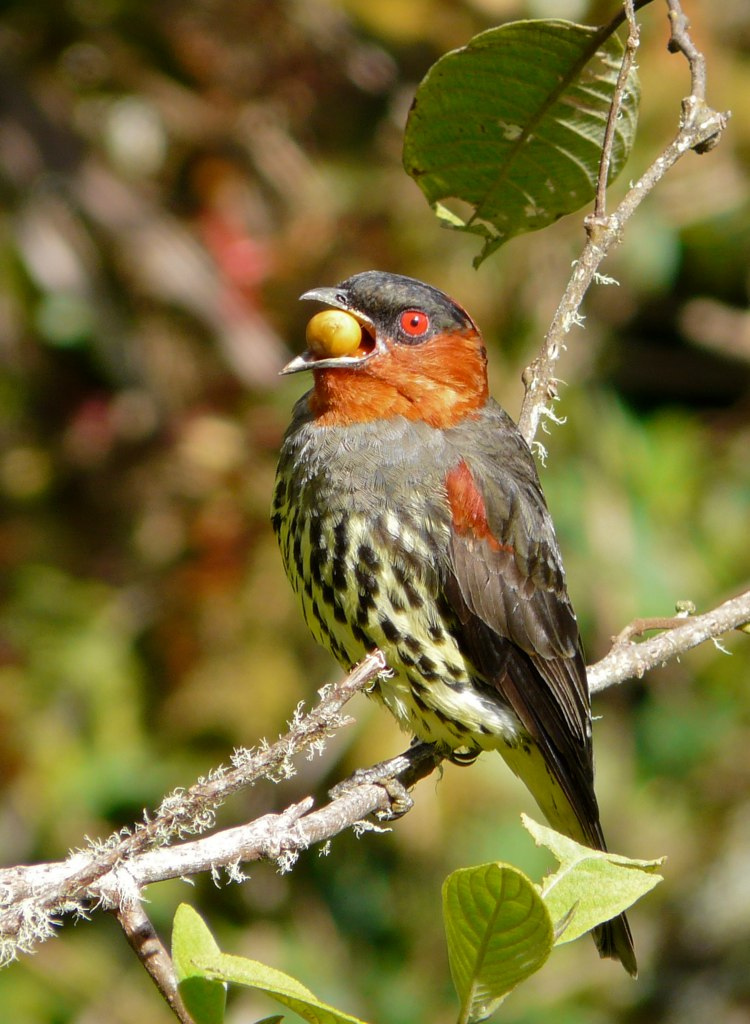
Fiery-throated Fruiteater
Pipreola chlorolepidota
Order: Passeriformes / Family: Cotingidae

Wikimedia Commons
About the Fiery-throated Fruiteater
The Fiery-throated Fruiteater, Pipreola chlorolepidota, stands out as a vibrant jewel within the Cotingidae family. This bird is primarily found in the mid-elevation cloud forests of the Andes, where it plays a significant role in the ecosystem as a seed disperser. It inhabits regions from Colombia to northern Peru, thriving in dense, moist montane forests between 900 and 2,200 meters above sea level. The Fiery-throated Fruiteater is not only a visual marvel but also an ecological linchpin, contributing to forest regeneration. Its presence signifies a healthy, biodiverse forest system. Seasonal changes influence its behavior, notably during the breeding season when it becomes more visible and vocal. The species displays altitudinal movements, often descending to lower elevations during the non-breeding season when food resources become scarce. Despite being less studied than some of its more charismatic relatives, the Fiery-throated Fruiteater's ecological importance cannot be understated. Its diet mainly consists of fruits from a variety of plant species, making it an essential agent of seed dispersal. By consuming fruits and excreting seeds, it facilitates plant reproduction and forest diversity. The bird's habitat preferences and dietary habits underscore its role in maintaining the ecological balance of its native cloud forests. Observers often find the Fiery-throated Fruiteater in pairs or solitary, especially during the breeding season. This period sees increased activity with males performing elaborate displays to attract mates. These displays often involve vocalizations and physical gestures that are as captivating as their plumage. Outside of the breeding season, these birds may join mixed-species flocks, benefiting from the safety and foraging opportunities such formations provide. The bird's vibrant coloration and unique behaviors make the Fiery-throated Fruiteater a favorite among birdwatchers and ornithologists alike. Its presence is a testament to the lush, vibrant life supported by the Andean cloud forests.
The Fiery-throated Fruiteater belongs to the family Cotingidae, within the order Passeriformes. These birds typically live average 6-8 years, with a maximum recorded of 11 years..
How to Identify a Fiery-throated Fruiteater
The Fiery-throated Fruiteater captivates with its striking plumage and distinctive markings. Adult males boast a vivid red throat contrasted by a rich green body, making them unmistakable within their habitat. Their upperparts are a deep, velvety green, while the underparts transition to lighter shades. Females, though less colorful, exhibit a more subdued palette with a greenish throat and a slightly duller overall appearance. Juveniles resemble adult females but are often even less vibrant as they lack the mature bird's full plumage saturation. This species can be confused with other fruiteaters, particularly those sharing similar habitat ranges. However, the combination of a fiery throat and distinct size helps differentiate it from others. In flight, the Fiery-throated Fruiteater presents a rounded silhouette, with its wings and tail proportionately short compared to its body. When perched, these birds maintain an upright posture, often accentuating their throat coloration. Their movement is deliberate, favoring short flights between fruiting trees. This behavior, coupled with their unique coloration, aids birders in distinguishing them from similar species in the dense forest.
Having trouble telling birds apart? Upload a photo to our bird identification tool for an instant species match.
Fiery-throated Fruiteater Habitat and Range
Preferred Habitat
The Fiery-throated Fruiteater thrives in the Andean cloud forests, a habitat rich in biodiversity and characterized by high humidity and dense vegetation. These forests, found on the eastern slopes of the Andes from Colombia to northern Peru, provide the ideal environment for this fruiteater. It prefers elevations ranging from 900 to 2,200 meters, where moss-laden branches and an array of fruiting plants abound. Seasonal shifts may lead these birds to adjust their altitudinal range, usually descending to lower elevations in search of food during leaner months. Unlike many birds, the Fiery-throated Fruiteater shows a particular affinity for undisturbed forests, avoiding urban areas and heavily altered landscapes. Its presence is typically restricted to rural and forested environments where human impact is minimal.
Geographic Range
The Fiery-throated Fruiteater's range extends along the eastern slopes of the Andes, from Colombia's central and southern regions through Ecuador to northern Peru. This area covers a substantial stretch of the tropical montane forests, where the bird is primarily a resident. While it does not undertake long migratory journeys, it exhibits some altitudinal migration. During certain times of the year, particularly outside the breeding season, it may move to lower elevations in search of food. Within its range, the Fiery-throated Fruiteater is most commonly found in areas of high biodiversity and dense canopy cover. These regions provide the necessary resources for its survival, including abundant fruiting trees and shrubs. Population density hotspots are often associated with regions that maintain their natural forest cover, such as protected reserves and national parks.
Want to know which birds visit your area? Browse our backyard birds by location guides for region-specific species lists.
What Does the Fiery-throated Fruiteater Eat?
The Fiery-throated Fruiteater's diet predominantly consists of fruits, aligning with its role as a frugivore within its ecosystem. It favors a wide variety of fruiting plants, including those from the Lauraceae and Melastomataceae families. Seasonal variations influence its diet, with the bird adjusting its foraging habits based on fruit availability. During the breeding season, when energy demands are higher, it may also consume small insects to supplement its diet. Foraging typically occurs during the cooler parts of the day, such as early morning and late afternoon. The bird employs a methodical approach, hopping between branches to pluck ripe fruits with its short, strong bill. Prey size varies, but the fruiteater generally targets medium-sized fruits, which it swallows whole. This feeding strategy not only sustains the bird but also plays a critical role in seed dispersal, contributing to the regeneration and maintenance of its forest habitat.
Fiery-throated Fruiteater Behavior and Social Structure
The Fiery-throated Fruiteater displays intriguing social and territorial behaviors. During the breeding season, males become particularly vocal and active, using a combination of calls and physical displays to attract females. These displays often involve fluttering flights and exaggerated postures that highlight their colorful throats. Outside the breeding season, the Fiery-throated Fruiteater is more reclusive, often found alone or in pairs. However, it may occasionally join mixed-species flocks, benefiting from the collective vigilance against predators and increased foraging efficiency. The bird exhibits strong territorial instincts during the breeding season, defending its chosen area vigorously against intruders. Daily activity patterns include periods of intense foraging followed by rest during the hottest parts of the day. In response to predators, the Fiery-throated Fruiteater relies on its cryptic coloring and the dense forest canopy to avoid detection.
Fiery-throated Fruiteater Nesting and Reproduction
The Fiery-throated Fruiteater constructs its nest in the dense foliage of its cloud forest habitat. Nests are typically cup-shaped and made from a combination of twigs, moss, and leaves, carefully camouflaged among the branches. Preferred nest sites include the forks of trees or thick limbs, often several meters above the ground. The clutch size generally consists of two to three eggs, which both parents incubate. The incubation period lasts approximately 18-20 days, during which time the parents share responsibilities. Once hatched, the chicks remain in the nest for about three weeks before fledging. Parental roles are shared, with both male and female tending to the young, feeding them regurgitated fruit and insects. The Fiery-throated Fruiteater typically raises one brood per year, although conditions such as food availability may influence this.
Fiery-throated Fruiteater Sounds and Vocalizations
The Fiery-throated Fruiteater's primary song is a series of soft, melodious whistles that rise and fall in pitch. This song serves to establish territory and attract mates during the breeding season. Its call notes, in contrast, are short and sharp, used for communication between individuals within the dense forest. Alarm calls are harsher and more abrupt, often heard when a predator is near. During the dawn chorus, the Fiery-throated Fruiteater's song can be distinguished by its rhythmic, flute-like quality, reminiscent of a distant, gentle whistle.
Interesting Facts About the Fiery-throated Fruiteater
- 1The Fiery-throated Fruiteater is one of the few birds with a throat patch that appears to glow, a result of iridescent feather structures.
- 2Despite its striking appearance, the Fiery-throated Fruiteater is seldom seen, blending seamlessly into the dense foliage of its forest home.
- 3This species plays a crucial role in its ecosystem by dispersing the seeds of over 20 different plant species.
- 4The Fiery-throated Fruiteater is named for its vivid red throat, a feature that is primarily used in courtship displays.
- 5The bird's diet consists almost entirely of fruit, making it a vital link in the seed dispersal chain.
- 6The Fiery-throated Fruiteater's call is often one of the first to be heard at dawn, signaling the start of a new day in the forest.
- 7Studies suggest that the bird's bright colors may serve as a warning to potential predators about its sour-tasting diet.
Fiery-throated Fruiteater Conservation Status
The IUCN currently lists the Fiery-throated Fruiteater as a species of Least Concern, although its population trends remain under observation. The primary threats to this bird include habitat destruction due to deforestation and agricultural expansion. Conservation efforts focus on preserving its cloud forest habitat through the establishment of protected areas and promoting sustainable land use practices. Historical data suggests that while populations have fluctuated, they remain relatively stable in regions where forest cover is maintained.