
Golden-headed Quetzal
Pharomachrus auriceps
Order: Trogoniformes / Family: Trogonidae
Wikimedia Commons
About the Golden-headed Quetzal
The Golden-headed Quetzal (Pharomachrus auriceps) is a captivating bird inhabiting the cloud forests of the Andes. This species is best known for its vivid emerald plumage and the golden sheen of the male's head, which makes it a sought-after sighting for birders. Found primarily from Venezuela to Bolivia, the Golden-headed Quetzal plays a crucial role in its ecosystem as a seed disperser. These birds thrive in high-altitude forests, typically ranging from 1,500 to 3,000 meters. They prefer dense, humid environments where they contribute significantly to the ecological balance by spreading seeds from the fruits they consume.
The cultural significance of the Golden-headed Quetzal stems from its stunning appearance, which has made it a symbol of beauty and freedom in many indigenous cultures. Their presence is a positive indicator of forest health, as they rely on large tracts of undisturbed habitat to thrive. Conservationists regard them as a flagship species for Andean cloud forest preservation efforts. The quetzal's role as a seed disperser aids in maintaining the diversity and structure of these forests, illustrating the interconnectedness of its existence with the broader ecosystem.
During the breeding season, which generally occurs from March to June, the Golden-headed Quetzal's activity becomes more noticeable. Males perform intricate courtship displays to attract females, showing off their iridescent feathers. While their bright colors make them conspicuous, they remain elusive due to the dense canopy they inhabit. Outside the breeding season, these birds are relatively solitary, although they may be seen in pairs or small family groups. Their seasonal behaviors, including altitudinal migration in search of food, highlight their adaptability to the changing conditions of their mountainous environment.
The Golden-headed Quetzal belongs to the family Trogonidae, within the order Trogoniformes. These birds typically live typically 5-6 years, with some living up to 10 years..
How to Identify a Golden-headed Quetzal
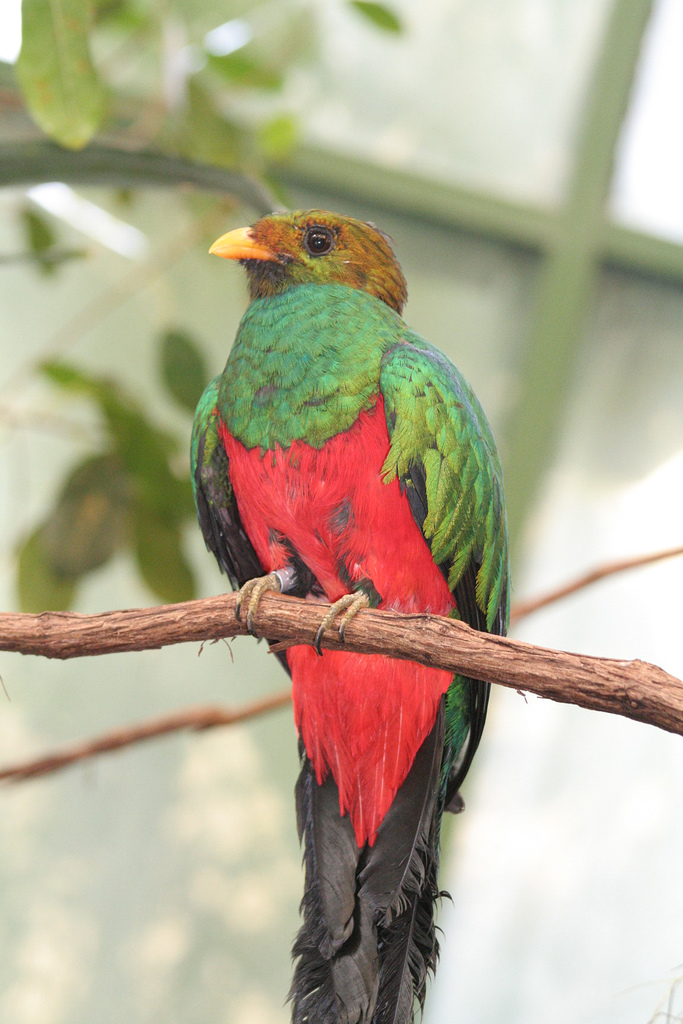
The adult male Golden-headed Quetzal is easily identified by its resplendent emerald green plumage and a distinctive golden patch on its crown. Its underparts are a contrasting bright red, while its tail feathers are a mix of green and white. Females, while similarly colored, have a more subdued golden hue and less vibrant red underparts, making them slightly less conspicuous than males. Juveniles resemble females but exhibit even duller coloration, lacking the full vibrancy of adults.
A distinguishing feature of the Golden-headed Quetzal is its flight silhouette, characterized by its long tail and rounded wings. When perched, the bird's upright posture highlights its full plumage, and the male's dazzling gold crown catches the light, making it a striking sight against the green backdrop of its habitat. In comparison to other quetzals, such as the Resplendent Quetzal, the Golden-headed Quetzal is smaller and lacks the extended tail streamers.
Identifying this species in the field requires attention to its habitat and behavior, as their preferred dense forest habitats often obscure them from view. However, their distinctive calls, which are sharp and repetitive, can aid in detection. Confusion with other trogon species may occur, but the unique combination of plumage colors and head markings provide reliable identification cues.
Having trouble telling birds apart? Upload a photo to our bird identification tool for an instant species match.
Golden-headed Quetzal Habitat and Range
Preferred Habitat
The Golden-headed Quetzal inhabits the cloud forests of the Andes, thriving in densely vegetated, humid environments. These forests are typically found at elevations ranging from 1,500 to 3,000 meters, where the humidity and vegetation density provide ample cover and food resources. Within these forests, the quetzal favors areas with abundant fruiting trees, which provide its primary food source.
Seasonal movements are common, with the quetzal moving altitudinally in response to food availability. During certain times of the year, they may venture into lower elevations or even edge habitats adjacent to primary forests, but they rarely occur in urban areas. Their reliance on pristine forest environments makes them sensitive to habitat degradation, emphasizing the importance of conserving large expanses of cloud forests for their continued survival.
Geographic Range
The Golden-headed Quetzal's range spans the northern Andes, from Venezuela through Colombia, Ecuador, Peru, and into Bolivia. This species occupies a relatively narrow band of cloud forests along these mountain ranges, where its specialized habitat requirements are met. Throughout its range, the quetzal is not considered migratory in the traditional sense but does exhibit altitudinal movements in response to seasonal changes in food availability.
Population densities vary across its range, with higher concentrations often found in regions where cloud forests remain intact and relatively undisturbed. In countries like Ecuador and Colombia, protected areas and national parks provide crucial refuges for these birds, ensuring their populations remain stable in these locales. While not considered globally threatened, local population declines can occur due to deforestation and habitat fragmentation, underscoring the need for continued conservation efforts.
Want to know which birds visit your area? Browse our backyard birds by location guides for region-specific species lists.
What Does the Golden-headed Quetzal Eat?
The Golden-headed Quetzal primarily feeds on a variety of fruits, which constitute the bulk of its diet. Ficus and Lauraceae family fruits are particularly favored. The bird's feeding technique involves deftly plucking fruits while hovering or from a perch, a behavior facilitated by its strong, broad bill.
Seasonal variations in fruit availability may lead the quetzal to supplement its diet with small invertebrates, including insects and larvae. During the breeding season, when nutritional demands are higher, it may increase its intake of protein-rich food items. This dietary flexibility allows the quetzal to adapt to the cyclical nature of fruiting in its forest environment.
Foraging typically occurs during the cooler parts of the day, early morning and late afternoon, when the bird is most active. This schedule helps the quetzal avoid the midday heat and potential predation while maximizing its food intake during peak fruiting times.
Golden-headed Quetzal Behavior and Social Structure
Golden-headed Quetzals display a semi-solitary lifestyle, often seen alone or in pairs outside the breeding season. During the breeding season, however, males become more territorial and engage in elaborate courtship displays, which include vocalizations and flight maneuvers to attract females.
These birds exhibit a strong sense of territory, with males defending their chosen areas against rivals. Courtship involves the male showcasing his stunning plumage and performing aerial displays to entice the female. Once paired, quetzals maintain a monogamous bond for the duration of the breeding season.
Flocking behavior is rare, but small family groups may form temporarily post-breeding. When faced with predators, such as hawks or snakes, the quetzal relies on its agility and the dense forest canopy for cover. Daily activity patterns reveal peaks during early morning and late afternoon, coinciding with foraging and maintenance of territory.
Golden-headed Quetzal Nesting and Reproduction
Golden-headed Quetzals prefer to nest in tree cavities, often taking advantage of natural holes or those created by woodpeckers. These cavities are typically located high in the trees, providing safety from ground predators. The nest is lined with minimal materials, relying on the cavity's natural protection.
Clutch size generally ranges from two to three eggs. Both parents participate in incubation, which lasts approximately 18 days. After hatching, the chicks are altricial, requiring substantial parental care. Both male and female share feeding duties, bringing a mix of fruits and small invertebrates to the growing chicks.
The fledging period lasts about three weeks, after which the young birds gradually gain independence. Usually, the quetzal produces one brood per year, but in regions with extended fruiting seasons, a second brood is possible. The high investment in care reflects the species' adaptation to its specialized and resource-rich environment.
Golden-headed Quetzal Sounds and Vocalizations
The Golden-headed Quetzal's primary song consists of a series of sharp, repetitive whistles that vary in pitch and duration. These calls are often described as resonant and clear, echoing through the dense forest. Males sing more frequently during the breeding season as part of their courtship displays.
Their call notes serve as both communication between mates and territorial signals to other quetzals. Alarm calls are sharper and more rapid, used to alert others of potential threats. During the dawn chorus, the quetzal's song contributes to the cacophony of the forest, announcing its presence and territorial claims.
The quality of the quetzal's calls can be likened to the sound of a flute, with a melodic and haunting quality that makes them stand out among the forest's avian inhabitants.
Interesting Facts About the Golden-headed Quetzal
- 1Golden-headed Quetzals exhibit a unique hovering behavior, allowing them to pluck fruits directly from branches without perching.
- 2The quetzal's iridescent feathers contain no pigments; their color results from microscopic structures that refract light.
- 3Despite their vibrant appearance, Golden-headed Quetzals can remain remarkably camouflaged when perched among the dense foliage of their cloud forest habitat.
- 4The species' altitudinal movements are closely tied to fruiting cycles, showcasing their adaptability to changing food availability.
- 5Golden-headed Quetzals have been observed using their strong bills to widen existing cavities for nesting, demonstrating their resourcefulness.
Golden-headed Quetzal Conservation Status
The IUCN currently lists the Golden-headed Quetzal as a species of Least Concern, but it faces localized threats from habitat destruction and fragmentation. The population trend remains stable in areas where conservation measures protect cloud forests, but deforestation poses a significant risk to its long-term survival. Primary conservation efforts focus on habitat preservation, including the establishment of protected areas and reserves in key regions of its range. Historically, population declines in some areas highlighted the impact of logging and agricultural expansion. Continued advocacy for forest conservation and sustainable practices is vital to ensuring the quetzal's survival. Efforts to engage local communities in conservation initiatives have proven beneficial, fostering a sense of stewardship and appreciation for the quetzal's ecological role.
Other Trogonidae Species


Birds Similar to the Golden-headed Quetzal
These species are often confused with the Golden-headed Quetzal due to similar appearance or overlapping range.

