
Gray-faced Liocichla
Liocichla omeiensis
Order: Passeriformes / Family: Leiothrichidae

Wikimedia Commons
About the Gray-faced Liocichla
The Gray-faced Liocichla (Liocichla omeiensis) is a captivating bird of the Leiothrichidae family, known for its striking combination of gray facial markings and rich, colorful plumage. This medium-sized bird is native to the mountainous regions of Asia, particularly in the Sichuan and Shaanxi provinces of China. These birds thrive in subtropical or tropical moist montane forests, often found at elevations ranging from 1,500 to 2,400 meters. The dense underbrush of these forests provides an ideal habitat, offering ample cover and food resources.
Ecologically, the Gray-faced Liocichla plays a significant role in its native habitat. As an insectivore, it helps control insect populations, aiding in maintaining the ecological balance of its environment. Additionally, its feeding habits contribute to seed dispersal, thus facilitating plant regeneration and forest health. The Gray-faced Liocichla's presence in these ecosystems is a testament to the intricate web of interactions that sustain biodiversity.
This bird exhibits seasonal behaviors that align with shifts in environmental conditions. During the breeding season, which typically occurs from April to June, the Gray-faced Liocichla becomes more vocal and territorial. Outside the breeding season, it may form small flocks, enhancing its social interactions and foraging efficiency. The Gray-faced Liocichla's adaptability to seasonal changes underscores its resilience, although habitat loss poses a significant threat to its populations.
The Gray-faced Liocichla belongs to the family Leiothrichidae, within the order Passeriformes. These birds typically live estimated 6-8 years, with limited data available.
How to Identify a Gray-faced Liocichla
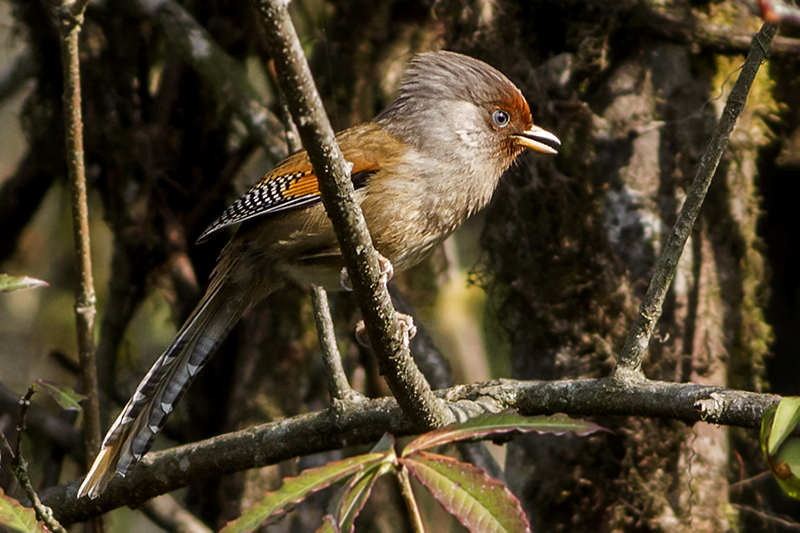
The Gray-faced Liocichla is distinctively marked, featuring a gray face that contrasts sharply with its olive-green upperparts and vivid red wing patches. The underparts have a subtle olive wash, with a more intense yellowish hue on the belly. This bird measures approximately 23 centimeters in length, making it a medium-sized member of the Leiothrichidae family.
Adults exhibit a uniform plumage pattern, while juveniles may have duller colors and less pronounced red in the wings. Males and females are similar in appearance, although males might display slightly brighter colors during the breeding season, which can aid in mate attraction. In terms of posture, the Gray-faced Liocichla often perches with an upright stance, its long tail aiding in balance.
While similar species like the Red-faced Liocichla can cause confusion due to overlapping ranges and similar habitats, the Gray-faced Liocichla's distinct gray facial markings and specific vocalizations assist in accurate identification. Observers should note its rounded wings and relatively short, stout bill, which are characteristic of the species.
Having trouble telling birds apart? Upload a photo to our bird identification tool for an instant species match.
Gray-faced Liocichla Habitat and Range
Preferred Habitat
The Gray-faced Liocichla predominantly inhabits subtropical and tropical montane forests, favoring areas with dense undergrowth and ample shrubbery. These environments provide essential resources such as food and nesting material. The bird is typically found at elevations between 1,500 and 2,400 meters, where the cooler climate supports diverse floral and faunal communities.
Seasonal habitat shifts occur, with the Gray-faced Liocichla moving to slightly lower elevations during colder months. This altitudinal migration helps the bird exploit different food resources and maintain a stable body temperature. While primarily a forest dweller, it occasionally ventures into forest edges and secondary growth areas, indicating some degree of adaptability to habitat modifications.
Urban presence is rare, as this species tends to avoid densely populated human areas, relying instead on the rich biodiversity of its native montane forests.
Geographic Range
The Gray-faced Liocichla is a resident bird, primarily confined to a small range within the Sichuan and Shaanxi provinces of China. This restricted range makes it an endemic species, with specific population densities concentrated in protected forested areas. Unlike migratory species, the Gray-faced Liocichla does not undertake long-distance migrations, instead showing limited altitudinal movements in response to seasonal changes.
During the breeding season, populations are more dispersed as individuals establish territories for nesting. Conversely, outside the breeding months, the birds may form small flocks, particularly in areas where food resources are abundant. Conservation efforts in these provinces focus on preserving the bird's natural habitat, crucial for maintaining stable population numbers.
While the species is not currently found outside its native range, habitat fragmentation could potentially impact its distribution in the future.
Want to know which birds visit your area? Browse our backyard birds by location guides for region-specific species lists.
What Does the Gray-faced Liocichla Eat?
The Gray-faced Liocichla feeds primarily on insects, playing a crucial role in controlling local insect populations. Its diet includes a variety of arthropods, such as beetles, caterpillars, and spiders. This insectivorous diet is supplemented by berries and small fruits, particularly during seasons when insect abundance declines.
Foraging techniques involve gleaning insects from leaves and branches, often hopping through the underbrush with agile movements. The bird's stout bill is adapted for picking insects from foliage, while its keen eyesight aids in detecting prey. The Gray-faced Liocichla feeds throughout the day, with peak activity observed during the early morning and late afternoon, when insect activity is highest.
Seasonal diet changes are evident, with a greater reliance on fruits during the non-breeding season. This dietary flexibility allows the Gray-faced Liocichla to exploit a range of food resources, contributing to its survival in varying environmental conditions.
Gray-faced Liocichla Behavior and Social Structure
The Gray-faced Liocichla exhibits complex social behaviors, with individuals often seen interacting within small family groups or pairs. These social structures are particularly evident during the non-breeding season, when the birds form loose flocks to enhance foraging efficiency and predator vigilance.
Territorial behavior is pronounced during the breeding season, with males singing to establish and defend their territories. The song, a series of melodious whistles, serves both to attract mates and deter intruders. Courtship displays include mutual preening and synchronized movements, strengthening pair bonds.
In response to predators, the Gray-faced Liocichla employs a range of vocal alarms and distraction displays to protect itself and its offspring. Its daily activity patterns are diurnal, with peak activity during the cooler hours of morning and late afternoon, aligning with periods of increased prey availability.
Gray-faced Liocichla Nesting and Reproduction
The Gray-faced Liocichla constructs cup-shaped nests using twigs, leaves, and moss, often situated in dense shrubbery or low trees. These locations provide camouflage and protection from predators. The breeding season typically spans from April to June, with one or two broods raised per year.
A typical clutch consists of 2 to 4 eggs, which are incubated primarily by the female for about 14 to 16 days. During this period, the male assists by providing food and defending the territory from intruders. After hatching, both parents share feeding duties, ensuring the chicks receive a balanced diet of insects and small fruits.
Fledging occurs approximately 12 to 14 days post-hatching, with young birds gaining independence shortly thereafter. The cooperative parental roles and strategic nesting habits are crucial for the survival of the species in its competitive montane environment.
Gray-faced Liocichla Sounds and Vocalizations
The primary song of the Gray-faced Liocichla is a series of clear, melodious whistles that rise and fall in pitch, creating a captivating auditory experience within its forested habitat. These songs are particularly prominent during the breeding season, serving to attract mates and assert territorial boundaries.
Call notes are softer and less structured, often used for communication between individuals within a group. Alarm calls, in contrast, are sharp and abrupt, designed to alert others to potential threats. During the dawn chorus, the Gray-faced Liocichla's song contributes to the vibrant acoustic tapestry of the montane forest, its melodies harmonizing with those of other forest dwellers.
The quality of its song, often compared to a flute's gentle notes, makes it a memorable component of its natural soundscape.
Interesting Facts About the Gray-faced Liocichla
- 1The Gray-faced Liocichla was first described in 1926, highlighting its relatively recent scientific recognition.
- 2Despite its striking appearance, the Gray-faced Liocichla's camouflaged nesting habits make it difficult to spot during breeding season.
- 3The bird's song has been likened to the sound of a flute, adding melodic charm to its forested environment.
- 4Gray-faced Liocichlas are known to form mixed-species foraging flocks, increasing their chances of locating food.
- 5Their diet shift from insects to fruits in colder months showcases their adaptability to seasonal changes.
- 6The species' restricted range in China makes it a sought-after sighting for bird enthusiasts visiting the region.
- 7Studies suggest that the Gray-faced Liocichla's population remains stable due to successful conservation efforts in its native habitat.
Gray-faced Liocichla Conservation Status
According to the IUCN Red List, the Gray-faced Liocichla is currently classified as Near Threatened due to its limited range and habitat loss. While the overall population appears stable at present, ongoing deforestation and land conversion for agriculture threaten its montane forest habitat. Conservation efforts focus on protecting existing forested areas and promoting reforestation projects in its native range. Local governments and conservation organizations play key roles in these initiatives, aiming to preserve the ecological integrity of the regions where the Gray-faced Liocichla thrives. Historical data indicates that the species has maintained stable numbers over the past few decades, but continued environmental pressures necessitate vigilant monitoring and proactive conservation strategies.
Other Leiothrichidae Species


Birds Similar to the Gray-faced Liocichla
These species are often confused with the Gray-faced Liocichla due to similar appearance or overlapping range.

