
Gray-headed Canary-Flycatcher
Culicicapa ceylonensis
Order: Passeriformes / Family: Stenostiridae

Wikimedia Commons
About the Gray-headed Canary-Flycatcher
The Gray-headed Canary-Flycatcher (Culicicapa ceylonensis) is a small passerine bird characterized by its striking gray head and contrasting bright yellow underparts. This bird belongs to the family Stenostiridae, which includes a selection of small flycatchers commonly found throughout Asia. The species plays a significant role in the ecosystem by controlling insect populations, thus maintaining a balance in its natural habitat.
Found predominantly in the Indian subcontinent and Southeast Asia, the Gray-headed Canary-Flycatcher inhabits a variety of forested environments, from dense tropical rainforests to subtropical broadleaf forests. Its presence is especially noted in countries such as India, Sri Lanka, Nepal, and parts of Myanmar. The bird demonstrates a remarkable adaptability to different forest types, often frequenting both primary and secondary forests, as well as plantations and gardens at varying elevations.
The Gray-headed Canary-Flycatcher is known for its unique ecological niche, primarily feeding on small insects which it skillfully captures in mid-flight. Its agile flight and foraging behavior make it an effective insectivore, significantly impacting insect population dynamics within its range. During the breeding season, this bird becomes particularly active, showcasing its energetic and acrobatic feeding techniques.
Seasonal behaviors of the Gray-headed Canary-Flycatcher include subtle altitudinal movements rather than extensive migrations. The species tends to remain within a relatively stable range throughout the year but may adjust its elevation preference in response to changes in food availability or climatic conditions. As a non-migratory bird, it exhibits strong site fidelity, often returning to the same breeding territories annually. Its role as a predator of insects and its adaptability to various habitats underscore its importance in maintaining the ecological balance within its range.
The Gray-headed Canary-Flycatcher belongs to the family Stenostiridae, within the order Passeriformes. These birds typically live average 5-6 years with a maximum recorded of 9 years..
How to Identify a Gray-headed Canary-Flycatcher
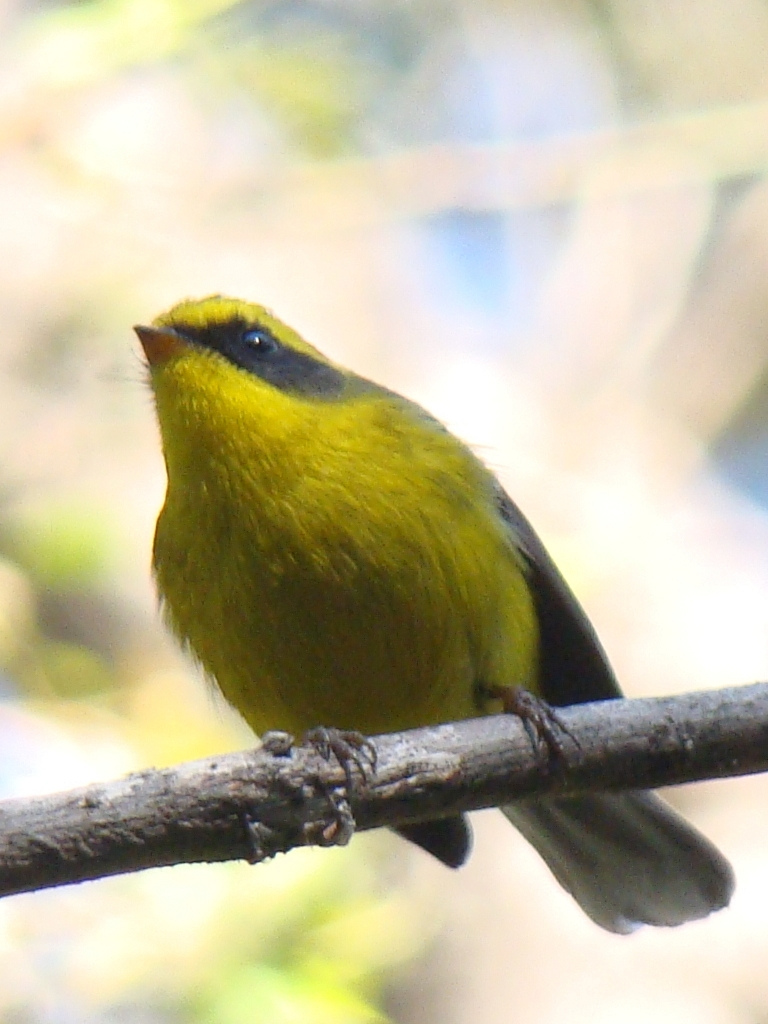
The Gray-headed Canary-Flycatcher is a small bird, measuring around 13 cm in length, making it a compact member of the passerine order. Its most distinctive feature is the gray head, which contrasts sharply with its bright yellow underparts. The back and wings are olive-green, providing additional camouflage in its forested habitat. Adult males and females appear quite similar, though females may have slightly duller plumage. Juveniles resemble adults but may exhibit a more muted overall color palette, especially on the head.
In the field, the Gray-headed Canary-Flycatcher's perching posture is often upright and alert, with its tail commonly flicked or wagged as it surveys its surroundings. This behavior, combined with its coloration, helps differentiate it from similar species such as the Yellow-bellied Fantail or the Grey-chinned Minivet, which may share overlapping ranges.
The bird's flight silhouette is characterized by quick, darting movements as it pursues insects. Its wingbeats are rapid and agile, allowing for exceptional maneuverability in dense foliage. This distinctive flight pattern is a key identification marker when observing the species in its natural habitat.
Having trouble telling birds apart? Upload a photo to our bird identification tool for an instant species match.
Gray-headed Canary-Flycatcher Habitat and Range
Preferred Habitat
The Gray-headed Canary-Flycatcher inhabits a wide range of forested environments across its distribution. It is commonly found in tropical and subtropical broadleaf forests, thriving in both primary and secondary growth areas. These birds are particularly fond of moist, densely vegetated regions, where they can be seen flitting among trees and shrubs.
The species is typically found at elevations ranging from lowland areas up to around 2500 meters in the Himalayas and other mountainous regions. During the breeding season, it may prefer mid-elevations, where forest density provides ample shelter and food sources.
In urban and rural settings, the Gray-headed Canary-Flycatcher often frequents well-wooded gardens and parks, demonstrating its adaptability to human-altered landscapes. While it shows a preference for more secluded, forested habitats, its presence in such areas reflects its capacity to adjust to varying environmental conditions.
Geographic Range
The Gray-headed Canary-Flycatcher's range extends across the Indian subcontinent and Southeast Asia. Within India, it is widespread, being found from the Himalayan foothills in the north to Kerala and Tamil Nadu in the south. In Sri Lanka, the species is a common resident, particularly in the central highlands and forested areas.
In Nepal, it occupies similar habitats, with its presence noted from lowlands to mid-elevations in the eastern and central regions. Its range extends into parts of Myanmar and the southern regions of China, where it can be found in suitable forested environments.
This bird is generally sedentary, with populations showing limited movement outside their core range. However, some altitudinal migration may occur, especially in response to climatic variations or shifts in food availability. Population density tends to be higher in regions with dense forest cover and abundant insect prey.
Want to know which birds visit your area? Browse our backyard birds by location guides for region-specific species lists.
What Does the Gray-headed Canary-Flycatcher Eat?
The Gray-headed Canary-Flycatcher primarily feeds on a diet of small insects, which it catches with remarkable agility. It is an active forager, often seen darting through the forest understory in pursuit of its prey. During feeding, it employs a technique known as 'hawking,' where it flits from a perch to snatch insects mid-air before returning to a resting spot.
Its diet includes a variety of insects such as beetles, flies, and caterpillars, with a preference for small and soft-bodied invertebrates. Seasonal changes can influence its diet, with the bird capitalizing on insect abundance during the wet season. During drier periods, it may expand its diet to include spiders and other arthropods.
The Gray-headed Canary-Flycatcher typically feeds during daylight hours, with peak activity during the early morning and late afternoon when insect activity is highest. This diurnal feeding schedule allows it to exploit the most favorable conditions for capturing its prey.
Gray-headed Canary-Flycatcher Behavior and Social Structure
The Gray-headed Canary-Flycatcher is a solitary or loosely social bird, often seen alone or in pairs. Outside the breeding season, it may join mixed-species foraging flocks, benefiting from the group’s collective vigilance and varied foraging strategies.
Territorial behavior is most pronounced during the breeding season, when males defend their nesting areas vigorously against intruders. Courtship displays involve a series of aerial acrobatics and vocalizations, with males showcasing their agility and plumage to attract mates.
Flocking patterns are relatively fluid, with individuals joining and leaving groups as they forage. This flexible social structure helps the species adapt to changes in food availability and environmental conditions.
In response to predators, the Gray-headed Canary-Flycatcher employs a range of tactics, including swift, evasive flight and the use of dense cover to avoid detection. Its alert posture and quick reflexes are key to its survival in the wild. Daily activity patterns are generally diurnal, with peak activity observed during the cooler parts of the day.
Gray-headed Canary-Flycatcher Nesting and Reproduction
The Gray-headed Canary-Flycatcher constructs its nest in a well-concealed location, often choosing a site within dense foliage or the fork of a tree. The nest itself is a cup-shaped structure, meticulously crafted from fine plant fibers, moss, and spider webs, providing both camouflage and insulation.
Clutch size typically ranges from two to four eggs, which are incubated primarily by the female. The incubation period lasts approximately 14 days, during which the male may assist by providing food to the female.
Once hatched, the chicks are altricial, requiring substantial parental care. Both parents participate in feeding the young and maintaining the nest. Fledging occurs about two weeks after hatching, with the juveniles remaining under parental supervision for a short period thereafter.
The Gray-headed Canary-Flycatcher typically raises one to two broods per year, depending on environmental conditions and food availability. Its diligent nesting efforts ensure the continuation of its population across its range.
Gray-headed Canary-Flycatcher Sounds and Vocalizations
The Gray-headed Canary-Flycatcher is known for its distinctive and melodious song, which consists of a series of high-pitched, sweet notes that are delivered in rapid succession. The rhythm and pitch vary slightly, giving each individual’s song a unique quality.
In addition to its primary song, this bird produces a range of call notes, including a sharp 'tsip' or 'chip' sound used for communication between mates or signaling alarm. Alarm calls are typically more urgent and repeated rapidly when potential threats are detected.
The Gray-headed Canary-Flycatcher participates in the dawn chorus, where its song can be heard amidst the cacophony of other forest birds. Its vocalizations are an integral part of its communication repertoire, aiding in territory defense and mate attraction.
Interesting Facts About the Gray-headed Canary-Flycatcher
- 1The Gray-headed Canary-Flycatcher can adapt to elevations from sea level up to 2500 meters, showcasing its ecological versatility.
- 2Despite being a small bird, it plays a crucial role in controlling insect populations within its range.
- 3Its scientific name, Culicicapa ceylonensis, reflects its strong association with Sri Lanka, where it is a common resident.
- 4The species demonstrates remarkable agility, often performing aerial acrobatics while hunting for insects.
- 5The Gray-headed Canary-Flycatcher's song is a key identifier, with its sweet, high-pitched notes standing out in the forest chorus.
- 6This bird exhibits strong site fidelity, often returning to the same breeding territories year after year.
- 7It is known to join mixed-species flocks outside the breeding season, capitalizing on the safety and foraging benefits of group living.
Gray-headed Canary-Flycatcher Conservation Status
The Gray-headed Canary-Flycatcher is currently listed as a species of Least Concern by the IUCN, reflecting its stable population across a broad range. However, habitat degradation and deforestation pose potential threats, particularly in regions undergoing rapid development and land-use change. Conservation efforts focus on habitat protection and sustainable land management practices to ensure the preservation of forested areas critical to the species' survival. While not currently endangered, maintaining stable population levels requires ongoing monitoring and habitat conservation initiatives. Historically, the Gray-headed Canary-Flycatcher has shown resilience in adapting to changing environments, but continued habitat loss could impact its numbers over time. Conservationists emphasize the importance of protecting forest ecosystems to support not only this bird but the myriad species that share its habitat.
Other Stenostiridae Species


Birds Similar to the Gray-headed Canary-Flycatcher
These species are often confused with the Gray-headed Canary-Flycatcher due to similar appearance or overlapping range.