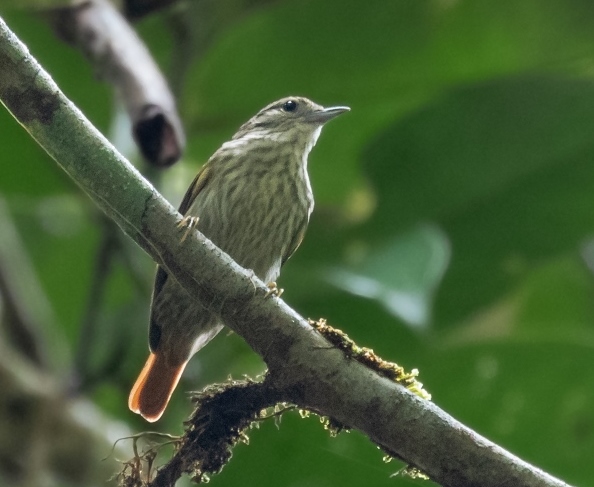
Great Xenops
Megaxenops parnaguae
Order: Passeriformes / Family: Furnariidae

Wikimedia Commons
About the Great Xenops
The Great Xenops (Megaxenops parnaguae) is a fascinating member of the Furnariidae family, renowned for its specialized adaptations that enable it to thrive in the unique ecosystems of northeastern Brazil. This bird inhabits the dry, open landscapes of the cerrado and caatinga, where it plays a crucial role in controlling insect populations. With its robust body and chisel-like bill, the Great Xenops is an expert at extracting insects from under tree bark, showcasing a foraging technique that is both intriguing and effective.
This species primarily resides in the states of Piauí and Maranhão, where its presence indicates healthy cerrado ecosystems. As an endemic species, the Great Xenops holds significant ecological importance, acting as an indicator of habitat quality and environmental health in its native regions. The bird's adaptability to the changing seasonal conditions of the cerrado, where dry and wet seasons dramatically alter the landscape, demonstrates its resilience and ecological versatility.
During the wet season, the Great Xenops benefits from the abundance of insects, which thrive in the lush vegetation. Conversely, in the dry season, it relies on its ability to uncover hidden insect larvae and eggs, showcasing its adaptability. These seasonal behaviors highlight the bird's role as both predator and prey within its ecosystem, contributing to the delicate balance of the cerrado.
The Great Xenops is not only a subject of interest for ornithologists but also for conservationists, given its limited range and specialized habitat needs. Its presence in protected areas and efforts to conserve the cerrado biome are crucial for its continued survival. Understanding the ecological role and significance of the Great Xenops provides insight into the health of these unique Brazilian habitats.
The Great Xenops belongs to the family Furnariidae, within the order Passeriformes. These birds typically live 6 years with a maximum recorded of 10 years..
How to Identify a Great Xenops
The Great Xenops is a medium-sized bird, approximately 20 cm in length, with a striking appearance characterized by its stout bill and rufous plumage. Adults exhibit a rich brown coloration on the upperparts, while the underparts are paler, often displaying a buffy hue. The bird's most distinctive feature is its robust, chisel-like bill, which it uses expertly to forage for insects under tree bark.
Juvenile Great Xenops resemble adults but tend to have slightly duller plumage and less prominent markings. Both males and females appear similar, making it challenging to distinguish between sexes in the field. However, subtle differences in size and behavior during the breeding season might offer some clues to seasoned observers.
While the Great Xenops might be confused with other members of the Furnariidae family, such as the Lesser Woodcreeper, its distinctive bill shape and foraging behavior set it apart. In flight, the Great Xenops displays a characteristic fluttering motion, while its perching posture often involves clinging vertically to tree trunks, similar to woodpeckers.
Having trouble telling birds apart? Upload a photo to our bird identification tool for an instant species match.
Great Xenops Habitat and Range
Preferred Habitat
The Great Xenops finds its niche in the open, dry landscapes of Brazil's cerrado and caatinga. These regions, known for their unique shrubland and savanna ecosystems, provide the perfect habitat for this bird to thrive. The species is typically found at elevations ranging from 200 to 800 meters, where it can exploit the diverse array of insect life.
Unlike many birds that might shift habitats with the seasons, the Great Xenops remains fairly consistent in its choice of environment, although it may adjust its foraging strategies as conditions change from wet to dry seasons. While urban encroachment poses a threat to many species, the Great Xenops currently maintains its presence primarily in rural and protected areas, where conservation efforts focus on preserving the integrity of its natural habitat.
Geographic Range
The range of the Great Xenops is limited to northeastern Brazil, specifically within the states of Piauí and Maranhão. This endemic bird is a non-migratory species, residing year-round in these regions, where the cerrado and caatinga landscapes provide essential resources.
Within its range, the Great Xenops tends to concentrate in areas where insect prey is abundant, often coinciding with well-preserved and protected habitats. While it does not engage in long-distance migrations, it may exhibit some local movement in response to seasonal changes in food availability, particularly during the dry season when insect populations decrease.
Population density hotspots include protected reserves and national parks, where efforts to maintain the integrity of the cerrado biome provide a safe haven for the Great Xenops. These areas not only support the bird's ecological needs but also serve as critical sites for scientific research and conservation initiatives.
Want to know which birds visit your area? Browse our backyard birds by location guides for region-specific species lists.
What Does the Great Xenops Eat?
The diet of the Great Xenops primarily consists of insects and their larvae, which it deftly extracts from beneath tree bark using its strong, chisel-like bill. Termites, ants, and beetle larvae form the bulk of its diet, with seasonal variations reflecting changes in insect availability.
During the wet season, the abundance of insects allows the Great Xenops to feed more opportunistically, often consuming larger prey items. In the dry season, the bird demonstrates remarkable adaptability by foraging deeper into bark crevices and exploiting less accessible food sources, such as insect eggs and pupae.
Foraging typically occurs during daylight hours, with peak activity in the early morning and late afternoon when temperatures are cooler. The Great Xenops utilizes a combination of visual and auditory cues to locate prey, often perching vertically on tree trunks to enhance its foraging efficiency.
Great Xenops Behavior and Social Structure
The Great Xenops exhibits a solitary or paired social structure, with individuals or mated pairs maintaining small territories within their preferred habitats. Territorial behavior is particularly pronounced during the breeding season, when pairs actively defend their nesting sites from potential intruders.
Courtship displays involve a series of vocalizations and physical behaviors, including wing-flicking and tail-spreading, designed to attract a mate and establish pair bonds. Once paired, the Great Xenops demonstrates strong fidelity, with pairs often remaining together across breeding seasons.
While generally non-flocking, the Great Xenops may occasionally be observed in loose associations with other insectivorous birds, particularly when food resources are abundant. In response to predators, the bird relies on its cryptic plumage and perching posture to blend into its environment, minimizing detection by potential threats. Daily activity patterns are largely diurnal, with periods of intense foraging interspersed with rest and preening.
Great Xenops Nesting and Reproduction
The nesting habits of the Great Xenops reflect its adaptability and resourcefulness. Nests are typically constructed in tree cavities or crevices, utilizing natural features or abandoned woodpecker holes as sites. The bird lines these cavities with a variety of materials, including twigs, leaves, and bark fragments, creating a secure environment for raising young.
Clutch size generally ranges from two to three eggs, with both parents sharing responsibilities for incubation, which lasts approximately 14 days. The fledging period extends for another 20 to 25 days, during which time both parents continue to provide food and protection to the growing chicks.
The Great Xenops typically produces one brood per year, although favorable conditions may allow for a second attempt. Parental roles are well-defined, with both male and female participating in feeding and guarding the nest, ensuring the survival and development of their offspring.
Great Xenops Sounds and Vocalizations
The vocalizations of the Great Xenops are characterized by a series of sharp, repeated notes that serve as both song and call. The primary song consists of a rapid sequence of high-pitched, metallic notes, often described as a 'tik-tik-tik,' which can be heard echoing through the cerrado.
In addition to its song, the Great Xenops emits a variety of call notes, including softer, contact calls used for communication between mates or family members. Alarm calls are sharper and more abrupt, signaling the presence of potential threats and prompting evasive action.
The dawn chorus is a particularly active period for the Great Xenops, with individuals contributing their voices to the early morning symphony of the cerrado. These vocalizations play a crucial role in territory establishment and maintenance, as well as in mate attraction.
Interesting Facts About the Great Xenops
- 1The Great Xenops is one of the few bird species that exhibits a vertical perching posture similar to that of woodpeckers.
- 2Endemic to Brazil, the Great Xenops serves as an important indicator species for the health of the cerrado biome.
- 3Despite its limited range, the Great Xenops showcases a remarkable adaptability to seasonal changes in its environment.
- 4The bird's robust, chisel-like bill is perfectly adapted for extracting insect larvae from beneath tree bark.
- 5Conservation efforts for the Great Xenops focus on protecting its unique cerrado habitat from deforestation and agricultural expansion.
- 6The Great Xenops's song is a series of sharp, metallic notes, often heard during the early morning hours in its native habitat.
- 7With a length of approximately 20 cm, the Great Xenops is a medium-sized bird within the diverse Furnariidae family.
Great Xenops Conservation Status
The Great Xenops is currently listed as Near Threatened on the IUCN Red List, with populations facing pressure from habitat loss and fragmentation. The primary threat to this species is the ongoing deforestation and conversion of cerrado habitats for agriculture and urban development. Conservation efforts focus on habitat preservation and the establishment of protected areas within the bird's range. Environmental organizations work alongside local communities to promote sustainable land use practices and raise awareness of the Great Xenops's ecological importance. Historical population changes indicate a gradual decline, but targeted conservation actions offer hope for stabilization and recovery. Continued research and monitoring are essential to ensure the long-term survival of this unique and ecologically significant species.
Other Furnariidae Species


Birds Similar to the Great Xenops
These species are often confused with the Great Xenops due to similar appearance or overlapping range.