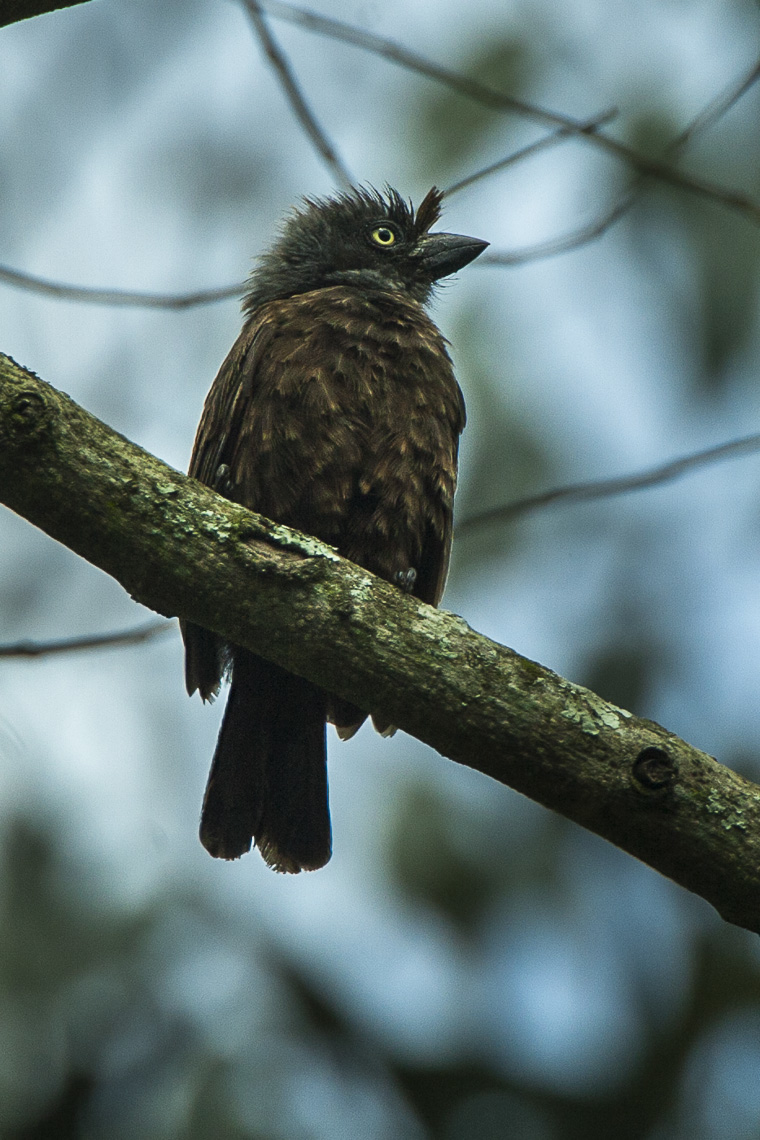
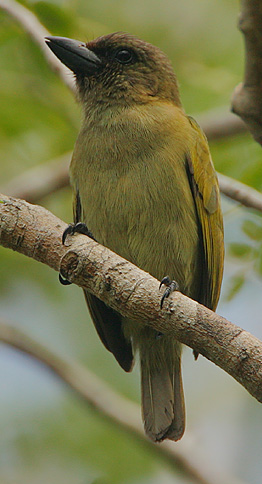
Green Barbet
Stactolaema olivacea
Order: Piciformes / Family: Lybiidae
Wikimedia Commons
About the Green Barbet
The Green Barbet, scientifically known as Stactolaema olivacea, is a captivating bird species that inhabits the dense forests of East Africa. This bird is a member of the family Lybiidae within the order Piciformes. Its range extends from southern Kenya through Tanzania and into parts of Malawi. The Green Barbet thrives in montane and lowland forests, where it finds an abundance of fruiting trees that form the bulk of its diet. These barbets play a crucial ecological role as seed dispersers, contributing to the health and regeneration of their forest habitats. By consuming fruits and excreting seeds across the forest floor, they facilitate the growth of new plants, maintaining the biodiversity of these ecosystems. The Green Barbet exhibits fascinating seasonal behaviors, especially during the breeding season when its vocalizations become more frequent and pronounced. Its calls, which echo through the forest canopy, serve not only for mate attraction but also for territory establishment. The bird's presence is often detected by its distinct calls long before it is observed visually. The bird's adaptation to its environment allows it to thrive in both wet and dry seasons, capitalizing on the fluctuations in fruit availability. Its ability to exploit a variety of fruit sources ensures its survival even in less favorable conditions. As a non-migratory species, the Green Barbet remains within its established territories year-round, making it a consistent component of the forest soundscape in regions like the Usambara Mountains and the Eastern Arc. The Green Barbet's significance extends beyond ecology, as it holds a place in the cultural tapestry of the regions it inhabits. Known to local communities and bird enthusiasts alike, this bird is a symbol of the lush, vibrant ecosystems of East Africa. Observing the Green Barbet in its natural habitat offers a window into the complex interplay of flora and fauna, where each species contributes to the overall health and continuity of the forest.
The Green Barbet belongs to the family Lybiidae, within the order Piciformes. These birds typically live average 6 years, with a maximum recorded of 10 years..
How to Identify a Green Barbet
The Green Barbet is a medium-sized bird with a distinctive olive-green plumage that helps it blend seamlessly into the forest canopy. Adults possess a stout, yellowish bill which is quite prominent against their green feathers. The underparts are a paler green, which may appear almost yellowish in certain lighting conditions. Both male and female Green Barbets exhibit similar plumage, making gender differentiation in the field challenging. Juvenile Green Barbets resemble adults but may display slightly duller plumage and a less pronounced bill. One of the key features to note when identifying this bird is its unique head pattern. It lacks the bright facial markings found in some related species but instead has a subtle shading of green around the eyes and cheeks. When perched, the Green Barbet often adopts an upright posture, allowing birders to observe its body proportions and bill shape clearly. In flight, its short, rounded wings and relatively straight flight path are characteristic. The Green Barbet can sometimes be confused with other green-plumaged birds within its range, such as certain species of greenbuls. However, the barbet's stockier build and distinctive vocalizations help distinguish it from these species. Observing the bird's behavior, including its preference for perching in the upper canopy and its fruit-eating habits, can also aid in accurate identification.
Having trouble telling birds apart? Upload a photo to our bird identification tool for an instant species match.
Green Barbet Habitat and Range
Preferred Habitat
The Green Barbet primarily inhabits montane and lowland forests across its range in East Africa. Within these forests, it prefers areas with a dense canopy and an abundance of fruiting trees. In Tanzania, for instance, it can be found in the Usambara Mountains, where the rich biodiversity provides ample food resources. This bird is typically found at elevations ranging from 500 to 2,000 meters, but it may venture to higher altitudes in search of fruit. While the Green Barbet is predominantly a forest dweller, it occasionally ventures into more open woodland areas, especially where fruit trees are prevalent. It tends to avoid heavily urbanized areas, although it may appear in rural gardens or orchards where fruit is abundant. Seasonal habitat shifts are minimal for this species, as it does not migrate and remains within its established range year-round. However, during the breeding season, it may select specific territories with optimal nesting sites. The presence of the Green Barbet in these habitats indicates healthy forest ecosystems, as it requires a stable supply of fruit and suitable nesting conditions.
Geographic Range
The Green Barbet's range is concentrated in East Africa, stretching from southern Kenya through Tanzania and into parts of Malawi. In Kenya, it occupies the coastal and montane forests of the Taita Hills and Shimba Hills. In Tanzania, it is commonly found in the Eastern Arc Mountains, including the Udzungwa and Usambara ranges. The bird's range extends into the Nyika Plateau in northern Malawi. Unlike many other bird species, the Green Barbet does not engage in long-distance migrations. Instead, it remains within its established territories throughout the year, showing only limited local movements in response to fruit availability. The Green Barbet's population density is highest in regions where fruiting trees are abundant, and it is most commonly observed in protected forest reserves and national parks, where habitat conditions remain relatively stable. While it is not considered a migratory species, the Green Barbet's distribution may shift slightly in response to changes in forest structure or food supply, but these movements are typically over short distances. The consistent presence of the Green Barbet in these regions underscores the importance of forest conservation efforts in maintaining its population levels.
Want to know which birds visit your area? Browse our backyard birds by location guides for region-specific species lists.
What Does the Green Barbet Eat?
The Green Barbet primarily feeds on a diet rich in fruits, making it an important frugivore in its ecosystem. Its favorite fruits include those from fig trees, wild olives, and various forest berries, which it forages for in the upper canopy. The bird uses its strong bill to pluck and consume these fruits, often swallowing them whole. During the wet season, when fruit is abundant, the Green Barbet's diet remains largely consistent. However, in the dry season, it may supplement its fruit intake with insects, including beetles and caterpillars, which provide additional protein. The Green Barbet's foraging technique is deliberate and methodical, as it moves through the forest canopy in search of ripe fruit. It forages primarily during the early morning and late afternoon, taking advantage of the cooler temperatures and the active presence of other frugivores, which can indicate the location of fruiting trees. The size of fruit consumed by the Green Barbet varies, but it typically prefers small to medium-sized fruits that can be easily swallowed. Its feeding schedule aligns with the availability of fruiting trees, and it often follows a predictable route through its territory to check known fruit sources.
Green Barbet Behavior and Social Structure
The Green Barbet exhibits a range of behaviors characteristic of its family. It is primarily solitary or found in pairs, especially during the breeding season when it maintains a strong territorial presence. The bird defends its territory through vocalizations, using its distinctive calls to deter intruders and communicate with its mate. During courtship, the Green Barbet engages in mutual preening and bill-touching, strengthening pair bonds. Flocking behavior is not common in this species, as it tends to focus on maintaining its territory and foraging within it. However, it may occasionally join mixed-species flocks when foraging opportunities arise. The Green Barbet shows a strong diurnal activity pattern, being most active in the early morning and late afternoon when temperatures are cooler and fruit is more accessible. It responds to predators by retreating into dense foliage, where its green plumage provides excellent camouflage. The bird's alertness to potential threats is heightened during the breeding season to protect its nest and young. The Green Barbet's daily routine revolves around foraging, preening, and vocalizing, with periods of rest during the hottest parts of the day.
Green Barbet Nesting and Reproduction
The Green Barbet nests in tree cavities, either natural or those excavated by other animals, as it lacks the ability to excavate its own nest. The preferred nesting sites are often in dead trees or branches where the wood is softer. Nesting occurs during the rainy season when food is plentiful, allowing the parents to feed their young effectively. The female typically lays a clutch of 2 to 4 eggs, which she incubates for about 14 days. During this period, the male assists by providing food and defending the nest site. After hatching, both parents participate in feeding the chicks, which remain in the nest for approximately 30 days before fledging. The fledging period is critical, as it involves the young learning to forage and fly within the safety of their territory. The Green Barbet usually raises one brood per year, although in regions with prolonged food availability, a second brood may be attempted. The bird's nest placement and choice of nesting materials reflect its reliance on forest habitats, emphasizing the importance of maintaining these environments for successful reproduction.
Green Barbet Sounds and Vocalizations
The Green Barbet's vocalizations are a key aspect of its presence in the forest. Its primary song is a series of repetitive, melodic notes that rise and fall in pitch, creating a soothing and rhythmic pattern. These calls serve as territorial markers and are most frequently heard during the breeding season. The bird's call notes are shorter and more abrupt, used for communication between mates or signaling alarm. When alarmed, the Green Barbet emits a sharp, chattering call that echoes through the forest, alerting other birds to potential danger. The dawn chorus is a prominent feature of the Green Barbet's vocal behavior, as it joins other birds in greeting the new day. Its song resembles the sound of a distant flute, with a mellow and resonant quality that is both distinctive and memorable. These vocalizations play a crucial role in the bird's social interactions, facilitating mating, territory defense, and cohesion within pairs.
Interesting Facts About the Green Barbet
- 1The Green Barbet can consume fruits up to 1.5 times the width of its bill, showcasing its unique feeding adaptations.
- 2Despite its bright plumage, the Green Barbet is often heard before it's seen, due to its distinctive flute-like calls.
- 3The Green Barbet contributes significantly to forest regeneration by dispersing seeds across its habitat, aiding in plant diversity.
- 4Unlike many birds, the Green Barbet does not migrate, making it a consistent presence in its East African range year-round.
- 5The Green Barbet's diet primarily consists of fruits, but it can switch to insects during periods of fruit scarcity.
- 6The species exhibits a strong pair bond, with both parents sharing responsibilities in incubating and feeding their young.
- 7Green Barbets are known to participate in dawn chorus singing, filling the forest with their melodic calls at first light.
Green Barbet Conservation Status
The Green Barbet is currently listed as Least Concern by the IUCN, indicating a stable population across its range. However, the primary threats to its continued survival include habitat loss and deforestation, which reduce the availability of suitable nesting sites and food resources. Conservation efforts focus on protecting and restoring forest habitats, particularly in the Eastern Arc Mountains, where the species is most prevalent. Historical population changes have been minimal due to the bird's adaptability to different forest types, but local declines have been noted in areas undergoing significant deforestation. Organizations working in East Africa prioritize the preservation of key forest areas and the establishment of protected reserves to ensure the Green Barbet's future. Continued monitoring of population trends and habitat conditions is essential to maintain the species' status and address potential threats.