
Greenish Schiffornis
Schiffornis virescens
Order: Passeriformes / Family: Cotingidae

Wikimedia Commons
About the Greenish Schiffornis
The Greenish Schiffornis (Schiffornis virescens) is a fascinating member of the Cotingidae family, often observed in the subtropical and tropical forests of South America. This medium-sized songbird is primarily found in countries such as Brazil, Argentina, and Paraguay. Its presence is a strong indicator of healthy forest ecosystems. It inhabits dense, humid forested areas, often choosing regions with abundant foliage where it can blend seamlessly with its surroundings. The bird plays a critical ecological role as both a predator and a prey species. By consuming a variety of insects and small invertebrates, the Greenish Schiffornis helps regulate insect populations. Additionally, it contributes to seed dispersal, aiding in the maintenance of its forest habitat. During the breeding season, these birds exhibit notable changes in behavior. The Greenish Schiffornis becomes more vocal and visible, with males engaging in elaborate vocal displays to attract mates. This period of increased activity typically coincides with the rainy season when food resources are abundant, ensuring that chicks have ample nourishment. Outside of the breeding season, the Greenish Schiffornis is more reclusive, often remaining silent and hidden within the forest canopy. The Greenish Schiffornis holds significance beyond its ecological contributions. As a species sensitive to habitat disturbance, it serves as an indicator of forest health. Conservation efforts aimed at preserving its natural habitat benefit not only the Schiffornis but a myriad of other forest-dependent species. The bird's presence in protected areas underscores the importance of these regions in maintaining biodiversity. Seasonal behavioral patterns of the Greenish Schiffornis are largely driven by environmental conditions. During wetter months, the increased availability of food prompts more active foraging. Conversely, in drier periods, the bird may reduce its activity, relying on stored fat reserves to sustain itself. This adaptability is crucial for its survival in a dynamic environment. By studying the Greenish Schiffornis, researchers gain valuable insights into the complex interplay between climate, behavior, and ecosystem health.
The Greenish Schiffornis belongs to the family Cotingidae, within the order Passeriformes. These birds typically live typically around 5-7 years, with a maximum recorded at 9 years..
How to Identify a Greenish Schiffornis
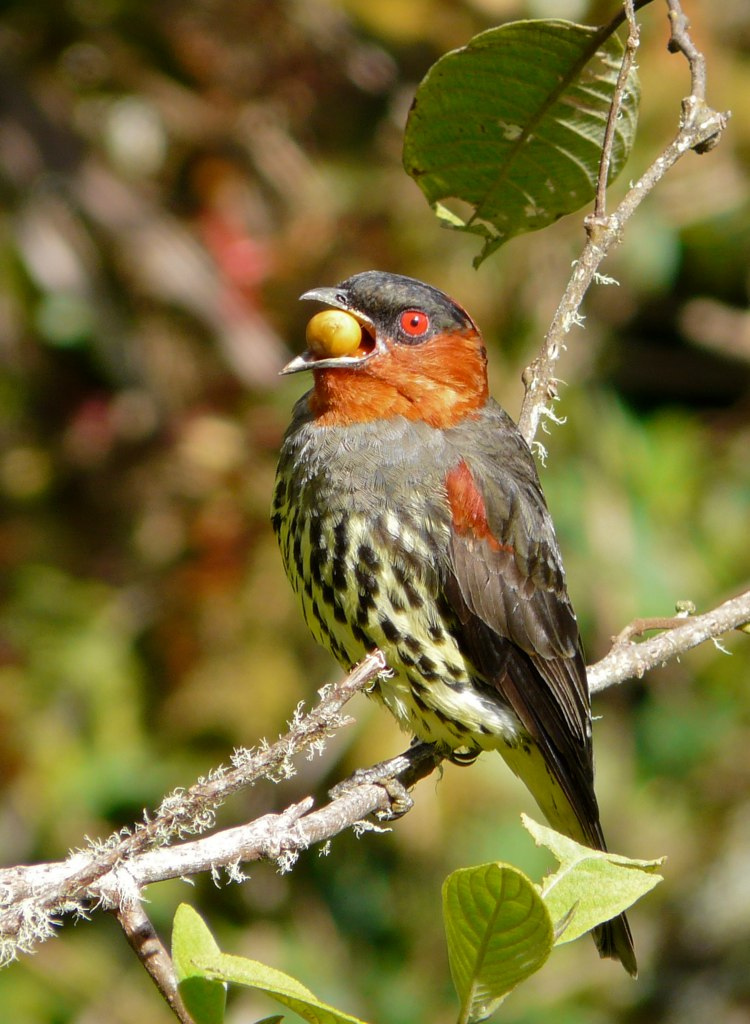
The Greenish Schiffornis is medium-sized, measuring about 19 to 21 centimeters in length. It boasts an olive-green plumage that provides excellent camouflage in its forest habitat. Adults exhibit a uniform greenish hue on their upperparts, with a slightly lighter greenish-yellow tone on the underparts. The eyes are a distinctive dark brown, providing a striking contrast against the bird's lighter facial plumage. Juveniles resemble adults but often have a more muted coloration with less defined plumage patterns. Both males and females appear similar in plumage, making it challenging to distinguish between the sexes in the field. However, during the breeding season, males may exhibit slightly more vibrant plumage as part of their courtship display. In flight, the Greenish Schiffornis displays a rounded silhouette with broad wings, which it uses to maneuver skillfully through dense forest canopies. While perched, the bird maintains an upright posture, often sitting quietly for extended periods. The Greenish Schiffornis can be confused with other members of the Schiffornis genus; however, its consistent greenish coloration and specific vocalizations help in accurate identification.
Having trouble telling birds apart? Upload a photo to our bird identification tool for an instant species match.
Greenish Schiffornis Habitat and Range
Preferred Habitat
The Greenish Schiffornis thrives in dense subtropical and tropical forests, particularly favoring humid lowland and montane forests. It is often found at elevations ranging from sea level to about 1,500 meters, although sightings at higher elevations are not uncommon. These birds prefer areas with dense leaf coverage, where they can remain inconspicuous. They are rarely seen in open spaces, as their survival strategy relies heavily on their ability to blend into the surrounding forest. During seasonal shifts, the Greenish Schiffornis may move to slightly different areas within its range, seeking optimal foraging conditions. While primarily a forest dweller, the Greenish Schiffornis can sometimes be found in semi-urban areas that retain significant tree cover, such as large parks or garden spaces in rural settings. However, it is notably absent from highly urbanized environments, underscoring its dependence on native forest habitats.
Geographic Range
The breeding range of the Greenish Schiffornis covers a substantial portion of South America, with the highest concentrations found in Brazil, Paraguay, and northern Argentina. It tends to inhabit regions within the Atlantic Forest biome, one of the most diverse ecosystems in the world. In Brazil, it is commonly observed in the states of São Paulo, Rio de Janeiro, and Minas Gerais. During the non-breeding season, the bird may undergo local migrations, moving between different elevations or forest patches in response to food availability and climatic conditions. Despite these movements, the Greenish Schiffornis remains within the same general geographical region year-round, exhibiting a relatively sedentary lifestyle. Population density hotspots for the Greenish Schiffornis coincide with areas where extensive undisturbed forest habitat remains, underscoring the critical need for habitat preservation in these regions.
Want to know which birds visit your area? Browse our backyard birds by location guides for region-specific species lists.
What Does the Greenish Schiffornis Eat?
The Greenish Schiffornis primarily feeds on insects and small invertebrates, playing an important role in controlling pest populations within its habitat. Its diet includes beetles, ants, spiders, and caterpillars, which it gleans from foliage and bark. The bird employs a methodical foraging technique, often working its way through dense vegetation to locate prey. Additionally, the Greenish Schiffornis occasionally consumes fruits and berries, contributing to seed dispersal within its ecosystem. Seasonal changes in diet are influenced by resource availability, with the bird consuming more fruit during periods when insect populations are lower. The Greenish Schiffornis typically forages during the early morning and late afternoon, taking advantage of cooler temperatures and peak insect activity. Its feeding schedule aligns with the daily rhythms of its prey, ensuring maximum foraging efficiency.
Greenish Schiffornis Behavior and Social Structure
Socially, the Greenish Schiffornis is generally solitary or found in pairs, particularly during the breeding season. It exhibits territorial behavior, with males defending their chosen breeding areas through vocal displays and occasional physical confrontations. Courtship involves a mix of vocalizations and subtle displays, with the male showcasing his plumage to potential mates. Outside the breeding season, the Greenish Schiffornis may join mixed-species foraging flocks, an adaptation that offers increased protection from predators through safety in numbers. The bird is diurnal, with activity patterns closely tied to daylight hours. It engages in most of its foraging and social interactions during the cooler parts of the day, avoiding the midday heat. When faced with threats, the Greenish Schiffornis employs a range of responses, from remaining motionless to vocal alarms that alert other birds in the vicinity. This adaptability in behavior is crucial for its survival in the diverse and often challenging environments it inhabits.
Greenish Schiffornis Nesting and Reproduction
The Greenish Schiffornis constructs cup-shaped nests, using materials such as twigs, leaves, and moss. These nests are typically situated in low to mid-level branches, hidden within dense foliage to protect against predators. The female plays a central role in nest building, with the male occasionally assisting by gathering materials. A typical clutch consists of two to three eggs, which are incubated primarily by the female over a period of about 18 to 20 days. Once hatched, both parents share the responsibility of feeding and caring for the chicks. Fledging occurs approximately 17 to 19 days post-hatching, with the young remaining close to their parents for a few additional weeks as they learn essential survival skills. The Greenish Schiffornis typically raises one brood per year, although in regions with extended favorable conditions, a second brood is possible.
Greenish Schiffornis Sounds and Vocalizations
The primary song of the Greenish Schiffornis is a series of clear, melodious whistles, often described as having a haunting, flute-like quality. These vocalizations are crucial during the breeding season, serving both to attract mates and to delineate territory. Call notes are softer and more subdued, used for communication between mates or to signal alarm. In response to threats, the bird emits a sharp, piercing sound that alerts nearby birds of potential danger. The Greenish Schiffornis participates in dawn chorus, contributing to the symphony of sounds that define its forest habitat. Its vocalizations are a distinctive feature, aiding birders in locating these otherwise inconspicuous birds.
Interesting Facts About the Greenish Schiffornis
- 1The Greenish Schiffornis is known for its elusive behavior, often remaining undetected despite its melodious song.
- 2Unlike many songbirds, both male and female Greenish Schiffornis participate in feeding their young.
- 3The species' olive-green coloration provides excellent camouflage, aiding in its survival in dense forests.
- 4The Greenish Schiffornis can be difficult to spot, often requiring patience and a keen ear for its distinctive calls.
- 5The bird's diet shifts to include more fruit during the dry season when insect availability decreases.
- 6Greenish Schiffornis nests are often hidden deep within foliage, making them challenging to locate.
- 7Despite its seemingly sedentary nature, the Greenish Schiffornis participates in local migrations within its range.
Greenish Schiffornis Conservation Status
The Greenish Schiffornis is currently classified as Least Concern by the IUCN, although its population trend is thought to be decreasing due to habitat loss. Deforestation for agriculture and urban development poses significant threats to its natural habitat, particularly in regions like the Atlantic Forest where deforestation rates are high. Conservation efforts focused on preserving and restoring native forest areas are crucial for maintaining healthy populations of the Greenish Schiffornis. Protected areas and national parks play a key role in safeguarding its habitat, providing a refuge from the pressures of human encroachment. Historical data suggest that the species once enjoyed a more extensive range, highlighting the impact of habitat alteration over time.
Other Cotingidae Species



Birds Similar to the Greenish Schiffornis
These species are often confused with the Greenish Schiffornis due to similar appearance or overlapping range.

