
Hairy-breasted Barbet
Tricholaema hirsuta
Order: Piciformes / Family: Lybiidae

Wikimedia Commons
About the Hairy-breasted Barbet
The Hairy-breasted Barbet (Tricholaema hirsuta) is a captivating bird species within the Lybiidae family, inhabiting the lush forests of Central and West Africa. These barbets play a vital role in their ecosystems, particularly as seed dispersers, contributing significantly to the regeneration of tropical forests. Found predominantly in countries such as Gabon, Côte d'Ivoire, and Nigeria, the Hairy-breasted Barbet thrives in the humid lowland forests, where they find both food and suitable nesting sites. The species is non-migratory, remaining in its preferred habitat throughout the year.
Their role in the ecosystem extends beyond seed dispersal. Hairy-breasted Barbets also contribute to controlling insect populations, as they consume a variety of insects and other invertebrates. By doing so, they help maintain a balance in the food web. Their presence is indicative of a healthy forest ecosystem, often serving as a bioindicator for biodiversity in the region.
These birds exhibit fascinating social behaviors. Hairy-breasted Barbets are often seen in small family groups, engaging in cooperative breeding. This social structure not only aids in the raising of young but also strengthens the group's territorial claims. Vocal communication plays a crucial role in their social interactions, with both melodious songs and harsher call notes being integral to their repertoire.
The Hairy-breasted Barbet's adaptation to its environment is exemplary. Its strong bill is adept at excavating nest sites in tree trunks, an essential trait for a species that depends on cavity-nesting. This adaptation not only provides safe nesting sites but also assists in foraging, as the barbet can access insects hidden under bark or within wood. The species' ability to thrive in dense forests highlights its specialized ecological niche.
The Hairy-breasted Barbet belongs to the family Lybiidae, within the order Piciformes. These birds typically live average 5-7 years, with a max recorded of 10 years..
How to Identify a Hairy-breasted Barbet
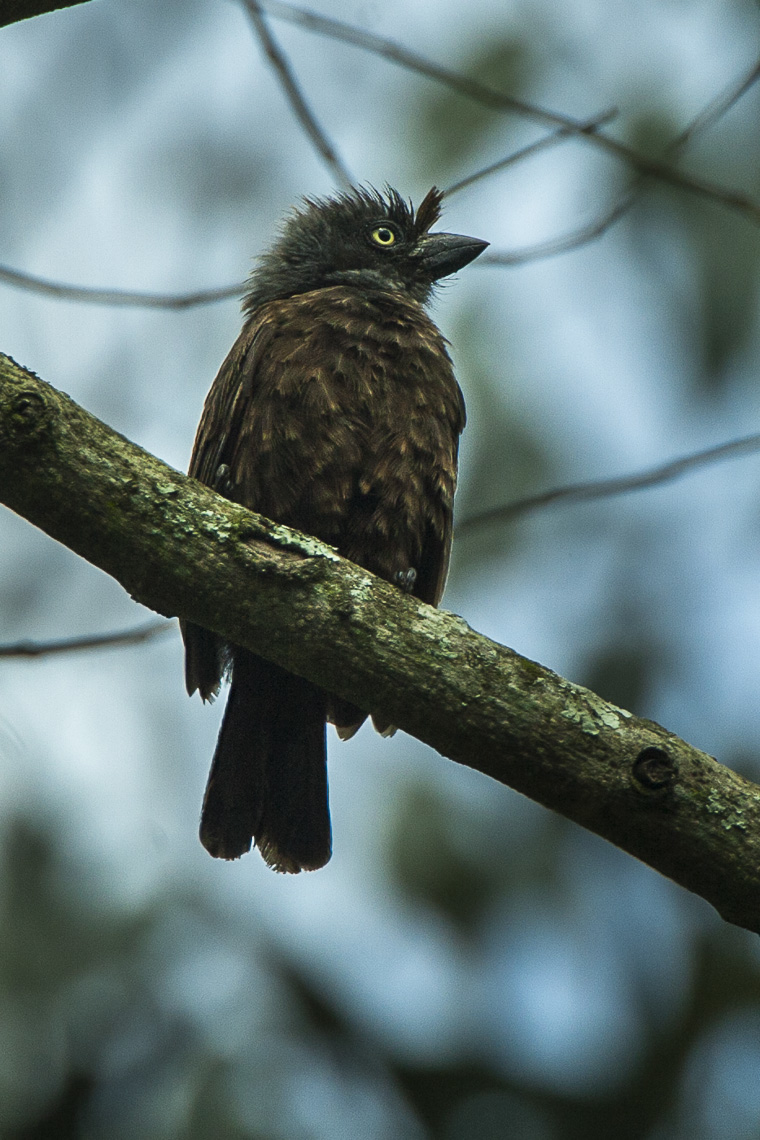
The Hairy-breasted Barbet is medium-sized, with a body length ranging from 17 to 20 cm. Adults are easily recognized by their fluffy, hair-like feathers on the chest, which give this bird its common name. The plumage is predominantly black with white spots adorning the wings and back, providing excellent camouflage in dappled forest light. A striking feature is the bright red patch on the lower belly, making it distinguishable from similar species.
Juveniles often present a more muted coloration, lacking the full brightness of the adults’ red belly patch. This can make young birds more challenging to identify at a distance. The males and females are similar in appearance, though females might have slightly less vibrant coloring, particularly on the chest feathers. This subtle dimorphism can sometimes be observed when the birds are seen in pairs.
In flight, the Hairy-breasted Barbet's silhouette is compact, with a short tail and rapid wing beats. When perched, they maintain an upright posture typical of barbets, often observed on high tree branches or in dense foliage. They can be confused with the Yellow-spotted Barbet, but the lack of yellow spots and the characteristic hairy chest distinguish them.
Having trouble telling birds apart? Upload a photo to our bird identification tool for an instant species match.
Hairy-breasted Barbet Habitat and Range
Preferred Habitat
The Hairy-breasted Barbet inhabits tropical and subtropical moist broadleaf forests. These birds are predominantly found in lowland rainforests up to elevations of 1200 meters, where dense vegetation provides ample foraging opportunities and nesting sites. They exhibit a preference for primary forests but can also adapt to secondary growth, provided the habitat retains sufficient canopy cover and biodiversity.
These barbets are not typically found in urban areas, as their habitat requirements are closely tied to forest ecosystems. Seasonal shifts in habitat are minimal due to their non-migratory nature, although some local movements may occur in response to food availability. In rural areas, they may occasionally inhabit forest edges or plantations, particularly where fruiting trees are abundant.
Geographic Range
The breeding range of the Hairy-breasted Barbet extends across much of the equatorial belt in Africa. It is most commonly found in countries such as Gabon, Nigeria, Cameroon, and the Democratic Republic of the Congo. The species is widespread within these regions, favoring the extensive, undisturbed forests that characterize much of Central Africa.
While they do not undertake long migrations, these barbets may exhibit local movements within their range, often driven by changes in food availability. Population densities are typically higher in areas where their preferred habitats remain intact and undisturbed by human activity. Key hotspots for observing these birds include the dense forests of the Congo Basin and the relatively undisturbed woodlands of Gabon's interior.
Want to know which birds visit your area? Browse our backyard birds by location guides for region-specific species lists.
What Does the Hairy-breasted Barbet Eat?
The Hairy-breasted Barbet's diet primarily consists of fruits, which they forage from the forest canopy. They exhibit a particular fondness for figs and other small fruits, which provide essential nutrients and hydration. During the wet season, when fruit is abundant, these birds can be seen actively foraging high in the trees, often in small groups.
In addition to fruits, they consume a variety of insects, including beetles, caterpillars, and ants, which they skillfully extract from crevices in bark or under leaves. This dietary flexibility allows them to thrive even when fruit availability declines, such as during the dry season. Their foraging technique involves both gleaning from foliage and more active pursuits, like flying short distances to catch airborne insects.
Hairy-breasted Barbet Behavior and Social Structure
Socially, the Hairy-breasted Barbet is a gregarious species, often seen in small family groups. These groups are typically composed of a breeding pair and their offspring from previous broods, which assist in territorial defense and chick rearing. Territorial behavior is pronounced, with males and females both playing active roles in defending their area through vocalizations and displays.
Courtship displays are subtle yet effective, involving mutual preening and bill touching between potential mates. These behaviors strengthen pair bonds and facilitate successful breeding. During the day, the barbet is most active in the early morning and late afternoon, when foraging conditions are optimal. They exhibit a vigilant response to predators, such as raptors, by retreating into dense foliage or giving alarm calls to alert conspecifics.
Hairy-breasted Barbet Nesting and Reproduction
Hairy-breasted Barbets are cavity nesters, excavating their nests in dead trees or branches. The nesting cavity is usually situated at a height of 3 to 10 meters, providing security from ground predators. Both sexes participate in the excavation process, using their strong bills to chip away at the wood.
The clutch size typically ranges from 2 to 4 eggs, with an incubation period of about 14 to 18 days. Both parents share incubation duties, ensuring the eggs remain at a stable temperature. After hatching, the fledging period lasts approximately 25 to 30 days, during which both parents actively feed and care for the chicks. The species generally produces one brood per year, with occasional second broods if conditions are favorable.
Hairy-breasted Barbet Sounds and Vocalizations
The Hairy-breasted Barbet's primary song is a series of rapid, melodious notes that carry well through the forest. This song is often repeated in quick succession, serving as both a territorial marker and a means of attracting a mate. In addition to the primary song, these birds emit a variety of call notes, ranging from sharp, high-pitched alarms to softer, conversational sounds exchanged between family members.
During the dawn chorus, their vocalizations are a prominent feature, contributing to the cacophony of forest sounds. These calls are generally less complex than the song but are vital for maintaining social bonds and alerting group members to potential threats.
Interesting Facts About the Hairy-breasted Barbet
- 1The Hairy-breasted Barbet's distinctive chest feathers are uniquely adapted for camouflage in the dappled light of the forest.
- 2This barbet species plays a critical role in seed dispersal, aiding in the regeneration of tropical forests across Central Africa.
- 3Hairy-breasted Barbets can excavate their own nesting cavities using their specially adapted bills, a rare trait among birds.
- 4The vocal repertoire of the Hairy-breasted Barbet includes both melodious songs and harsh call notes, essential for communication.
- 5During the breeding season, cooperative breeding is observed, with offspring from previous broods helping to raise new chicks.
- 6Despite their non-migratory nature, these barbets may exhibit local movements in response to changes in food availability.
- 7The species' preference for dense, undisturbed forests makes them excellent bioindicators for assessing forest health and biodiversity.
Hairy-breasted Barbet Conservation Status
The Hairy-breasted Barbet is currently listed as Least Concern by the IUCN, with stable population trends across its range. However, habitat destruction poses a significant threat, primarily due to logging and agricultural expansion in Central Africa. Conservation efforts focus on preserving large tracts of continuous forest, which are crucial for maintaining viable populations. Historical population changes indicate that while some local declines have occurred due to deforestation, the species remains widespread and adaptable to varying forest conditions. Continued monitoring and habitat protection are essential to ensure the long-term survival of the Hairy-breasted Barbet.
Other Lybiidae Species


Birds Similar to the Hairy-breasted Barbet
These species are often confused with the Hairy-breasted Barbet due to similar appearance or overlapping range.