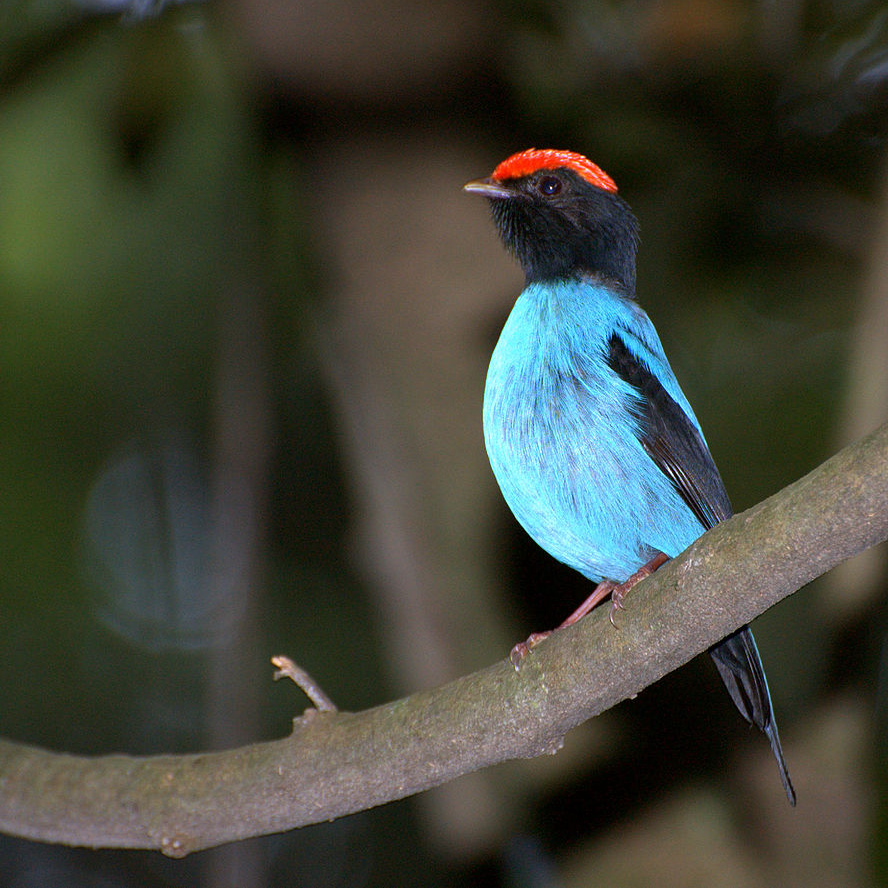
Helmeted Manakin
Antilophia galeata
Order: Passeriformes / Family: Pipridae

Wikimedia Commons
About the Helmeted Manakin
The Helmeted Manakin, scientifically known as Antilophia galeata, is a remarkable bird native to South America, particularly thriving in the subtropical and tropical forests of Brazil, Paraguay, and northeastern Argentina. This species belongs to the Pipridae family and is renowned for its vibrant plumage and unique courtship displays. The Helmeted Manakin plays a critical role in its ecosystem as a seed disperser, aiding in the propagation of various plant species by consuming fruits and excreting seeds in different locations. Its presence indicates a healthy, biodiverse environment.
Found predominantly in the Atlantic Forest biome, the Helmeted Manakin is an indicator species for forest conservation efforts. This biome is one of the most diverse and yet endangered ecosystems on the planet. Its dense undergrowth provides the manakin with ample foraging opportunities, as well as safe nesting sites. These birds are often observed in the mid-story and understorey levels of the forest, where they can find food and create nests with minimal disturbance.
Seasonally, the Helmeted Manakin exhibits some changes in behavior and habitat usage. During the breeding season, males become more territorial and display to attract females. Outside of this period, they tend to be less conspicuous, blending into the lush green surroundings. The species’ reliance on well-preserved forest habitats makes it vulnerable to deforestation and habitat fragmentation. Conservationists closely monitor the Helmeted Manakin to ensure that its habitat remains intact, as it is critical not only for the bird's survival but also for the myriad other species that share its environment.
The Helmeted Manakin belongs to the family Pipridae, within the order Passeriformes. These birds typically live average 6 years, with a maximum recorded of 10 years..
How to Identify a Helmeted Manakin
Adult Helmeted Manakins are easily identifiable by their striking appearance. Males boast a vibrant red crown that sharply contrasts with their otherwise glossy black plumage. The rest of their body, including the wings and tail, is predominantly black, giving it a sleek look. Females, on the other hand, have more subdued olive-green coloring, which provides excellent camouflage in the dense foliage. Juveniles resemble females until they reach maturity, when males develop their distinctive red helmets.
In terms of size, the Helmeted Manakin is relatively small, measuring about 14 cm in length and weighing approximately 20 to 25 grams. Their compact body and short wings are adapted for agile movements through dense vegetation. When perched, the Helmeted Manakin typically sits upright, often on thin branches where it can maintain a watchful eye over its territory.
The Helmeted Manakin can be confused with other manakin species, particularly those with similar body shapes or overlapping ranges. However, the vivid red crown of the male is a distinguishing feature. In flight, these birds exhibit a rapid, direct flight pattern, characterized by quick wingbeats and short glides. Their flight silhouette is compact, with wings held close to the body, allowing them to navigate the forest with precision.
Having trouble telling birds apart? Upload a photo to our bird identification tool for an instant species match.
Helmeted Manakin Habitat and Range
Preferred Habitat
The Helmeted Manakin inhabits subtropical and tropical moist lowland forests, primarily within the Atlantic Forest of Brazil, Paraguay, and northeastern Argentina. This region is characterized by high humidity, dense foliage, and a rich diversity of plant species. The manakin thrives in areas with dense undergrowth and a complex vertical structure that provides ample food resources and nesting sites.
It is typically found at elevations ranging from sea level up to 1,200 meters. While the manakin favors undisturbed forest environments, it can occasionally be observed in secondary forests and forest edges, particularly where these areas border primary forest.
Seasonal habitat shifts in the Helmeted Manakin are minimal, as the species generally remains within the same forested areas year-round. However, slight movements may occur in response to food availability, particularly during the non-breeding season. The Helmeted Manakin is not commonly found in urban settings, as it relies heavily on intact forest ecosystems for survival.
Geographic Range
The Helmeted Manakin's range is concentrated in South America, specifically within the Atlantic Forest biome that spans Brazil, Paraguay, and northeastern Argentina. Its breeding range corresponds closely with its year-round habitat, as this species does not engage in long-distance migration.
In Brazil, the Helmeted Manakin is found in states such as São Paulo, Minas Gerais, and Rio de Janeiro, where it inhabits both coastal and inland forest regions. In Paraguay, it occupies the eastern part of the country, particularly areas that are part of the Upper Paraná Atlantic Forest. The species is also present in the Misiones region of Argentina, where conservation efforts are particularly focused due to the region's high biodiversity.
Population density hotspots for the Helmeted Manakin are closely tied to areas of well-preserved forest. These hotspots are often located within protected areas and national parks, where the threats of deforestation and habitat degradation are minimized. The species' stable presence within these protected regions highlights the importance of conservation initiatives in maintaining biodiversity.
Want to know which birds visit your area? Browse our backyard birds by location guides for region-specific species lists.
What Does the Helmeted Manakin Eat?
The Helmeted Manakin primarily feeds on fruits, making it an important frugivore within its ecosystem. Its diet consists of a variety of small fruits and berries, which it plucks from the forest understorey and mid-story. The manakin has a preference for soft, fleshy fruits that are easily digestible.
During the breeding season, the manakin's diet remains consistent, although it may increase fruit consumption to meet the energy demands of mating and territory defense. In addition to fruits, the Helmeted Manakin occasionally supplements its diet with small insects and arthropods, providing an important source of protein and nutrients.
Foraging behavior is characterized by short, quick flights between fruiting trees and shrubs. The Helmeted Manakin often forages alone or in small groups, and it uses its agile movements to navigate dense foliage efficiently. Feeding typically occurs during the early morning and late afternoon, when temperatures are cooler and fruit availability is high.
Helmeted Manakin Behavior and Social Structure
Helmeted Manakins exhibit fascinating social and territorial behaviors, particularly during the breeding season. Males are known for their elaborate courtship displays, which involve a series of acrobatic flight maneuvers and vocalizations designed to attract females. These displays often take place in specific lekking areas where multiple males gather to compete for female attention.
Outside the breeding season, Helmeted Manakins are generally solitary or found in small, loose groups. They maintain a defined territory, which they defend against intruders, particularly during the breeding season. Territorial defense involves visual displays and vocalizations intended to deter other males.
In terms of daily activity, Helmeted Manakins are most active during the cooler parts of the day, such as early morning and late afternoon. This timing coincides with increased fruit availability and reduced competition from other frugivores. In response to predators, these birds rely on their agility and dense habitat to avoid detection and capture.
Helmeted Manakin Nesting and Reproduction
The nesting habits of the Helmeted Manakin involve constructing cup-shaped nests, which are typically positioned in the fork of a tree branch or shrub within dense forest undergrowth. Nests are built using fine plant materials such as leaves, fibers, and moss, providing a secure and concealed environment for the eggs.
The female is responsible for nest construction and incubation, laying a clutch of two eggs. The incubation period lasts approximately 18 to 20 days, during which the female remains attentive to the nest. Once the chicks hatch, both parents participate in feeding the young, bringing them a diet rich in fruits and occasionally insects to ensure proper nutrition.
Fledging occurs about 15 to 20 days after hatching, with young birds gradually gaining independence as they learn to forage and navigate their environment. The Helmeted Manakin typically raises one brood per year, although in areas with abundant resources, a second brood may occasionally be attempted.
Helmeted Manakin Sounds and Vocalizations
The Helmeted Manakin produces a distinctive primary song consisting of a series of rapid, high-pitched notes that are crisp and clear. This song serves as a territorial call and is most frequently heard during the breeding season, as males seek to establish dominance and attract females.
In addition to its primary song, the Helmeted Manakin emits various call notes, including soft chirps and whistles used for communication between individuals. Alarm calls are sharp and abrupt, alerting other manakins to the presence of potential threats such as predators.
The Helmeted Manakin participates in the dawn chorus, with males vocalizing energetically during the early morning hours. The rhythmic and repetitive nature of their calls creates a vibrant auditory landscape within their forest habitat.
Interesting Facts About the Helmeted Manakin
- 1Helmeted Manakins are known for their lekking behavior, where males gather to perform courtship displays.
- 2The Helmeted Manakin's bright red crown is not just for show; it's used to signal fitness and attract mates.
- 3Despite their small size, Helmeted Manakins play a significant role in seed dispersal within their habitats.
- 4Helmeted Manakins can consume fruits up to 15% of their body weight in a single day, aiding forest regeneration.
- 5The Atlantic Forest, home to the Helmeted Manakin, is one of the world's most diverse and threatened ecosystems.
- 6The name 'Helmeted Manakin' refers to the male's striking red head, resembling a helmet.
- 7Helmeted Manakins are part of a diverse family of birds known for their elaborate courtship rituals and vivid plumage.
Helmeted Manakin Conservation Status
The Helmeted Manakin is currently classified as Least Concern by the IUCN, with a generally stable population trend. However, the species faces threats from habitat loss due to deforestation and land-use changes in its native range. As the Atlantic Forest continues to be cleared for agriculture and urban development, the available habitat for the Helmeted Manakin shrinks, putting pressure on the population. Conservation efforts focus on protecting and restoring forest habitats, particularly within established reserves and national parks. Initiatives that promote sustainable land use and reforestation are vital for maintaining the ecological balance required by the Helmeted Manakin and other forest-dependent species. Historically, the Helmeted Manakin's population has fluctuated in response to changes in forest cover. Continued conservation measures are essential to ensure that this vibrant species remains a common and thriving component of its ecosystem.