
Swallow-tailed Manakin
Chiroxiphia caudata
Order: Passeriformes / Family: Pipridae
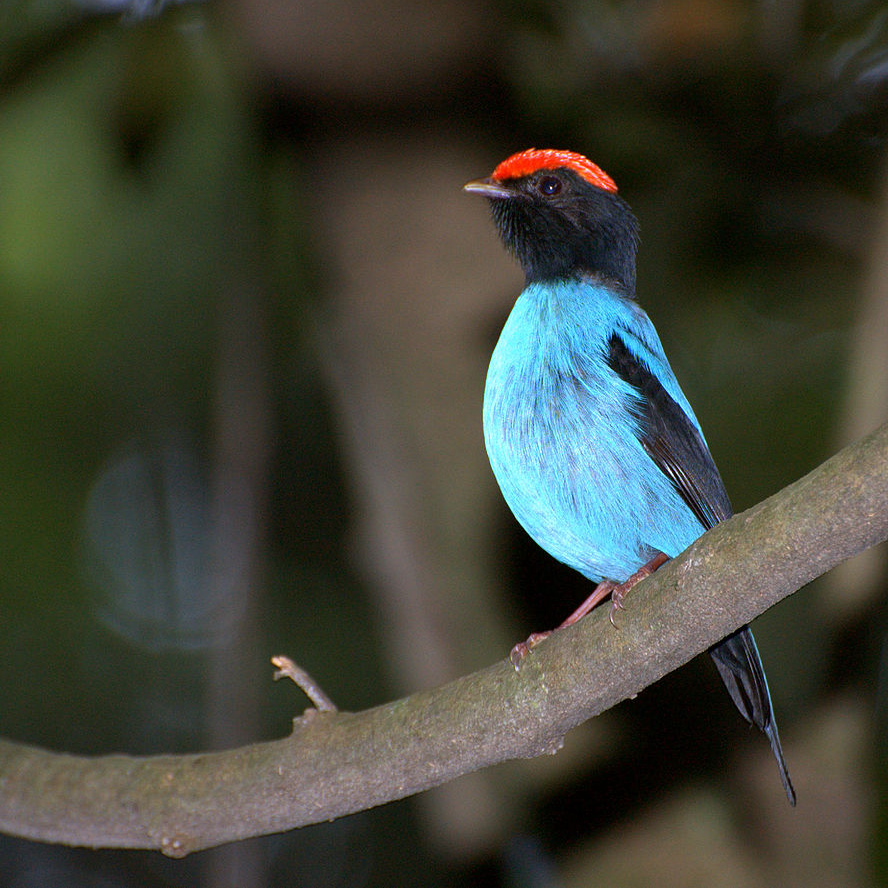
Wikimedia Commons
About the Swallow-tailed Manakin
The Swallow-tailed Manakin, scientifically known as Chiroxiphia caudata, is a captivating avian species belonging to the Pipridae family. This species predominantly inhabits the Atlantic Forest regions of Brazil, Paraguay, and northeastern Argentina. The bird plays a significant ecological role in these tropical and subtropical forests by acting as a seed disperser, thereby contributing to forest regeneration and plant diversity. As a frugivore, the Swallow-tailed Manakin consumes a wide variety of fruits, aiding in the distribution of seeds across its range. This behavior underscores the bird's importance in maintaining healthy forest ecosystems.
The Swallow-tailed Manakin is a small passerine bird, measuring approximately 15-17 cm in length. Its long, swallow-like tail and brilliant coloration make it a standout species among the dense foliage of its forest habitat. The male's vibrant blue plumage and contrasting black cap are particularly stunning, while females and juveniles sport more subdued olive-green feathers, allowing them to blend seamlessly into the woodland environment. This dimorphism plays a role in their mating strategies and survival.
During the breeding season, which typically coincides with the rainy season from September to February, the Swallow-tailed Manakin engages in elaborate courtship displays. Males gather in leks, where they perform complex dances and vocalizations to attract females. This behavior not only facilitates mate selection but also increases the likelihood of genetic diversity within the population. Outside of the breeding season, these birds are more solitary, foraging individually or in small groups. Despite their limited geographic range, Swallow-tailed Manakins are adaptable to various microhabitats within their forested environment, from lowland to montane areas, up to elevations of 1200 meters.
In addition to their ecological contributions, Swallow-tailed Manakins are of interest to ornithologists and birdwatchers due to their unique behaviors and striking appearance. As habitat destruction and fragmentation threaten the Atlantic Forest, understanding the species' habits and needs is crucial for conservation efforts. Protecting their habitat not only benefits the Swallow-tailed Manakin but also supports a wide range of species that share this biodiverse ecosystem.
The Swallow-tailed Manakin belongs to the family Pipridae, within the order Passeriformes. These birds typically live average 8 years, with a maximum recorded of 12 years..
How to Identify a Swallow-tailed Manakin
The Swallow-tailed Manakin is easily identified by its brilliant blue plumage and long, forked tail, which sets it apart from other manakins. The adult male features vibrant blue feathers with a contrasting black cap and mask, a visual signature that facilitates recognition even in dense forest canopies. In contrast, females and juveniles exhibit olive-green plumage, providing effective camouflage against predators in their lush environment. These differences in plumage are significant for breeding and protective purposes.
Male Swallow-tailed Manakins can be distinguished from similar species by their unique tail structure and the striking contrast of blue and black. In flight, the bird's silhouette is characterized by its long, pointed tail and compact body, a shape reminiscent of a swallow. When perched, the manakin maintains an upright posture, often visible atop branches during courtship displays.
Juvenile Swallow-tailed Manakins resemble adult females with their greenish tones but can be identified by the gradual appearance of blue feathers as they mature. This progressive molting into adult plumage is a key identification feature during field observations. The bird's distinct appearance ensures that even novice birdwatchers can identify it with relative ease in its native habitat.
Having trouble telling birds apart? Upload a photo to our bird identification tool for an instant species match.
Swallow-tailed Manakin Habitat and Range
Preferred Habitat
The Swallow-tailed Manakin primarily inhabits tropical and subtropical moist broadleaf forests, particularly the Atlantic Forest of Brazil, Paraguay, and Argentina. This biome is characterized by its high biodiversity and dense canopy cover, providing an ideal environment for the manakin's foraging and breeding activities. The bird is typically found at elevations ranging from sea level to 1200 meters, adapting to both lowland and montane forests.
Within these forests, the Swallow-tailed Manakin prefers areas with abundant fruiting trees and a well-developed understory, which offer ample feeding and nesting opportunities. It can also be found in forest edges and secondary growth areas, demonstrating some level of adaptability to habitat changes. Despite this adaptability, the species is less common in heavily urbanized or agricultural regions, where natural vegetation is sparse.
Seasonal habitat shifts are minimal for this non-migratory species, although local movements may occur in response to fruit availability and environmental conditions. Preservation of the Atlantic Forest is critical for maintaining suitable habitats for the Swallow-tailed Manakin and the myriad other species that rely on this unique ecosystem.
Geographic Range
The Swallow-tailed Manakin's range is concentrated within the Atlantic Forest biome, stretching across southeastern Brazil, eastern Paraguay, and northeastern Argentina. In Brazil, it is found from the states of Bahia and Minas Gerais southward to Rio Grande do Sul. Its distribution extends into Paraguay's eastern regions, such as Alto Paraná, and into Argentina's Misiones province, where the Atlantic Forest remains relatively intact.
This species is non-migratory, maintaining a year-round presence within its range. However, it may undertake local movements within the forest in search of fruiting trees or optimal breeding sites during the rainy season. These movements are not extensive but are crucial for the bird's survival and reproductive success.
Population density is highest in areas where forest cover is intact and fruiting trees are abundant. Conservation efforts in regions with significant habitat loss are vital to prevent further population declines. The Swallow-tailed Manakin's reliance on the Atlantic Forest makes it particularly vulnerable to deforestation and habitat fragmentation, emphasizing the need for targeted conservation initiatives.
Want to know which birds visit your area? Browse our backyard birds by location guides for region-specific species lists.
What Does the Swallow-tailed Manakin Eat?
The diet of the Swallow-tailed Manakin primarily consists of a diverse array of fruits, making it an essential frugivore within its ecosystem. It feeds on fruits from a variety of plant species, including those from the genera Ficus, Miconia, and Cecropia. The manakin's role as a seed disperser is crucial for forest regeneration, as it aids in the propagation of numerous plant species.
During the breeding season, when energy demands are higher, the Swallow-tailed Manakin may supplement its diet with small insects and spiders. This added protein supports the energy-intensive activities associated with courtship and nesting. The bird employs a hovering and gleaning foraging technique, plucking fruits and insects from foliage while in mid-air or from branches.
Feeding occurs throughout the day, with peaks in activity during the early morning and late afternoon when fruit availability is highest and temperature conditions are optimal. The Swallow-tailed Manakin's diet may vary slightly with seasonal fruiting patterns, showcasing its adaptability to the dynamic forest environment.
Swallow-tailed Manakin Behavior and Social Structure
The Swallow-tailed Manakin exhibits fascinating social and courtship behaviors, making it a subject of interest for ornithologists and bird enthusiasts alike. Males are renowned for their lekking behavior, where they gather in small groups to perform intricate courtship displays aimed at attracting females. These displays involve a series of coordinated dances, flights, and vocalizations.
Territoriality is pronounced within these leks, with males defending their display sites vigorously from rivals. Despite this aggression, the lek system promotes genetic diversity, as females have the opportunity to select mates from a pool of competitors based on display quality.
Outside the breeding season, Swallow-tailed Manakins are more solitary, foraging alone or in small, loosely associated groups. They remain alert to predators, utilizing the dense forest canopy for cover and relying on their swift, agile flight to evade threats. Daily activity patterns include periods of rest during the hottest parts of the day, with peak activity in the cooler mornings and late afternoons.
The Swallow-tailed Manakin's behavior reflects its adaptation to the challenges of forest life, balancing the demands of reproduction with the need for survival in a complex and dynamic environment.
Swallow-tailed Manakin Nesting and Reproduction
Swallow-tailed Manakins build delicate cup nests, typically located in the fork of a tree branch or shrub within dense forest undergrowth. The nest construction involves an intricate weaving of fine plant fibers, moss, and spider silk, creating a secure cradle for the eggs.
Females are solely responsible for nest building, incubation, and chick rearing, as males do not participate in these tasks. A typical clutch consists of two eggs, which are incubated for approximately 18 to 20 days. Once hatched, the chicks remain in the nest for another 15 to 20 days before fledging.
The breeding season, aligned with the rainy season, ensures ample food supply for the growing chicks. Swallow-tailed Manakins may produce one or two broods per year, depending on environmental conditions and food availability. The parental care provided by the female ensures high survival rates for the fledglings, which gradually gain independence over several weeks post-fledging. This nesting strategy reflects the species' adaptation to the cyclical nature of its forest environment.
Swallow-tailed Manakin Sounds and Vocalizations
The Swallow-tailed Manakin's vocal repertoire is a key component of its courtship display. The primary song consists of a series of high-pitched, melodious notes that rise and fall in a rhythmic pattern, each lasting several seconds. This song is often accompanied by mechanical wing noises, produced as the male performs its display.
In addition to the primary song, the manakin emits various call notes used for communication between individuals. These include soft, chattering sounds and sharp, alarm calls that alert others to potential threats. During the dawn chorus, males are particularly vocal, their songs filling the forest with sound as they compete for female attention.
Compared to other forest songbirds, the Swallow-tailed Manakin's vocalizations are distinctive and easily recognized by experienced birders. Their melodic quality and rhythmic structure contribute to the auditory landscape of the Atlantic Forest, playing a role in the complex social interactions of the species.
Interesting Facts About the Swallow-tailed Manakin
- 1The Swallow-tailed Manakin's tail, measuring up to 7 cm, is longer compared to its body size than in many other birds.
- 2These manakins are known for their complex lekking behavior, where up to five males perform synchronized displays.
- 3Swallow-tailed Manakins primarily consume fruits, aiding in the dispersal of over 25 plant species within their range.
- 4During the breeding season, males can spend up to 90% of their day performing courtship displays, showcasing their dedication.
- 5Despite their vivid coloration, Swallow-tailed Manakins can remain surprisingly well-hidden in dense forest foliage.
- 6The species is a vital component of the Atlantic Forest ecosystem, contributing to seed dispersal and forest health.
- 7Swallow-tailed Manakins exhibit a rare social structure among birds, with males cooperating in lek displays to attract females.
Swallow-tailed Manakin Conservation Status
The Swallow-tailed Manakin is currently classified as Least Concern by the IUCN, reflecting a stable population trend. However, the species faces ongoing threats from habitat destruction and fragmentation, particularly within the Atlantic Forest, which has experienced significant deforestation over the past decades. Conservation efforts focus on preserving remaining forest areas and promoting reforestation projects to restore degraded habitats. These initiatives are crucial not only for the Swallow-tailed Manakin but also for the myriad species that share this biodiversity hotspot. Historically, the manakin's population has fluctuated in response to habitat availability, highlighting the importance of continued conservation action. Efforts by local and international organizations aim to curb habitat loss and ensure a sustainable future for this and other Atlantic Forest species.


