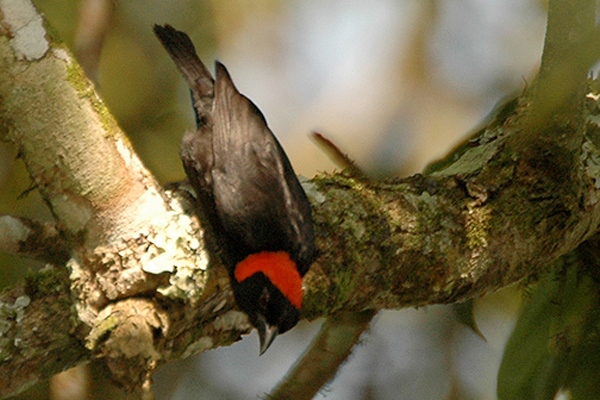
Ibadan Malimbe
Malimbus ibadanensis
Order: Passeriformes / Family: Ploceidae

Wikimedia Commons
About the Ibadan Malimbe
The Ibadan Malimbe (Malimbus ibadanensis) is a captivating bird found exclusively in southwestern Nigeria, particularly in the forested regions around Ibadan. This elusive species belongs to the Ploceidae family, which includes weavers and allies known for their intricate nest-building skills. The Ibadan Malimbe is a species of significant conservation concern due to its restricted range and habitat loss. Its presence is primarily confined to the lowland tropical forests, which are increasingly threatened by agricultural expansion and urbanization. Despite its limited distribution, the Ibadan Malimbe plays a crucial role in the ecosystem as both a seed disperser and an insect predator, contributing to the health and sustainability of its habitat. Characterized by its striking red head and contrasting black body, the Ibadan Malimbe is easily recognizable in the dense foliage it calls home. The bird's ecological role extends beyond its immediate environment, as it serves as an indicator species for the health of Nigeria's diminishing forest ecosystems. Observers often find the Ibadan Malimbe foraging energetically in the mid-levels of the forest canopy, where it partakes in complex social interactions and displays seasonal shifts in behavior. During the breeding season, which typically aligns with the rainy season, the Ibadan Malimbe becomes more vocal and engages in elaborate courtship rituals. These rituals are crucial for mate selection and successful reproduction, ensuring the continuation of the species amidst growing environmental pressures. The bird's adaptability within its forest habitat is noteworthy, as it navigates through various ecological niches, from dense undergrowth to open tree canopies. This adaptability, however, is not limitless, and the ongoing habitat fragmentation poses a severe threat to its survival. Conservation efforts aimed at protecting the remaining forest tracts are vital for the long-term preservation of the Ibadan Malimbe and its unique ecological contributions.
The Ibadan Malimbe belongs to the family Ploceidae, within the order Passeriformes. These birds typically live average 4-5 years, with some living up to 7 years..
How to Identify a Ibadan Malimbe
Adult Ibadan Malimbes are distinctively marked with a bright red head, which contrasts sharply with their black body and wings. This striking coloration makes them relatively easy to identify within their limited range. Juveniles, however, exhibit more muted tones, with a duller red on the head that gradually brightens as they mature. Males and females share similar plumage, making sexual dimorphism minimal in this species. The Ibadan Malimbe's flight silhouette is characterized by a short, rounded tail and broad wings, which allow for agile movement through dense forest canopies. In terms of perching posture, these birds often position themselves on the underside of branches, a behavior that aids in their foraging activities. While confusion with other species is uncommon due to their unique coloration, novice birders might mistake them for the Red-headed Malimbe, which shares a similar range but has a more extensive red area covering the throat and chest. Careful observation of the Ibadan Malimbe's smaller red patch and its vocalizations will aid in accurate identification.
Having trouble telling birds apart? Upload a photo to our bird identification tool for an instant species match.
Ibadan Malimbe Habitat and Range
Preferred Habitat
The Ibadan Malimbe predominantly inhabits lowland tropical forests, a habitat rich in biodiversity but increasingly threatened by human activities. These forests, found in southwestern Nigeria, provide the essential cover and resources the species requires. Elevation ranges for this bird typically do not exceed 500 meters, as it favors the humid, dense canopy of the lowlands. Seasonal habitat shifts are minimal, as the Ibadan Malimbe remains year-round in its forested environment. While primarily a forest species, it occasionally ventures into forest edges and secondary growth areas, particularly when searching for food. Urban encroachment has yet to see the Ibadan Malimbe adapt to city life, and it remains absent from heavily urbanized areas, highlighting its preference for untouched or lightly disturbed forest landscapes.
Geographic Range
The Ibadan Malimbe's range is strictly limited to the southwestern region of Nigeria, with a strong concentration around the city of Ibadan. This species does not undertake long migrations, remaining within its restricted geographical range throughout the year. Its breeding territories align closely with its overall range, as the bird relies on consistent environmental conditions to support its reproductive activities. Population density hotspots are primarily found in the remaining forested areas surrounding Ibadan, where conservation efforts are crucial. The lack of significant dispersal beyond this region makes the Ibadan Malimbe particularly vulnerable to habitat changes within its confined range.
Want to know which birds visit your area? Browse our backyard birds by location guides for region-specific species lists.
What Does the Ibadan Malimbe Eat?
The diet of the Ibadan Malimbe consists mainly of insects and small arthropods, which it skillfully extracts from leaves and bark in the forest canopy. Seasonal diet changes are influenced by the availability of these prey items, with a higher reliance on seeds and fruits during periods of reduced insect abundance. Foraging techniques involve acrobatic maneuvers through the treetops, often hanging upside down to access hidden food sources. The size of prey typically ranges from small insects like ants and beetles to larger caterpillars, which provide a rich source of protein. The Ibadan Malimbe is most active in its feeding during the early morning and late afternoon, times when insect activity peaks and temperatures are moderate.
Ibadan Malimbe Behavior and Social Structure
The Ibadan Malimbe exhibits complex social structures, often observed in small, cohesive family groups. Territorial behavior is pronounced during the breeding season, with males defending their chosen nest sites from intruders. Courtship displays involve a series of elaborate flight patterns and vocalizations designed to attract females. Outside the breeding season, these birds can be found in mixed-species flocks, which offer increased protection from predators through heightened awareness. The Ibadan Malimbe's response to predators includes alarm calls and swift, evasive flight. Daily activity patterns show peak activity in cooler hours, with midday often spent resting or engaging in social grooming. Despite its small range, the Ibadan Malimbe displays a remarkable adaptability in its social and foraging behaviors, essential traits for navigating its dynamic forest environment.
Ibadan Malimbe Nesting and Reproduction
Ibadan Malimbes construct intricate hanging nests, primarily using grasses, twigs, and leaves. These nests, suspended from tree branches, provide protection from ground-based predators and are often located in the mid to upper levels of the forest canopy. The typical clutch size ranges from two to four eggs, with an incubation period of approximately 14 days. Both parents participate in feeding and caring for the fledglings, which leave the nest about three weeks after hatching. The number of broods per year usually remains at one, although favorable conditions can occasionally lead to a second brood. Parental roles are well-defined, with both male and female sharing incubation duties and post-hatching care.
Ibadan Malimbe Sounds and Vocalizations
The primary song of the Ibadan Malimbe is a series of melodious whistles, characterized by a rhythmic pattern and a clear, ringing quality. These vocalizations serve multiple functions, from attracting mates during the breeding season to establishing territory. Call notes are typically short, sharp chirps used for communication within groups. Alarm calls are more abrupt and harsh, signaling the presence of predators or intruders. During the dawn chorus, the Ibadan Malimbe's song stands out with its distinct tonal quality, reminiscent of a soft flute. These vocalizations are crucial for maintaining social bonds and navigating the dense forest environment.
Interesting Facts About the Ibadan Malimbe
- 1The Ibadan Malimbe was first described in 1951, making it one of the more recently discovered African birds.
- 2Despite being relatively small, the Ibadan Malimbe builds nests that can be as long as 30 centimeters.
- 3The Ibadan Malimbe's call is often compared to the sound of a gentle flute, making it a favorite among birdwatchers.
- 4This species is one of only a few birds endemic to Nigeria, highlighting its unique ecological niche.
- 5Ibadan Malimbes can consume up to 50 insects per day during peak feeding times, contributing to pest control.
Ibadan Malimbe Conservation Status
The Ibadan Malimbe is currently listed as Endangered on the IUCN Red List, with a decreasing population trend. Primary threats include habitat destruction due to agricultural expansion and urban development. Conservation efforts focus on preserving the remaining forest habitats and raising awareness about the species' plight. Historical population changes have shown a decline corresponding with increased deforestation rates. Protecting critical habitats and implementing sustainable land-use practices are essential for reversing this trend and ensuring the survival of the Ibadan Malimbe.
Other Ploceidae Species



Birds Similar to the Ibadan Malimbe
These species are often confused with the Ibadan Malimbe due to similar appearance or overlapping range.