
Indian Skimmer
Rynchops albicollis
Order: Charadriiformes / Family: Laridae
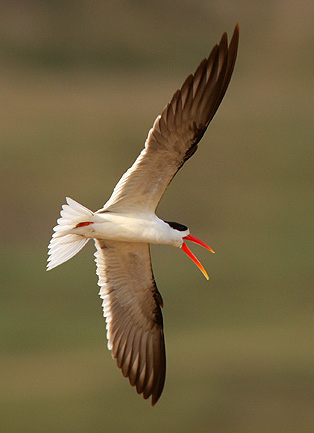
Wikimedia Commons
About the Indian Skimmer
The Indian Skimmer, known scientifically as Rynchops albicollis, is a highly specialized bird within the family Laridae. Renowned for its unique method of foraging, this species employs a remarkable technique of skimming the water's surface with its elongated lower mandible to catch fish. This behavior not only sets the Indian Skimmer apart but also underscores its significant role in its ecosystem. Found primarily in the Indian subcontinent, the Indian Skimmer inhabits major river systems such as the Ganges, Brahmaputra, and Indus, as well as various large lakes and estuaries. Its presence is most notable in India, Bangladesh, and occasionally in Pakistan. The bird's distribution and population dynamics have been influenced by its reliance on specific riverine ecosystems, which are increasingly threatened by human activity. The Indian Skimmer's ecological role extends beyond its feeding habits. As a top predator in its environment, it helps maintain the balance of aquatic ecosystems. The bird's seasonal movements are largely dictated by the availability of suitable habitats and food sources. During the breeding season, which generally spans from March to May, Indian Skimmers congregate in large colonies on sandbars and riverbanks, where they lay their eggs and rear their young. Outside the breeding season, these birds exhibit a degree of nomadism, moving in response to changes in water levels and food availability. This adaptability has become crucial as the species faces habitat degradation and other anthropogenic pressures. The Indian Skimmer's presence in a region often indicates a healthy and functioning aquatic ecosystem. Conservation efforts for this species focus not only on protecting its natural habitats but also on promoting awareness of its ecological importance. Despite these efforts, the Indian Skimmer remains vulnerable to threats such as habitat loss, pollution, and disturbance from human activities along riverbanks. The species' future hinges on targeted conservation strategies and international cooperation, given its cross-border range and the interconnected nature of its habitats.
The Indian Skimmer belongs to the family Laridae, within the order Charadriiformes. These birds typically live average 10-12 years with a maximum recorded of 15 years..
How to Identify a Indian Skimmer
The Indian Skimmer is immediately recognizable by its contrasting black and white plumage. Adults possess a striking white forehead and underparts, set against a black cap and upper wings. The beak is long and orange, with the lower mandible distinctly longer than the upper. This adaptation is crucial for its unique feeding method. In juveniles, the plumage is slightly duller, and the distinction between the black cap and the white forehead is less pronounced. Both males and females look alike, making sexual dimorphism minimal in this species. However, careful observation might reveal subtle size differences, with males generally being slightly larger. In flight, the Indian Skimmer's silhouette is unmistakable. Its long, narrow wings and deeply forked tail enable agile and swift movements over water. When perched, it maintains an upright stance, often on sandy riverbanks or exposed sandbars. Despite its distinctive appearance, the Indian Skimmer can sometimes be confused with other waterbirds, such as terns. However, the longer lower mandible and the bird's unique foraging behavior easily set it apart from such species.
Having trouble telling birds apart? Upload a photo to our bird identification tool for an instant species match.
Indian Skimmer Habitat and Range
Preferred Habitat
The Indian Skimmer thrives in lowland riverine environments, where it can exploit sandbars and exposed mudflats for breeding. These birds prefer large rivers, estuaries, and lakes that provide ample feeding opportunities. They are most commonly found at elevations below 300 meters, where slow-flowing water and sandy substrates are prevalent. Seasonal shifts in habitat are largely influenced by water levels. During the breeding season, Indian Skimmers seek out undisturbed sandbanks along rivers. In contrast, the non-breeding season may see them frequenting coastal areas or reservoirs. While primarily rural, their habitats can occasionally overlap with urban environments, especially where rivers pass through populated areas. However, they tend to avoid heavily urbanized settings, where human disturbance and habitat degradation pose significant challenges.
Geographic Range
The Indian Skimmer's range is primarily concentrated in the Indian subcontinent. The breeding range includes major river systems in India, such as the Ganges and Brahmaputra, extending into Bangladesh. Smaller populations have been observed in Pakistan, particularly along the Indus River. During the non-breeding season, Indian Skimmers may disperse more widely, occasionally reaching coastal areas of Myanmar and Nepal. Migration corridors remain poorly defined, but seasonal movements are likely driven by changes in water levels and food availability. Population densities are highest along undisturbed stretches of river with ample sandbanks, although these areas are increasingly under threat from human activities.
Want to know which birds visit your area? Browse our backyard birds by location guides for region-specific species lists.
What Does the Indian Skimmer Eat?
The Indian Skimmer primarily feeds on small fish, which it captures through its unique skimming technique. This involves flying low over the water with its elongated lower mandible submerged, snapping shut when it contacts prey. Secondary food sources include crustaceans and aquatic insects, which provide dietary variety. Seasonal changes in diet are minimal, although availability of prey may fluctuate. Skimmers typically feed during the early morning and late afternoon, when fish are most active near the water's surface. Prey size ranges from small fry to fish several centimeters long, reflecting the skimmer's adaptability in diverse aquatic habitats.
Indian Skimmer Behavior and Social Structure
Indian Skimmers are social birds, often seen in flocks during the non-breeding season. They exhibit complex social structures and engage in communal roosting and foraging. Territorial behavior is most evident during the breeding season, when pairs establish nesting sites on sandbanks. Courtship displays involve aerial acrobatics and synchronized flights, strengthening pair bonds. Skimmers show resilience to predators through group vigilance and alarm calls, which alert the colony to danger. Daily activity patterns revolve around feeding and resting, with increased activity during cooler parts of the day. Despite their social nature, Indian Skimmers can become aggressive when defending nests from intruders.
Indian Skimmer Nesting and Reproduction
Indian Skimmers nest in colonies, preferring sandy riverbanks and exposed sandbars. Nests are simple scrapes in the sand, sometimes lined with small pebbles or plant material. Clutch size ranges from 3 to 5 eggs, which are camouflaged against the sandy substrate. Incubation lasts approximately 21 to 25 days, with both parents sharing duties. After hatching, chicks are precocial and leave the nest scrape soon after, though they remain dependent on their parents for food. Fledging occurs around 4 weeks post-hatching. Indian Skimmers typically raise one brood per year, although conditions may permit a second if the first clutch fails.
Indian Skimmer Sounds and Vocalizations
The Indian Skimmer's vocalizations consist of sharp, barking calls often described as 'kyip-kyip' or 'yip-yip.' These calls serve various functions, from maintaining flock cohesion to signaling alarm. The pitch is relatively high, and the rhythm can be irregular. Alarm calls are more urgent and repetitive, especially when predators approach. While not known for a melodious song, the Indian Skimmer's vocal repertoire is essential for communication within flocks. Dawn chorus behavior is subdued compared to more vocal passerines, yet it plays a role in social interactions and territory defense.
Interesting Facts About the Indian Skimmer
- 1The Indian Skimmer's lower mandible is about 30% longer than the upper mandible, an adaptation for skimming.
- 2Indian Skimmers can cover over 100 kilometers in a day while foraging, showcasing impressive stamina.
- 3The species' distinctive feeding method is shared with only two other skimmer species worldwide.
- 4Despite their specialized feeding, Indian Skimmers can adapt their diet when fish are scarce.
- 5Indian Skimmers often roost communally with other waterbird species, demonstrating their social nature.
- 6Scientists use the Indian Skimmer as an indicator species to assess riverine ecosystem health.
- 7Indian Skimmers have been observed feeding in flocks of up to 50 individuals, enhancing their foraging success.
Indian Skimmer Conservation Status
The Indian Skimmer is listed as Vulnerable by the IUCN, with a declining population trend. Primary threats include habitat loss from dam construction, sand mining, and river pollution. Conservation efforts focus on habitat protection and restoration, alongside legal measures to minimize human disturbance during the breeding season. Historically, the population has experienced fluctuations due to varying water management policies and land use changes. Ongoing international cooperation is crucial for securing the future of this distinctive species.
Other Laridae Species


Birds Similar to the Indian Skimmer
These species are often confused with the Indian Skimmer due to similar appearance or overlapping range.

