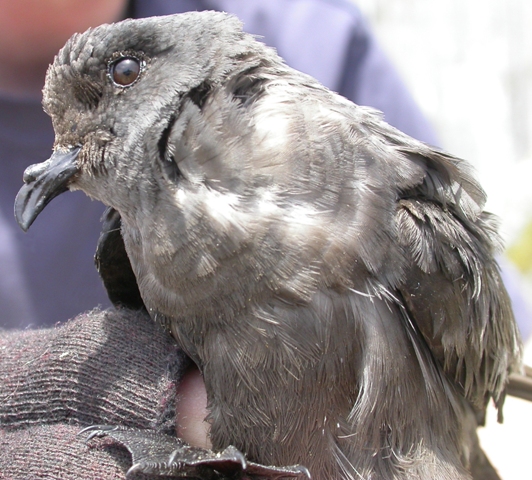
Leach's/Townsend's/Ainley's Storm-Petrel
Oceanodroma leucorhoa
Order: Procellariiformes / Family: Hydrobatidae

Wikimedia Commons
About the Leach's/Townsend's/Ainley's Storm-Petrel
Leach's Storm-Petrel, scientifically known as Oceanodroma leucorhoa, holds a significant place among seabirds due to its vast migratory patterns and its role in oceanic ecosystems. This small, agile bird is a quintessential pelagic species that spends most of its life far from land, only returning to coastal areas during the breeding season. With a wingspan of approximately 43 cm and a body length around 20 cm, this storm-petrel is adapted to life at sea, showcasing a surprisingly buoyant flight characterized by rapid flaps and glides. The species is named after William Elford Leach, a 19th-century British zoologist, and is sometimes referred to by the names Townsend's or Ainley's Storm-Petrel in certain taxonomic revisions, though these are generally considered synonymous with the primary species. Leach's Storm-Petrel is primarily nocturnal on its breeding grounds, which helps it avoid predators such as gulls and skuas. Its preference for nesting on remote islands in burrows or rock crevices highlights its adaptation to life in isolated, rugged landscapes. The bird’s ecological role is vital as it aids in nutrient cycling by feeding on plankton and small fish, transferring marine nutrients to terrestrial ecosystems when it returns to land to breed. Geographically, Leach's Storm-Petrel breeds in the North Atlantic and North Pacific Oceans, with significant populations found on islands off the coasts of Canada, the United Kingdom, and Norway. During non-breeding months, this species disperses widely across the open ocean, reaching as far south as the subtropical waters of the Atlantic and Pacific. Seasonal migrations play a crucial role in its lifecycle, enabling the bird to exploit different marine resources throughout the year. The storm-petrel’s ability to traverse long distances also makes it an indicator of ocean health, as changes in oceanic conditions can directly impact its distribution and abundance.
The Leach's/Townsend's/Ainley's Storm-Petrel belongs to the family Hydrobatidae, within the order Procellariiformes. These birds typically live average 20 years with a max recorded of 36 years..
How to Identify a Leach's/Townsend's/Ainley's Storm-Petrel
Identifying Leach's Storm-Petrel involves noting its unique flight pattern and distinct physical features. Adults possess a predominantly sooty black plumage with a slightly paler rump patch, which can be a key identifier when seen from above. The forked tail, more pronounced than in other storm-petrel species, sets it apart during flight. Juveniles resemble adults but may show slightly fresher feathering and less worn plumage. Male and female Leach's Storm-Petrels exhibit similar plumage, making gender differentiation difficult in the field. When comparing Leach's Storm-Petrel to similar species like the Wilson's Storm-Petrel, one should note the latter's more squared tail and different flight style, which is characterized by a more fluttering motion. In silhouette, the long wings of Leach's Storm-Petrel, often held in a slightly bowed position, are distinct. On the rare occasions when they perch, they typically rest with their heads tucked, presenting a compact profile. Observers should pay attention to the bird's behavior and environment, as these can provide additional clues for accurate identification.
Having trouble telling birds apart? Upload a photo to our bird identification tool for an instant species match.
Leach's/Townsend's/Ainley's Storm-Petrel Habitat and Range
Preferred Habitat
Leach's Storm-Petrel primarily inhabits open ocean environments. Their breeding habitat consists of remote islands, often characterized by steep cliffs and rocky shores. These islands are typically found in the North Atlantic and North Pacific regions. The species shows a marked preference for islands that offer suitable nesting sites, such as burrows or crevices in rock. During the non-breeding season, Leach's Storm-Petrel is pelagic, residing in open ocean waters far from the coast. This seabird does not frequent urban or heavily populated areas, remaining largely unseen by land-based observers. Elevation is not a limiting factor since they are predominantly oceanic, but they do breed on islands that rise significantly above sea level.
Geographic Range
The breeding range of Leach's Storm-Petrel spans the North Atlantic and North Pacific Oceans. Significant breeding colonies exist on islands off the coast of Newfoundland in Canada, the United Kingdom, and the Aleutian Islands in Alaska. During the non-breeding season, this species disperses widely across the oceans, with individuals recorded as far south as the subtropical Atlantic and Pacific. Notable migration corridors include the waters off the Eastern United States and the mid-Pacific. While at sea, Leach's Storm-Petrel is highly pelagic, rarely approaching land except during storms or breeding. Population densities are higher near productive marine areas where upwelling currents provide abundant food resources.
Want to know which birds visit your area? Browse our backyard birds by location guides for region-specific species lists.
What Does the Leach's/Townsend's/Ainley's Storm-Petrel Eat?
Leach's Storm-Petrel primarily feeds on planktonic crustaceans, small fish, and squid. Their diet varies seasonally, with a higher intake of fish larvae and squid during summer months in breeding areas. They employ a unique foraging technique known as 'surface seizing,' where they snatch prey items from the water's surface while in flight. Prey size is typically small, ranging from a few millimeters to several centimeters. Leach's Storm-Petrels are primarily nocturnal feeders, taking advantage of the cover of darkness to avoid predators and to exploit vertically migrating prey that come closer to the surface at night. Feeding often occurs in mixed-species flocks, where their foraging activity can benefit from the presence of other seabird species.
Leach's/Townsend's/Ainley's Storm-Petrel Behavior and Social Structure
Leach's Storm-Petrel exhibits fascinating social structures, particularly during the breeding season. They nest in large colonies, often in close proximity to other seabirds. Although colonial, each pair defends its nesting burrow vigorously. Courtship displays include aerial chases and vocalizations, which help reinforce pair bonds. These storm-petrels are highly migratory, spending much of their lives at sea. They exhibit a remarkable homing ability, returning to the same breeding sites year after year. In response to predators, Leach's Storm-Petrel relies on nocturnality and cryptic behavior at nesting sites to minimize risk. Their daily activity patterns are largely governed by the availability of food, with increased activity around dawn and dusk when prey is most accessible.
Leach's/Townsend's/Ainley's Storm-Petrel Nesting and Reproduction
Leach's Storm-Petrel typically nests in burrows or rock crevices on isolated islands. Nesting burrows are often self-excavated, though they may also use existing cavities. The nest consists of a simple scrape lined with leaves, grass, or feathers. Nesting sites are chosen for their protection from predators and harsh weather conditions. The typical clutch size is one egg per breeding season. The incubation period lasts about 40 to 50 days, with both parents sharing the responsibility. Chicks fledge approximately 60 to 70 days after hatching, with parental feeding continuing until fledging. Leach's Storm-Petrel generally raises only one brood per year, reflecting the energy-intensive nature of their nesting strategy.
Leach's/Townsend's/Ainley's Storm-Petrel Sounds and Vocalizations
The primary vocalization of Leach's Storm-Petrel is a series of high-pitched, rapid trills and chatters used mainly during the breeding season. These calls serve to communicate between mates and to ward off intruders. The rhythm of their calls is often described as a continuous, buzzy trill, contrasted by softer, more conversational notes exchanged between paired birds. Alarm calls are sharper and more abrupt, alerting nearby birds to potential threats. Unlike many passerines, Leach's Storm-Petrel does not participate in a dawn chorus; rather, their vocal activity peaks during the night when they are active at the colony.
Interesting Facts About the Leach's/Townsend's/Ainley's Storm-Petrel
- 1Leach's Storm-Petrel can live over 30 years in the wild, making it one of the longest-lived small bird species.
- 2They possess an extraordinary sense of smell, which they use to locate food over vast ocean expanses.
- 3These storm-petrels can travel thousands of kilometers during migration, exhibiting remarkable navigational skills.
- 4Leach's Storm-Petrel can drink seawater due to specialized salt glands that excrete excess salt.
- 5Their name honors William Elford Leach, a 19th-century British zoologist who made significant contributions to ornithology.
Leach's/Townsend's/Ainley's Storm-Petrel Conservation Status
Currently, Leach's Storm-Petrel is listed as Vulnerable by the IUCN. Its population trend is decreasing, primarily due to predation by introduced mammals such as rats and cats on breeding islands. Climate change poses additional threats, affecting food availability and breeding success. Conservation efforts include habitat restoration, predator control, and monitoring programs to better understand population dynamics. Historical changes have shown fluctuations in numbers, but recent pressures are more acute due to human-related impacts and environmental changes.