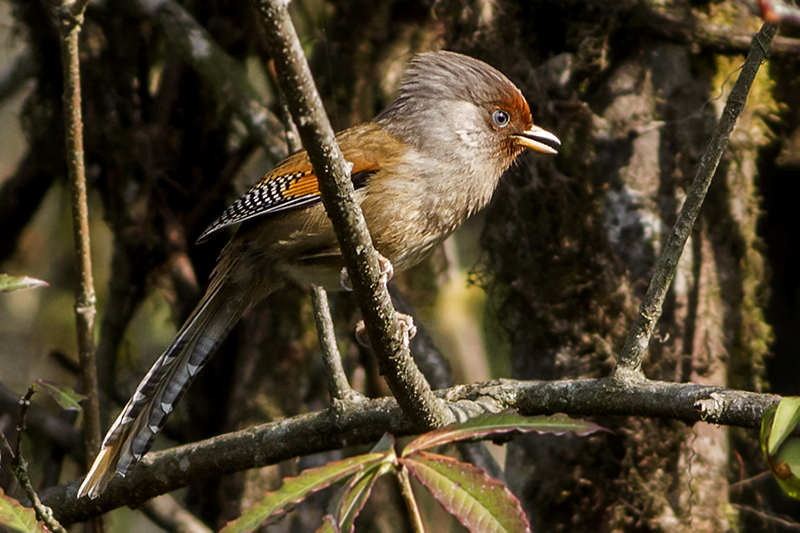
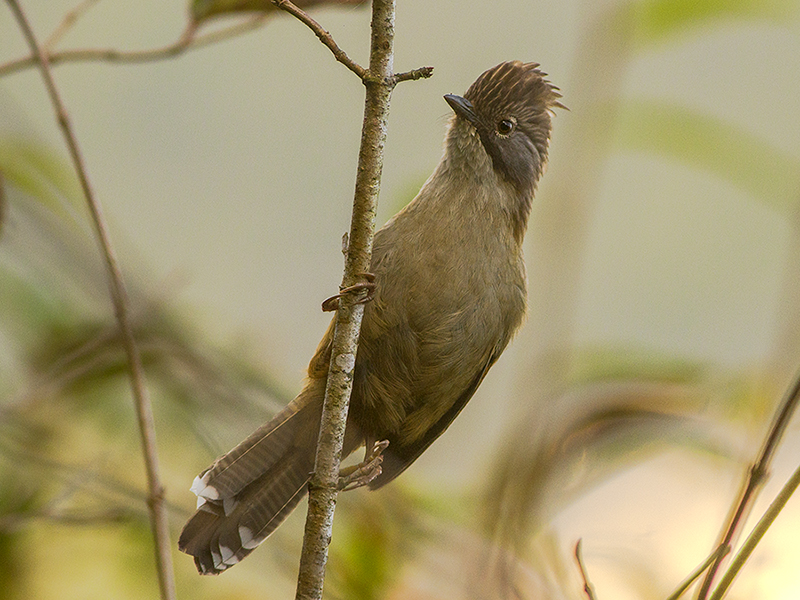
Lesser Necklaced Laughingthrush
Garrulax monileger
Order: Passeriformes / Family: Leiothrichidae

Wikimedia Commons
About the Lesser Necklaced Laughingthrush
The Lesser Necklaced Laughingthrush, Garrulax monileger, belongs to the family Leiothrichidae, a group known for their gregarious nature and complex vocalizations. Found predominantly in the forests of Southeast Asia, the bird plays a significant role in seed dispersal and insect control. Its range extends from the eastern Himalayas across northern India, Nepal, Bhutan, and into Southeast Asia, including Thailand, Laos, and Vietnam. The Lesser Necklaced Laughingthrush's presence in these regions underscores its adaptability to a variety of dense forest ecosystems, from lowland deciduous forests to montane regions. During the breeding season, typically from March to July, these birds exhibit increased territorial behavior, often forming small family groups. In the non-breeding season, they can be observed in larger flocks, sometimes mixing with other species of laughingthrushes. Their ecological role as both predator and prey makes them an integral part of the forest food web. By feeding on insects, small invertebrates, fruits, and seeds, they help control insect populations and disperse plant seeds across their habitat. This behavior benefits both the bird and the ecosystem, promoting plant diversity and forest health. Their loud, melodious calls contribute to the soundscape of their habitats, making them a favorite among bird enthusiasts and researchers alike. The Lesser Necklaced Laughingthrush's adaptability to various forest types and altitudinal ranges demonstrates its resilience, yet it remains dependent on forest health and continuity. This highlights the importance of preserving forested areas to maintain their populations and the ecological functions they support. With ongoing habitat loss in many parts of its range, conservation efforts must prioritize habitat preservation and restoration to ensure the species' continued survival. The Lesser Necklaced Laughingthrush's significance extends beyond its ecological roles, serving as a cultural icon in some regions, where its calls are believed to bring good fortune. This cultural dimension adds another layer to the importance of conserving this remarkable species.
The Lesser Necklaced Laughingthrush belongs to the family Leiothrichidae, within the order Passeriformes. These birds typically live average 8 years, with a maximum of 12 years recorded..
How to Identify a Lesser Necklaced Laughingthrush
The Lesser Necklaced Laughingthrush is a medium-sized bird, measuring about 26 to 28 cm in length. Its most distinctive feature is the pronounced black and white necklace pattern around its neck, which gives it its name. The bird's upperparts are primarily olive-brown, while its underparts are lighter with a whitish belly. The wings and tail feathers exhibit a rufous tint, offering a subtle contrast to its otherwise subdued plumage. Juveniles resemble adults but lack the full development of the necklaced pattern, appearing more uniform in coloration. Both males and females share similar plumage, making visual sex differentiation challenging in the field. However, subtle differences in size, with males generally being slightly larger, may be noted upon close observation. In flight, the Lesser Necklaced Laughingthrush displays a characteristic rounded wing silhouette, with a slightly elongated tail that aids in maneuvering through dense foliage. While perched, the bird's posture is upright, often with its tail slightly flicked, adding to its alert demeanor. Confusion with similar species, such as the Greater Necklaced Laughingthrush, can occur. However, the latter is larger and exhibits a more extensive necklaced pattern. Observers can also distinguish the Lesser Necklaced Laughingthrush by its specific vocalizations, which are integral to its identification.
Having trouble telling birds apart? Upload a photo to our bird identification tool for an instant species match.
Lesser Necklaced Laughingthrush Habitat and Range
Preferred Habitat
The Lesser Necklaced Laughingthrush inhabits a variety of forest types across its range, including subtropical and tropical moist lowland forests, as well as montane forests. These birds thrive at elevations ranging from sea level up to 2,500 meters, favoring areas with dense undergrowth and rich biodiversity. In the Indian subcontinent, they are often found in the humid forests of the eastern Himalayas, while in Southeast Asia, they frequent the dense jungles of Thailand and Vietnam. During the breeding season, they prefer undisturbed forest interiors, which provide ample nesting sites and food resources. Outside of the breeding season, they may venture into more open forest edges and secondary growth areas, demonstrating a degree of habitat flexibility. Though primarily forest dwellers, these birds occasionally visit rural gardens and plantations, especially where forest fragments remain. However, they are seldom found in urban environments, as they rely heavily on the cover and resources provided by natural habitats. Their presence in a range of forest types highlights their adaptability, but it also underscores the importance of forest conservation to support their populations.
Geographic Range
The breeding range of the Lesser Necklaced Laughingthrush extends from the eastern Himalayas through northern India and Bhutan, reaching into Southeast Asia. Countries like Nepal, Myanmar, Thailand, Laos, and Vietnam host significant populations. Within these regions, they inhabit forested areas where they can find the cover and food resources necessary for breeding and survival. While the species does not undertake long-distance migrations, some altitudinal movements may occur as birds descend from higher elevations to lower ones during colder months, particularly in the northern parts of their range. In Southeast Asia, populations tend to be more sedentary, remaining within their established territories year-round. Population density hotspots include the dense forests of Arunachal Pradesh in India and the montane regions of northern Thailand, where the birds are relatively common. Despite their stable presence in these regions, localized declines have been reported due to habitat destruction and fragmentation. Conservation efforts are crucial in maintaining the integrity of their habitat to ensure the survival of this species across its range.
Want to know which birds visit your area? Browse our backyard birds by location guides for region-specific species lists.
What Does the Lesser Necklaced Laughingthrush Eat?
The Lesser Necklaced Laughingthrush exhibits an omnivorous diet, primarily feeding on insects, small invertebrates, fruits, and seeds. During the breeding season, their diet leans heavily towards protein-rich insects and larvae, which provide essential nutrients for chick development. They adeptly forage on the forest floor, often seen flipping leaves and probing into crevices to uncover hidden prey. Insects such as beetles, ants, and caterpillars form a significant portion of their diet during this time. As the seasons shift, so does their diet. In the non-breeding season, when insect availability may decrease, they increase their intake of fruits and seeds. They frequently consume berries from undergrowth shrubs and small trees, playing a crucial role in seed dispersal. Their foraging technique is both ground-based and arboreal, as they move through forest layers in search of food. Typically, they forage in small groups, which can include family members or mixed-species flocks, enhancing their feeding efficiency and predator vigilance. Their feeding activity peaks during the early morning and late afternoon, coinciding with cooler temperatures and increased prey activity.
Lesser Necklaced Laughingthrush Behavior and Social Structure
The Lesser Necklaced Laughingthrush exhibits a highly social structure, often found in small family groups or larger flocks, particularly outside the breeding season. These groups engage in cooperative behaviors, including foraging and sentinel duties, enhancing their survival prospects in the dense forest environments they inhabit. Territorial behavior becomes more pronounced during the breeding season when pairs or small family groups defend their chosen nesting areas against intruders. Courtship displays involve a series of vocalizations and physical postures, with males often singing to attract mates and strengthen pair bonds. Flocking patterns vary with the seasons; during the non-breeding season, they may join mixed-species flocks, a strategy that increases foraging success and reduces predation risk. In the presence of predators, such as raptors or snakes, the flock employs a range of alarm calls and evasive maneuvers to protect its members. Daily activity patterns show peaks in the early morning and late afternoon, times when the birds are most active in foraging. This schedule helps them avoid the midday heat common in their tropical habitats. Overall, their complex social behaviors and adaptability to environmental changes highlight their resilience and ecological importance.
Lesser Necklaced Laughingthrush Nesting and Reproduction
The Lesser Necklaced Laughingthrush constructs its nest in dense foliage, often in the fork of a tree or within thick shrubbery. The nests are cup-shaped, composed of twigs, leaves, and grasses, and sometimes lined with finer materials like rootlets or feathers to ensure comfort for the eggs and hatchlings. Preferred nesting sites are typically located at heights ranging from 1 to 3 meters above the ground, providing safety from ground predators while remaining concealed from aerial threats. Clutch sizes generally range from three to five eggs, with the eggs being pale blue and speckled with reddish-brown spots. Both parents share responsibilities during the incubation period, which lasts approximately 14 to 16 days. Once hatched, the chicks are altricial, requiring significant parental care and feeding. Fledging occurs about 12 to 14 days after hatching, although the young continue to rely on their parents for food and protection for several weeks post-fledging. The species typically raises one to two broods per year, depending on environmental conditions and food availability. Parental roles are clearly defined, with both male and female participating in feeding and protection duties, ensuring the successful rearing of their offspring.
Lesser Necklaced Laughingthrush Sounds and Vocalizations
The Lesser Necklaced Laughingthrush is renowned for its vocal repertoire, featuring a series of melodious and varied notes. Its primary song consists of a rapid, rhythmic sequence of whistles and warbles, often described as musical and flute-like in quality. These songs can vary significantly between individuals and are used primarily during the breeding season for mate attraction and territory establishment. In addition to its song, the bird has a range of call notes, including harsh, chattering sounds that serve as contact calls among flock members. Alarm calls are sharp and loud, intended to alert the flock to potential danger, such as approaching predators. The dawn chorus, a period of intense vocal activity at sunrise, showcases the bird's vocal abilities and is a key feature of their social interactions. Their sounds, though distinct, can be compared to the complex song patterns of thrushes and other songbirds, providing an auditory delight for birdwatchers and naturalists observing these birds in the wild.
Interesting Facts About the Lesser Necklaced Laughingthrush
- 1The Lesser Necklaced Laughingthrush can form flocks of up to 20 individuals during non-breeding seasons.
- 2This species has a varied diet, consuming over 50 different types of insects and fruits throughout the year.
- 3Their melodious calls can be heard up to 100 meters away, making them more easily detectable than visible.
- 4The Lesser Necklaced Laughingthrush can adapt to elevations ranging from sea level up to 2,500 meters.
- 5They often participate in mixed-species flocks, a behavior that enhances their foraging efficiency and safety.
- 6The bird's intricate nest-building involves both male and female, showcasing their cooperative breeding strategy.
- 7Despite their name, these birds are not closely related to true thrushes but are instead part of the leiothrichid clade.
Lesser Necklaced Laughingthrush Conservation Status
The International Union for Conservation of Nature (IUCN) lists the Lesser Necklaced Laughingthrush as a species of Least Concern, indicating that it currently faces no immediate threat of extinction. However, population trends show localized declines in certain regions, primarily due to habitat loss and fragmentation from logging, agriculture, and urban development. Conservation efforts focus on preserving forest habitats, enforcing legal protections, and promoting sustainable land-use practices. Historical population changes have shown resilience, but ongoing pressures necessitate proactive measures to ensure long-term stability. Conservation groups work to establish protected areas and community-based initiatives that involve local populations in conservation, emphasizing the importance of maintaining forest ecosystems for both biodiversity and human benefit.