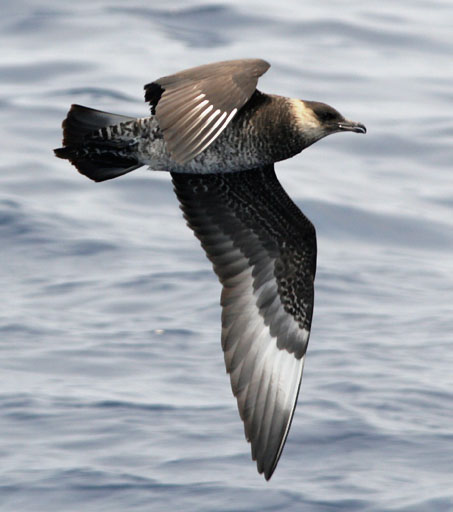
Long-tailed Jaeger
Stercorarius longicaudus
Order: Charadriiformes / Family: Stercorariidae

Wikimedia Commons
About the Long-tailed Jaeger
The Long-tailed Jaeger (Stercorarius longicaudus) is a fascinating seabird distinguished by its elegant, elongated tail feathers. This bird belongs to the family Stercorariidae and is among the smallest jaegers, with a lithe and agile build that enables it to execute impressive aerial maneuvers. The Long-tailed Jaeger is particularly noted for its kleptoparasitic behavior, where it harasses other seabirds, such as terns and gulls, to steal their hard-earned catches. This species thrives in the harsh environments of the Arctic tundra, where it breeds during the summer months. Its presence is vital in these ecosystems, serving as both a predator and a competitor, influencing the dynamics of prey species and other avian populations.
The Long-tailed Jaeger plays a crucial role in the Arctic food web. As a migratory bird, it covers vast distances, traveling from its breeding grounds in the Arctic to wintering locations in the Southern Hemisphere. This extensive migration connects ecosystems across the globe, contributing to nutrient cycling and energy transfer between these diverse habitats. The bird's breeding season sees it nesting in open tundra regions, where it lays its eggs directly on the ground, often in scrapes lined with bits of vegetation.
Climate change poses a significant threat to the Long-tailed Jaeger's habitat. Rising temperatures and changing precipitation patterns impact the availability of prey and suitable nesting sites in the Arctic tundra. Despite these challenges, the Long-tailed Jaeger remains an adaptable species, capable of altering its foraging strategies and migration timing in response to environmental changes. This adaptability is a testament to the bird's resilience and its ability to navigate the complexities of a rapidly changing world.
The Long-tailed Jaeger belongs to the family Stercorariidae, within the order Charadriiformes. These birds typically live average 12-15 years with max recorded at 20 years..
How to Identify a Long-tailed Jaeger
Identifying the Long-tailed Jaeger requires attention to its distinctive features. Adult plumage is marked by a contrast between the dark cap and pale underparts, while the back and wings are a muted gray-brown. The most striking feature is the elongated central tail feathers, which can extend several inches beyond the rest of the tail, giving the bird its name. Juveniles, however, present a more complex plumage pattern, often with a mottled brown appearance that can make them difficult to distinguish from other jaeger species.
Sexual dimorphism is subtle in Long-tailed Jaegers, with males and females appearing similar in plumage. However, males typically have slightly longer and more ornate tail feathers. In comparison to similar species such as the Parasitic Jaeger and Pomarine Jaeger, the Long-tailed Jaeger is more slender and exhibits a less robust build. Its flight silhouette is characterized by swift, buoyant movements, with narrow, pointed wings aiding in its agile aerial capabilities.
When perched, the Long-tailed Jaeger maintains an upright posture, often on open tundra or floating ice. Observers can note its relatively small size compared to other jaegers, which further aids in identification. Despite these clear markers, field identification can prove challenging, particularly in mixed flocks or during the non-breeding season when tail feathers may be worn or missing.
Having trouble telling birds apart? Upload a photo to our bird identification tool for an instant species match.
Long-tailed Jaeger Habitat and Range
Preferred Habitat
The Long-tailed Jaeger prefers open Arctic tundra for breeding, often nesting in areas with sparse vegetation and a mix of mosses and lichens. These regions provide ample visibility to detect predators and proximity to coastal waters for foraging. The bird is commonly found at low elevations, though it may venture into alpine tundra as well.
During migration, the Long-tailed Jaeger is highly pelagic, frequenting open oceans and seas. It rarely appears inland except when crossing land masses during migration. In winter, it inhabits southern oceans, often seen far from shore, indicative of its preference for open water environments.
This jaeger's adaptability to both marine and terrestrial habitats is noteworthy, as it transitions from breeding in remote tundra regions to surviving long stretches over oceanic waters. Despite its adaptability, it remains uncommon in urban or heavily forested areas, preferring the wide-open spaces of its natural habitats.
Geographic Range
The Long-tailed Jaeger's breeding range is confined to the high Arctic, with significant populations in northern Alaska, Canada, and Russia. It breeds primarily above the Arctic Circle, favoring sites with little human disturbance. During the non-breeding season, it undertakes long migrations to the Southern Hemisphere, wintering in the oceans off South America, Africa, and Australia.
The migration corridors of the Long-tailed Jaeger span vast distances. Birds from North America typically travel along the Pacific and Atlantic flyways, with some individuals recorded crossing the central United States and Canada. In Europe, jaegers may pass through the British Isles and western Europe en route to southern waters.
Population density hotspots during the breeding season include areas such as the North Slope of Alaska and the Canadian Arctic Archipelago. Despite the bird's extensive range, it remains relatively uncommon to spot outside of its primary habitats, making sightings particularly prized among birders.
Want to know which birds visit your area? Browse our backyard birds by location guides for region-specific species lists.
What Does the Long-tailed Jaeger Eat?
The Long-tailed Jaeger's diet predominantly consists of fish and marine invertebrates, making it a proficient hunter and scavenger. It employs a variety of foraging techniques, including stealing food from other birds, known as kleptoparasitism, and capturing prey directly from the surface of the water.
During the breeding season, the jaeger's diet shifts to include more terrestrial prey, such as lemmings and other small mammals, which are abundant in the tundra. In years of low lemming populations, the Long-tailed Jaeger may rely more heavily on insects and even bird eggs. This flexibility in diet is crucial for survival in the unpredictable Arctic environment.
The jaeger feeds primarily during daylight hours, taking advantage of the long summer days in the Arctic. Its prey varies in size, from small fish to larger invertebrates, allowing it to exploit a broad range of food resources. This dietary adaptability highlights the bird's role in its ecosystem, influencing both marine and terrestrial food webs.
Long-tailed Jaeger Behavior and Social Structure
The Long-tailed Jaeger exhibits complex social and territorial behaviors. During the breeding season, it forms loose colonies on the tundra, with pairs vigorously defending their nesting territories from intruders. Courtship displays involve aerial chases and vocalizations, showcasing the bird's agility and coordination.
Flocking behavior is more pronounced during migration, when the jaeger may be observed in small groups traveling together. Despite their generally solitary nature, these birds demonstrate remarkable cooperation when harrying potential prey or deterring predators.
In response to predators, the Long-tailed Jaeger shows aggressive defensive behavior, often mobbing larger birds and mammals that approach its nest. Its daily activity patterns revolve around foraging and territory maintenance, with peak activity occurring during the extended daylight hours of the Arctic summer. As a migratory species, the jaeger exhibits seasonal shifts in behavior, transitioning from territorial and nesting activities in the north to more communal and foraging-focused behaviors in the south.
Long-tailed Jaeger Nesting and Reproduction
The Long-tailed Jaeger nests on the ground in the open tundra, often selecting sites that offer panoramic views to detect approaching predators. Nests are simple scrapes in the earth, occasionally lined with lichens, moss, or grass to provide some insulation for the eggs.
Clutch size typically ranges from one to three eggs, with two being the most common. Both parents share incubation duties, which last about 23 to 25 days. After hatching, the chicks remain in the nest for a short period before becoming mobile and exploring the surrounding area.
Fledging occurs approximately 25 to 30 days after hatching, with both parents actively involved in feeding and protecting the chicks. The Long-tailed Jaeger typically raises one brood per year, though in favorable conditions, it may attempt a second. Parental roles are shared, with both males and females contributing to feeding and guarding the young.
Long-tailed Jaeger Sounds and Vocalizations
The Long-tailed Jaeger produces a range of vocalizations, including a distinctive rhythmic call often described as a rapid "ki-ki-ki-ki." This call serves multiple purposes, from territory defense to mate attraction. The bird's alarm calls are harsh and grating, intended to deter predators and alert others to potential threats.
During the breeding season, the Long-tailed Jaeger becomes more vocal, especially at dawn and dusk when activity levels peak. Its calls are less melodious than those of songbirds, reflecting its role as a seabird in harsh environments.
Compared to its relatives, the Long-tailed Jaeger's vocalizations are less varied but are nonetheless effective for communication within its species. These sounds are a key component of its social interactions and territorial displays.
Interesting Facts About the Long-tailed Jaeger
- 1The Long-tailed Jaeger can travel over 20,000 kilometers during its annual migration, showcasing its endurance.
- 2This jaeger species is capable of reaching speeds up to 60 km/h when pursuing prey or engaging in aerial acrobatics.
- 3Long-tailed Jaegers have been observed nesting in loose colonies, with individual territories spaced several hundred meters apart.
- 4Juvenile Long-tailed Jaegers may take up to three years to acquire their adult plumage, making identification challenging.
- 5The central tail feathers of an adult Long-tailed Jaeger can measure up to 15 centimeters in length, aiding in its identification.
- 6Despite being a kleptoparasite, the Long-tailed Jaeger also captures its own prey, showcasing its adaptability.
- 7The Long-tailed Jaeger prefers breeding sites with a high density of lemmings, as they are a crucial food source for raising chicks.
Long-tailed Jaeger Conservation Status
As of the latest assessments, the Long-tailed Jaeger is classified as Least Concern by the IUCN, with stable population trends. However, certain localized threats persist, particularly habitat alteration due to climate change in the Arctic. Primary threats include the impact of changing weather patterns on prey availability and breeding success. Conservation efforts focus on monitoring populations and preserving critical breeding habitats in the Arctic. Historically, the Long-tailed Jaeger has maintained stable numbers, though continued vigilance is necessary to ensure this trend persists. International cooperation is key in conserving this migratory species, with agreements in place to protect essential habitats across its range. As climate change continues to reshape the Arctic, adaptive management strategies become increasingly important.
Other Stercorariidae Species


Birds Similar to the Long-tailed Jaeger
These species are often confused with the Long-tailed Jaeger due to similar appearance or overlapping range.