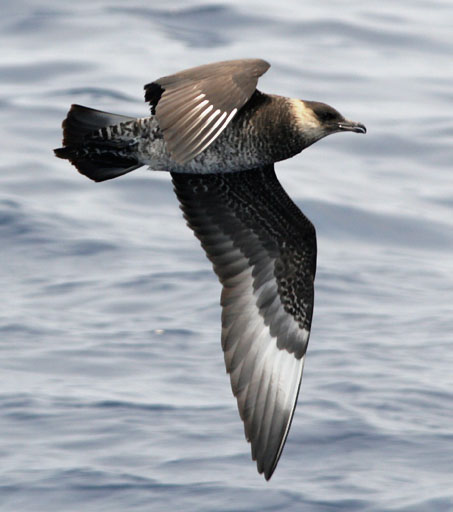
Parasitic Jaeger
Stercorarius parasiticus
Order: Charadriiformes / Family: Stercorariidae

Wikimedia Commons
About the Parasitic Jaeger
The Parasitic Jaeger (Stercorarius parasiticus) is a fascinating bird that plays a unique role in the ecosystems it inhabits. Belonging to the family Stercorariidae, this bird is found primarily in the northern hemisphere, with breeding grounds predominantly in the Arctic tundra regions of North America, Europe, and Asia. During the breeding season, this species is known for its aggressive behavior, particularly its kleptoparasitic tendencies. The Parasitic Jaeger often chases other birds, such as terns and gulls, to force them to drop their catches, which the jaeger then claims as its own. This behavior is not just opportunistic; it is a significant part of the jaeger's survival strategy, especially in areas where food is sparse.
In addition to its kleptoparasitic activities, the Parasitic Jaeger also hunts independently, often preying on small birds, rodents, and insects. During the breeding season, its diet can include lemmings and other small mammals when available. In contrast, during migration and in wintering areas, it relies heavily on marine resources, feeding on fish and other small marine organisms.
This species is notable for its long migratory routes. After the breeding season, Parasitic Jaegers embark on extensive migrations to winter in the southern oceans, including areas off South America, Africa, and Australia. This migration is a remarkable feat, as these birds travel thousands of miles to exploit different ecological niches throughout the year. Their presence in these diverse regions highlights their adaptability and the critical ecological role they play in various marine and coastal environments. The Parasitic Jaeger's ability to thrive in such varied habitats, from the icy Arctic to temperate and tropical seas, underscores its importance as both a predator and a competitor within its ecosystem.
The Parasitic Jaeger belongs to the family Stercorariidae, within the order Charadriiformes. These birds typically live average 11-15 years with max recorded at 25 years..
How to Identify a Parasitic Jaeger
The Parasitic Jaeger is a medium-sized seabird, measuring about 41-48 cm in length with a wingspan of 107-125 cm. Adults display two main morphs: light and dark. Light morph adults have a pale underbelly and chest, contrasting with a dark cap and back. The tail is elongated, with central feathers extending into distinctive streamers. Dark morphs, on the other hand, are more uniformly sooty-brown. Both morphs can have white wing patches that become visible in flight.
Juveniles of the Parasitic Jaeger are generally darker and lack the long tail streamers found in adults. They exhibit a more mottled appearance with shades of brown and grey. Over time, as they mature, these juveniles transition into their respective adult morphs. Males and females are similar in appearance, though females are often slightly larger.
In flight, Parasitic Jaegers are agile and swift, displaying rapid wingbeats and sharp turns, which aid in their pursuit of prey. When perched, these birds maintain an upright posture, often scanning their surroundings with sharp, attentive movements. Compared to similar species like the Long-tailed Jaeger, the Parasitic Jaeger is more robust and lacks the exceptionally long tail streamers of its close relative. Its distinctive flight silhouette, with broad wings and a relatively short tail (compared to the Long-tailed Jaeger), helps differentiate it from other jaegers and skuas.
Having trouble telling birds apart? Upload a photo to our bird identification tool for an instant species match.
Parasitic Jaeger Habitat and Range
Preferred Habitat
The Parasitic Jaeger inhabits a range of environments throughout its life cycle. During the breeding season, it selects the Arctic tundra, preferring coastal plains and areas near water bodies where prey is plentiful. These regions provide open landscapes necessary for spotting and pursuing prey, as well as for nesting.
Outside the breeding season, this jaeger transitions to marine habitats. It can be found in offshore waters, often far from land, as it migrates and winters. Here, it favors open sea environments where it can continue its kleptoparasitic lifestyle, harassing other seabirds for fish and other marine prey. In contrast to many seabirds that frequent coastal areas, the Parasitic Jaeger often ventures further into pelagic zones.
In terms of elevation, the Parasitic Jaeger breeds at low elevations, typically at sea level in Arctic regions. However, during migration and winter, it is not restricted by elevation as it follows marine currents and food sources. The species is more commonly observed in rural and remote areas rather than urban settings, reflecting its preference for undisturbed habitats.
Geographic Range
The Parasitic Jaeger boasts an extensive range across the globe. During the breeding season, it is found in the circumpolar Arctic regions, including Alaska, northern Canada, Greenland, Iceland, and northern Scandinavia, extending across Siberia. These breeding grounds are characterized by open tundra landscapes where the jaeger can nest and hunt.
As the breeding season concludes, the Parasitic Jaeger embarks on long migrations to wintering grounds in the Southern Hemisphere. Its wintering range spans the open oceans off the coasts of South America, Southern Africa, and Australia. During migration, the jaegers follow oceanic routes, utilizing the rich feeding grounds along the way.
Population density is highest in the Arctic regions during breeding, with notable concentrations in areas like the Bering Sea and the Svalbard Archipelago. During migration and in wintering areas, the density can vary, often depending on the availability of food resources and oceanic conditions. This species is well-adapted to life at sea, making it a regular presence in many pelagic birding trips.
Want to know which birds visit your area? Browse our backyard birds by location guides for region-specific species lists.
What Does the Parasitic Jaeger Eat?
The diet of the Parasitic Jaeger is diverse and seasonally variable. During the breeding season, it primarily relies on small birds, eggs, and chicks, as well as small mammals like lemmings, which are abundant in its Arctic breeding grounds. This dietary flexibility allows it to exploit available resources and reduce competition for food.
As a kleptoparasite, the Parasitic Jaeger often steals food from other seabirds, such as gulls and terns. This involves chasing and harassing the birds until they drop or regurgitate their catch. The jaeger's agility and speed make it particularly effective at this behavior, which is a crucial survival strategy, especially when prey is scarce.
During migration and wintering, the Parasitic Jaeger's diet shifts predominantly to marine foods. It consumes fish, squid, and crustaceans, often engaging in surface-dipping or plunge-diving to catch prey. This opportunistic foraging strategy allows it to adapt to different marine environments and maintain its energy needs throughout its extensive migratory journey.
Parasitic Jaeger Behavior and Social Structure
The Parasitic Jaeger is known for its aggressive and territorial behavior, especially during the breeding season. It defends its nesting territory fiercely from intruders, including other jaegers and potential predators. This territorial nature helps ensure sufficient resources and nesting success.
Courtship displays involve aerial chases and vocalizations, where males often present food to females as part of the pair-bonding process. Once paired, both sexes share responsibilities, including nest building and chick rearing.
Socially, the Parasitic Jaeger is more solitary or found in pairs during breeding, but it can be seen in larger mixed-species flocks during migration and winter. These flocks provide safety in numbers and increase foraging efficiency.
In response to predators, the Parasitic Jaeger employs aggressive mobbing tactics, repeatedly diving at intruders to drive them away. Daily activity patterns revolve around feeding and territory defense, with peak activity often occurring during daylight hours, although the jaeger remains active at various times to maximize feeding opportunities.
Parasitic Jaeger Nesting and Reproduction
Parasitic Jaegers nest on the ground in open tundra areas, often choosing sites with sparse vegetation to avoid predators. They prefer locations near water, which provide abundant food resources. The nest is a simple scrape in the ground, sometimes lined with plant material, feathers, or debris.
A typical clutch consists of 1-3 eggs, which are olive-brown with dark spots, providing camouflage against the tundra backdrop. Both parents share incubation duties, which last approximately 24-28 days. This shared responsibility allows one parent to forage while the other protects the eggs from potential threats.
Once hatched, chicks are precocial and covered in down, allowing them to thermoregulate and be mobile shortly after hatching. Both parents continue to care for the young, providing food and protection until fledging, which occurs around 25-30 days after hatching. Parasitic Jaegers typically raise one brood per year, with breeding success closely tied to food availability and environmental conditions.
Parasitic Jaeger Sounds and Vocalizations
The Parasitic Jaeger produces a variety of calls, most notably its harsh, repetitive alarm calls used to ward off intruders. These calls are sharp and carry well over the open tundra, serving as effective deterrents to potential threats. Its vocalizations during courtship are softer and more varied, including trills and whistles exchanged between mates.
Unlike songbirds, the Parasitic Jaeger's vocal repertoire is not melodic but rather functional, with calls adapted for communication in its open habitat. During the dawn and dusk periods, when activity levels are high, these calls are more frequently heard as the birds engage in territorial and social interactions.
Interesting Facts About the Parasitic Jaeger
- 1The Parasitic Jaeger can cover over 15,000 kilometers during its annual migration from Arctic breeding grounds to Southern Hemisphere wintering areas.
- 2Despite its name, the Parasitic Jaeger is a skilled hunter and relies on its own hunting abilities as much as kleptoparasitism for food.
- 3The jaeger's streamlined body and long wings allow it to reach speeds of up to 60 kilometers per hour when chasing other birds.
- 4Unlike many seabirds, the Parasitic Jaeger does not build a complex nest, opting instead for a simple ground scrape.
- 5This species can be identified by its distinctive tail streamers, which are longer in adults and used for agility in flight.
- 6Parasitic Jaegers are known to mimic the calls of other seabird species, potentially to confuse and exploit them during feeding.
- 7The term 'jaeger' comes from the German word 'Jäger,' meaning hunter, fitting for this aggressive, opportunistic bird.
Parasitic Jaeger Conservation Status
The Parasitic Jaeger is currently listed as Least Concern by the IUCN, with a stable population trend. While not immediately threatened, it faces challenges from climate change, which affects its Arctic breeding grounds and the availability of prey species like lemmings. Habitat degradation and pollution in marine environments also pose potential risks. Conservation efforts focus on monitoring population trends and understanding the impacts of environmental changes on its life cycle. Historically, the Parasitic Jaeger has maintained stable populations, but ongoing research is crucial to ensure it continues to thrive amidst global environmental changes.
Other Stercorariidae Species


Birds Similar to the Parasitic Jaeger
These species are often confused with the Parasitic Jaeger due to similar appearance or overlapping range.