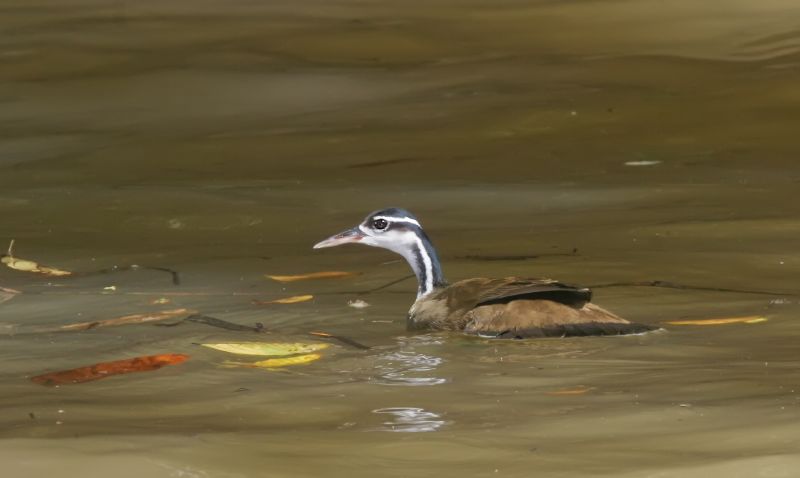
Masked Finfoot
Heliopais personatus
Order: Gruiformes / Family: Heliornithidae

Wikimedia Commons
About the Masked Finfoot
The Masked Finfoot (Heliopais personatus) holds a unique place among wetland birds due to its rare and elusive nature. This enigmatic species belongs to the family Heliornithidae and is a part of the order Gruiformes. It occupies a niche habitat in tropical and subtropical wetlands, predominantly located in Southeast Asia, encompassing countries such as Bangladesh, Cambodia, and Vietnam. The species is often considered an indicator of healthy wetland ecosystems, given its sensitivity to habitat degradation. The Masked Finfoot exhibits a range of intriguing behaviors and adaptations that make it a subject of fascination for ornithologists and birdwatchers alike. One of the distinctive features of the Masked Finfoot is its vivid plumage, which provides excellent camouflage within its dense, forested wetland habitats. This bird's strikingly patterned face, reminiscent of a mask, lends it its common name and aids in identification amidst the verdant backdrop of its environment. The Masked Finfoot's long neck and body, coupled with lobed feet, enable it to navigate through water with ease, a necessary adaptation for its semi-aquatic lifestyle. The ecological role of the Masked Finfoot is significant, as it serves as both predator and prey within its ecosystem. As a predator, it helps control the populations of aquatic invertebrates and small fish, thus maintaining a balanced food web. Conversely, it falls prey to larger predators, connecting various trophic levels within its habitat. Seasonal behaviors of the Masked Finfoot are closely tied to the monsoon cycles of its habitat. During the wet season, the bird is more active and conspicuous, taking advantage of the abundant food supply and breeding opportunities. Conversely, in the dry season, the Masked Finfoot becomes more reclusive, often retreating to denser vegetation where it remains hidden from view. These seasonal shifts highlight the bird's adaptability and resilience in the face of changing environmental conditions. The Masked Finfoot's presence in specific geographic regions is both a boon and a challenge for conservationists. While its occurrence in protected areas such as the Sundarbans and Tonle Sap Lake offers some security, the species continues to face threats from habitat destruction and human encroachment. Conservation efforts focused on preserving wetland habitats are crucial for ensuring the survival of this enigmatic bird, underscoring its importance as a flagship species for wetland conservation in Southeast Asia.
The Masked Finfoot belongs to the family Heliornithidae, within the order Gruiformes. These birds typically live estimated 10-15 years in the wild..
How to Identify a Masked Finfoot
Identifying the Masked Finfoot requires a keen eye, as its cryptic plumage allows it to blend seamlessly into its wetland surroundings. Adult Masked Finfoots possess a striking facial mask, with a black stripe running from the base of the bill through the eyes, contrasting sharply with their white throat and chest. Their upperparts are olive-brown, while the underparts are paler, providing effective camouflage against the dappled light of their forested habitats. Juvenile Masked Finfoots share similar plumage patterns, though the facial mask is less pronounced, and the overall coloration is duller. Males and females exhibit similar plumages, making sex differentiation challenging in the field. However, males are slightly larger and may display more vibrant facial markings during the breeding season. Observers should note the bird's distinctive lobed feet, which are well-suited for swimming and are a key feature distinguishing it from other waterbirds. The Masked Finfoot's flight silhouette is characterized by broad, rounded wings and a relatively short tail, an adaptation for maneuvering through dense vegetation. When perched, the bird often adopts a horizontal stance, with its long neck held outstretched and its body low to the ground, further enhancing its ability to remain inconspicuous. The Masked Finfoot may occasionally be confused with similar species, such as rails and crakes, due to its secretive behavior and habitat preferences. However, the unique combination of its facial mask and lobed feet sets it apart from other wetland birds, making careful observation crucial for accurate identification.
Having trouble telling birds apart? Upload a photo to our bird identification tool for an instant species match.
Masked Finfoot Habitat and Range
Preferred Habitat
The Masked Finfoot inhabits a variety of wetland environments across Southeast Asia, favoring dense, forested swamps, mangrove forests, and riverine systems. These habitats provide the necessary cover and food resources required for their survival. Typically found at lower elevations, the Masked Finfoot thrives in areas with ample aquatic vegetation, where it can forage and nest discreetly. Seasonal habitat shifts occur as water levels fluctuate with the monsoon rains. During the wet season, the Masked Finfoot may expand its range into flooded forests and temporarily inundated areas. Conversely, in the dry season, the bird retreats to permanent water bodies, where it remains more concealed within the denser vegetation. While the Masked Finfoot is primarily associated with rural and remote wetland habitats, it can occasionally be found in more urbanized areas, particularly where green spaces and waterways are preserved within cities. However, urban sightings are rare due to the bird's elusive nature and preference for undisturbed environments.
Geographic Range
The breeding range of the Masked Finfoot primarily spans Southeast Asia, including countries such as Thailand, Cambodia, and Vietnam. Within these regions, the bird occupies specific wetland habitats that provide the necessary resources for nesting and foraging. During the non-breeding season, the Masked Finfoot may exhibit some local movements, although it is generally considered sedentary. The bird's core range includes significant population densities in the Sundarbans of Bangladesh and India, where it benefits from protected status and relatively undisturbed habitats. Smaller, scattered populations can be found throughout mainland Southeast Asia, with occasional reports from Malaysia and Indonesia. Migration corridors for the Masked Finfoot are not well-documented, as the species does not undertake long-distance migrations typical of many other waterbirds. However, seasonal movements within its range are influenced by rainfall patterns and water availability. Conservationists focus on these areas to monitor population trends and implement protective measures to ensure the bird's continued presence.
Want to know which birds visit your area? Browse our backyard birds by location guides for region-specific species lists.
What Does the Masked Finfoot Eat?
The Masked Finfoot's diet consists primarily of aquatic invertebrates and small fish, with seasonal variations in prey availability influencing its feeding habits. During the wet season, an abundance of insects such as beetles, dragonfly larvae, and aquatic snails become readily accessible, forming the bulk of the bird's diet. In addition to these primary food sources, the Masked Finfoot may consume small crustaceans and amphibians, as well as seeds and plant matter when animal prey is scarce. Foraging techniques employed by the Masked Finfoot include surface pecking and probing in shallow waters with its slender bill. The bird demonstrates remarkable dexterity and agility in navigating through aquatic vegetation, using its lobed feet to maneuver efficiently. The Masked Finfoot typically feeds during the early morning and late afternoon, taking advantage of the cooler temperatures and reduced predation risk during these times.
Masked Finfoot Behavior and Social Structure
The Masked Finfoot exhibits a variety of intriguing behaviors, reflecting its adaptation to a semi-aquatic lifestyle. It is generally solitary or found in pairs, with limited social interaction outside of the breeding season. Territorial behavior is pronounced during the breeding season, with males establishing and defending territories against intruders to secure access to suitable nesting sites. Courtship displays involve vocalizations and visual signals, with males performing elaborate displays to attract females. These displays include wing-fluttering, neck-stretching, and presenting food items to prospective mates. Flocking behavior is uncommon, as the Masked Finfoot prefers to remain hidden within its dense wetland habitat, avoiding detection by predators. When threatened, the bird relies on its cryptic plumage and stealthy movements to evade capture, often slipping silently into the water and submerging for extended periods. Daily activity patterns of the Masked Finfoot are largely crepuscular, with peak activity occurring during dawn and dusk. This behavior minimizes exposure to predators and maximizes foraging efficiency during cooler parts of the day.
Masked Finfoot Nesting and Reproduction
The Masked Finfoot constructs its nest in discreet locations within its wetland habitat, preferring dense vegetation that offers protection from predators and environmental elements. Nests are typically built over water, using a combination of twigs, leaves, and other plant materials to form a platform structure. The clutch size generally ranges from two to five eggs, with both parents sharing incubation duties over a period of approximately 20 to 25 days. Once hatched, chicks remain in the nest for a short period before becoming mobile and venturing into the water with their parents. The fledging timeline for the Masked Finfoot is relatively brief, with young birds gaining independence within several weeks. Parental roles are shared, with both male and female providing care and protection to the chicks, including feeding and leading them to foraging areas. The Masked Finfoot typically produces one to two broods per year, dependent on environmental conditions and resource availability.
Masked Finfoot Sounds and Vocalizations
The Masked Finfoot's primary song is a series of rhythmic, low-pitched whistles, often described as mournful and haunting. These vocalizations serve as contact calls between mates and are most frequently heard during the breeding season. In addition to its song, the Masked Finfoot produces a variety of call notes, including sharp clicks and softer churrs used for communication with chicks and other finfoots in the vicinity. Alarm calls are characterized by abrupt, high-pitched squawks, alerting nearby individuals to the presence of potential threats. The Masked Finfoot participates in the dawn chorus, with males vocalizing from concealed locations within their territory.
Interesting Facts About the Masked Finfoot
- 1The Masked Finfoot's striking facial mask pattern helps it blend into its dense wetland habitat, making it one of nature's masters of disguise.
- 2With lobed feet rather than the webbed feet typical of other waterbirds, the Masked Finfoot is adept at navigating through aquatic vegetation.
- 3The Masked Finfoot can remain submerged underwater for extended periods, using this ability to evade predators and surprise prey.
- 4Despite its elusive nature, the Masked Finfoot is often considered a flagship species for wetland conservation in Southeast Asia.
- 5The Masked Finfoot's vocalizations are often compared to the mournful whistles of a distant steam train, echoing through its swampy habitats.
Masked Finfoot Conservation Status
The Masked Finfoot currently holds an Endangered status on the IUCN Red List, with its population trend showing a decline due to habitat loss and degradation. Primary threats include deforestation, wetland drainage, and human encroachment, which reduce the availability of suitable breeding and foraging habitats. Conservation efforts focus on preserving and restoring wetland ecosystems within the bird's range, with initiatives involving habitat protection, community engagement, and legal measures to safeguard critical areas. Historically, the Masked Finfoot's population has experienced fluctuations in response to environmental changes, underscoring the need for continued monitoring and adaptive management strategies to ensure its survival.